
Strategy’s Michael Saylor Sees Trillions Flowing Into Bitcoin-Backed Digital Banks
Strategy’s Michael Saylor is pressing governments to rethink digital banking by anchoring national deposit systems to Bitcoin, arguing that overcollateralized, tokenized credit backed by sovereign BTC reserves could unlock tens of trillions of dollars in global capital flows.
Speaking at the Bitcoin MENA conference, Saylor said countries could create regulated digital bank accounts using Bitcoin-backed digital credit instruments that deliver higher yields with reduced volatility compared to traditional savings products.
Under his proposed structure, roughly 80% of the product would be allocated to tokenized digital credit, 20% to fiat currency, and a further 10% would be held as a volatility buffer. The digital credit itself would be backed by Bitcoin at a 5:1 overcollateralization ratio held by a treasury entity.
Saylor framed the model as a direct response to what he described as widespread frustration with near-zero-yield bank deposits across developed markets.
In Japan, Europe, and Switzerland, he noted, depositors often earn virtually nothing, while euro money-market funds pay roughly 150 basis points and U.S. money markets closer to 400 basis points.
He said this explains why investors turn to the corporate bond market, which “wouldn’t exist if people weren’t so disgusted with their bank account.â€
If implemented at a national scale through a regulated banking system, Saylor argued that such Bitcoin-backed digital accounts could attract “$20 trillion or $50 trillion†in global deposits. A country that adopts the model early, he added, could position itself as “the digital banking capital of the world.â€
Strategy Expands Its Bitcoin Treasury Despite Stock Slump
Further underscoring his conviction, Saylor revealed that Strategy has just completed another major Bitcoin purchase.
According to a post on X, the company bought 10,624 BTC for approximately $962.7 million at an average price of $90,615 per coin.
That acquisition lifts Strategy’s total holdings to 660,624 BTC, acquired for about $49.35 billion at an average cost of $74,696.
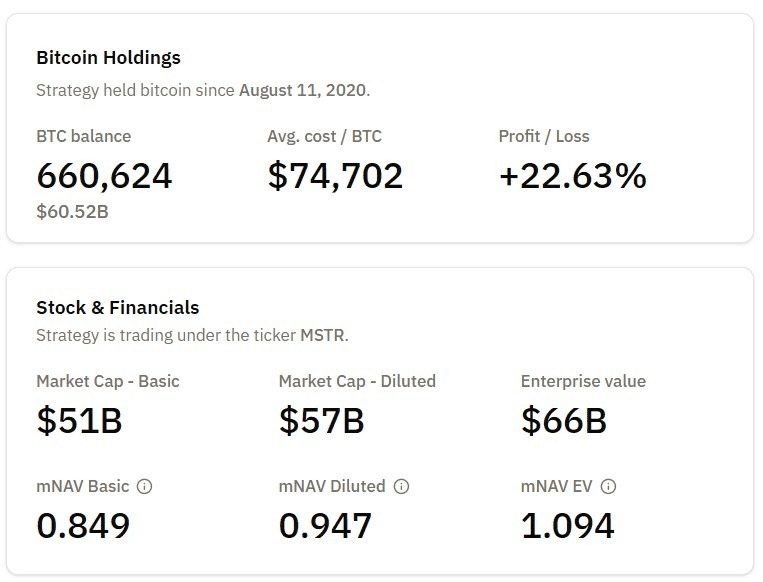
Strategy’s BTC holdings (Source: BitcoinTreasuries)
The move comes during a difficult period for Strategy’s equity performance.
Data from Google Finance shows the stock recently trading near $178.99, down roughly 51% over the past 12 months.
Also read: Why Cantor Slashed Strategy’s Price Target — and Still Calls It a Buy
Despite that decline, the firm is still sitting on substantial unrealized gains tied to its Bitcoin holdings.
According to Bitcoin Treasuries, Strategy’s BTC stash is currently worth over $60 billion—more than 22% above its aggregate cost basis.
Despite the sustained downturn in Strategy’s share price, Saylor has repeatedly emphasized that the company “won’t back down†from its Bitcoin strategy.
The firm recently raised $1.44 billion to counter investor concerns surrounding its ability to service debt and meet dividend obligations if the stock were to fall further. Strategy CEO Phong Le said fears that the company could default on payments had fueled short positioning in both the equity and Bitcoin markets.
“There was FUD that was put out there that we wouldn’t be able to meet our dividend obligations,†he said.
Digital Asset Treasury Inflows Slow Sharply
Strategy’s latest Bitcoin buy also arrives as broader digital asset treasury (DAT) activity shows signs of cooling.
Data from DefiLlama indicates that DAT inflows fell to $1.32 billion in November, marking the slowest month of 2025 so far and a 34% decline from October. Bitcoin-focused treasury firms still accounted for over $1 billion of those inflows, largely driven by Strategy’s $835 million purchase in mid-November. By contrast, Ether-focused treasuries recorded $37 million in net outflows.
Also read: CryptoQuant Says Strategy’s BTC Buying Collapse Signals Deep Bear Cycle Ahead
Meanwhile, Bitcoin itself continues to reflect the tension between long-term conviction and short-term volatility. At the time of writing, BTC was trading around $90,700, roughly 28% below its all-time high of $126,080, according to CoinGecko.
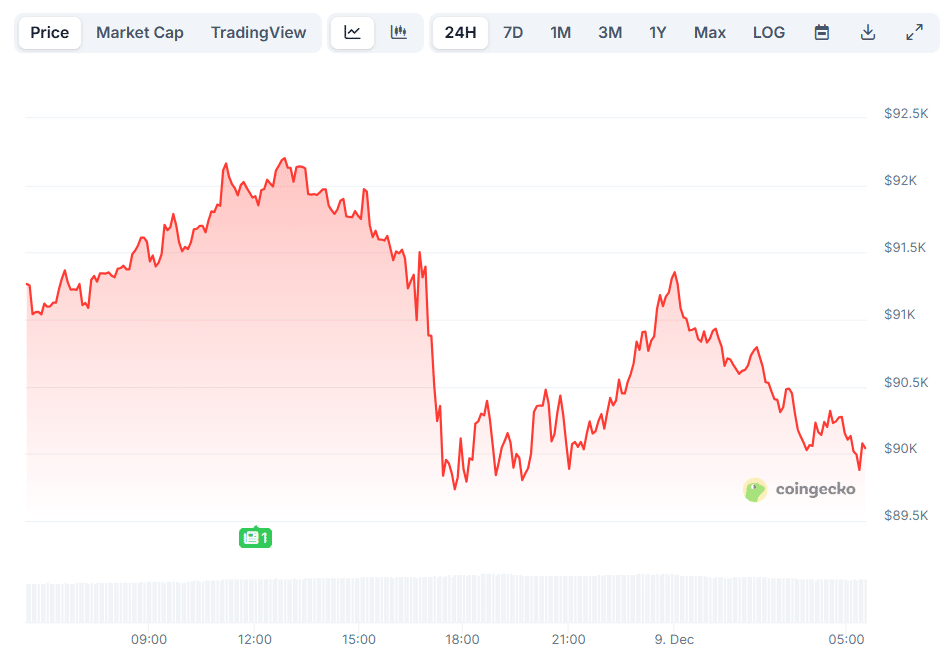
BTC price (Source: CoinGecko)
For Saylor, that long-term trajectory underpins his sovereign-scale vision.
While critics warn that Bitcoin’s price swings pose structural risks for deposit-style products, Saylor contends that extreme overcollateralization and regulated digital credit frameworks can neutralize much of that volatility.
Whether governments ultimately adopt his blueprint remains uncertain, but his message to wealth funds, banks, and policymakers is increasingly explicit: Bitcoin, in his view, is no longer just a speculative asset—it is the foundation of a new digital capital system.


