
Bitcoin Finally Shakes the Tulip Bubble Label After 17 Years, Says Eric Balchunas
A prominent Bloomberg expert on exchange-traded funds (ETFs) has asserted that Bitcoin’s sustained endurance and resilience over nearly two decades irrevocably discredits any comparison to the infamous 17th-century Dutch Tulip Mania.
Eric Balchunas, Senior ETF Analyst at Bloomberg, stated on Sunday that the cryptocurrency’s ability to recover from multiple significant downturns fundamentally differentiates it from the fleeting speculative fervor of the tulip market.
Balchunas explicitly rejected the analogy, noting, “I personally would not compare Bitcoin to tulips, no matter how bad the sell-off.”
He highlighted the stark contrast in longevity and recovery, explaining that the tulip market “rose and collapsed in around three years, punched once in the face and knocked out.”
Bitcoin, in stark opposition, has come back from like six to seven haymakers to reach all-time highs and has survived 17 years.
Also read: Ripple CEO Brad Garlinghouse Predicts Bitcoin Will Hit 180K by 2026
This prolonged existence, coupled with its remarkable price recovery, he argued, “The endurance alone warrants shedding tulip comparison, let alone the fact that it’s still up like 250% [over the] past three years and was up 122% last year.”
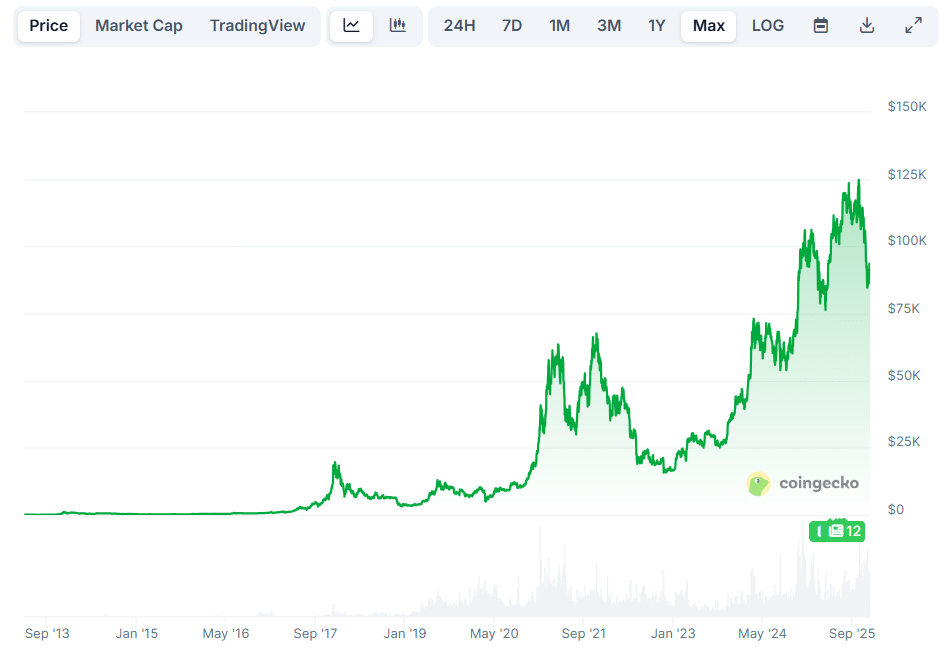
BTC price (Source: CoinGecko)
Balchunas also suggested that some persistent critics of Bitcoin might be driven by a desire to enrage the people who like it, a sentiment he believes is unlikely to change.
Bitcoin’s Enduring Comparison and Its Critics
The “Tulip Bubble” analogy has long been a go-to criticism for skeptics of Bitcoin and the broader cryptocurrency market.
High-profile figures have frequently invoked it. Earlier this month, “The Big Short” investor Michael Burry referred to Bitcoin as “the tulip bulb of our time.”
Famously, in 2017, JPMorgan CEO Jamie Dimon declared Bitcoin was “worse than tulip bulbs” and labeled it a “fraud.”
Those comparisons typically hinge on the idea that Bitcoin, like tulips in the 1630s, represents an asset whose value is purely speculative, detached from any intrinsic utility, and therefore prone to an inevitable and catastrophic collapse.
Also read: Larry Fink Reveals State Investors Were Accumulating Bitcoin During the Crash
A Deep Dive into the Tulip Mania
To understand the weight of Balchunas’s dismissal, it’s crucial to revisit the historical event itself.
The Dutch Tulip Mania unfolded as a speculative frenzy in the Netherlands during its Golden Age. Tulip bulbs, initially introduced to Europe from Turkey, rapidly transformed from exotic flowers into coveted status symbols among the nation’s burgeoning class of wealthy merchants.
Prices began their meteoric ascent in 1634, reaching the peak of their speculative mania in 1636. During this period, some rare tulip bulbs commanded prices exceeding that of an entire house in Amsterdam. However, this unprecedented speculative bubble burst abruptly in February 1637, with prices plummeting by over 90% in just a few weeks.
The tulip mania is widely recognized as one of history’s earliest recorded speculative bubbles, often serving as a textbook example of a “pump and dump” pattern due to its rapid rise and even faster, irreversible collapse within a mere three-year span.
That brief, singular event stands in stark contrast to Bitcoin’s protracted and volatile, yet ultimately upward, trajectory.
Beyond the “Non-Productive Asset” Argument
Balchunas further challenged another common criticism: that Bitcoin’s lack of traditional “productivity” makes it akin to tulips.
He argued, “Yes, Bitcoin and tulips are both non-productive assets. But so is gold, so is a Picasso painting, rare stamps, would you compare those to tulips? Not all assets have to be productive to be valuable.”
This line of reasoning positions Bitcoin alongside established stores of value and collectibles, whose worth is derived from scarcity, demand, and perceived cultural or historical significance rather than income generation or industrial application.
The analyst suggests that applying a productivity metric to all valuable assets is an overly narrow perspective that fails to account for entire categories of enduring wealth.
Also read: Bitcoin’s $6.9T Settlement Surge Puts It Neck-and-Neck With Visa and Mastercard
Bitcoin’s Current Trajectory and Market Perspective
Reflecting on Bitcoin’s recent market performance, Balchunas suggested that the asset’s current price action is simply a healthy correction after a period of significant gains.
“All Bitcoin has done so far this year is give up the extreme excess of last year,” he observed. He elaborated that even if the current year were to end flat or moderately down, Bitcoin would still be operating at approximately 50% of its annual average.
That perspective indicates that assets are allowed to cool off once in a while, even stocks, and that current market analysis might be “overanalyzing it.”


