Kalshi Strikes Multi-Year Deal With CNBC as Prediction Markets Go Mainstream
CNBC is making a decisive move into the fast-growing world of prediction markets, announcing a multi-year partnership with regulated forecasting platform Kalshi that will weave real-time probability data directly into the network’s TV programming, digital coverage and subscription products.
The collaboration marks one of the biggest mainstream media integrations of prediction-market analytics to date and shows how financial newsrooms are increasingly embracing probabilistic data as a complement to traditional reporting.
According to Thursday’s announcement, Kalshi’s event-probability feeds will begin appearing across CNBC content beginning in 2026.
Also read: Kalshi, Polymarket and Robinhood Face New State Pressure
Shows such as Squawk Box and Fast Money will feature a dedicated ticker displaying live forecast moves, giving viewers a constant stream of market-priced expectations on elections, economic releases, geopolitical events, and more.
Kalshi will also host a CNBC-branded page on its own platform, where markets curated by the network will be made available for users to explore and trade.
Kalshi Expands Media Footprint
The announcement comes just days after Kalshi revealed a separate partnership with CNN, where its markets will be integrated into on-air analysis and newsroom reporting.
For the six-year-old platform, the deals represent a major leap into mainstream visibility after spending years building regulatory credibility in the United States.
Founded in 2018, Kalshi operates one of the country’s only fully regulated event-contracts exchanges, allowing users to trade the outcomes of elections, economic data prints, sports results, weather events, and other real-world scenarios.
The company raised $1 billion in November at an $11 billion valuation, instantly propelling both of its 29-year-old co-founders into billionaire status.
CEO Luana Lopes Lara became the world’s youngest self-made woman billionaire, according to Forbes, marking a rare milestone in the fintech sector.
Kalshi’s rapid growth comes at a time when regulators, policymakers and traditional finance players are reassessing the role of prediction markets.
While the platforms remain contentious in some jurisdictions—as demonstrated by recent cease-and-desist actions in Connecticut—momentum at the federal level has tilted toward acceptance, especially as media organizations seek clearer quantitative signals around complex political and economic events.
Polymarket’s Parallel Rise Shows Sector-Wide Momentum
Kalshi may be the most prominent U.S.-regulated platform, but blockchain-based competitors are also experiencing surging demand.
Polymarket, built on Polygon, has emerged as the sector’s other major breakout player, announcing multiple partnerships and expansions throughout the final quarter of 2025.
In October, sports betting giant DraftKings began using Polymarket as the clearinghouse for its new prediction-market initiative, bringing Polymarket’s pricing engine into a mainstream operator with millions of users.
Also read: CFTC Clears Polymarket to Operate Fully Regulated Prediction Market in the U.S.
The platform followed up with a November deal with PrizePicks, integrating its markets into the fantasy-gaming app’s ecosystem and enabling users to make forecasts on sports, entertainment, and other categories.
Polymarket also reached a multi-year agreement with TKO Group Holdings to serve as the official prediction-market partner for UFC and Zuffa Boxing. The partnership brings real-time forecasting elements directly into fight broadcasts—an integration that mirrors Kalshi’s expansion into traditional media and signals growing competition for audience attention.
Valued at $10 billion as of October, Polymarket is preparing for an even larger presence in the United States after receiving approval from the Commodity Futures Trading Commission (CFTC) to operate an intermediated trading platform. The company plans to introduce a token following that authorization, a move that could further cement its position within the crypto-native user base.
As of publication, Polymarket users were pricing a 99% likelihood that the platform’s full U.S. launch will occur in 2025—another sign of market confidence in the sector’s accelerating regulatory tailwinds.
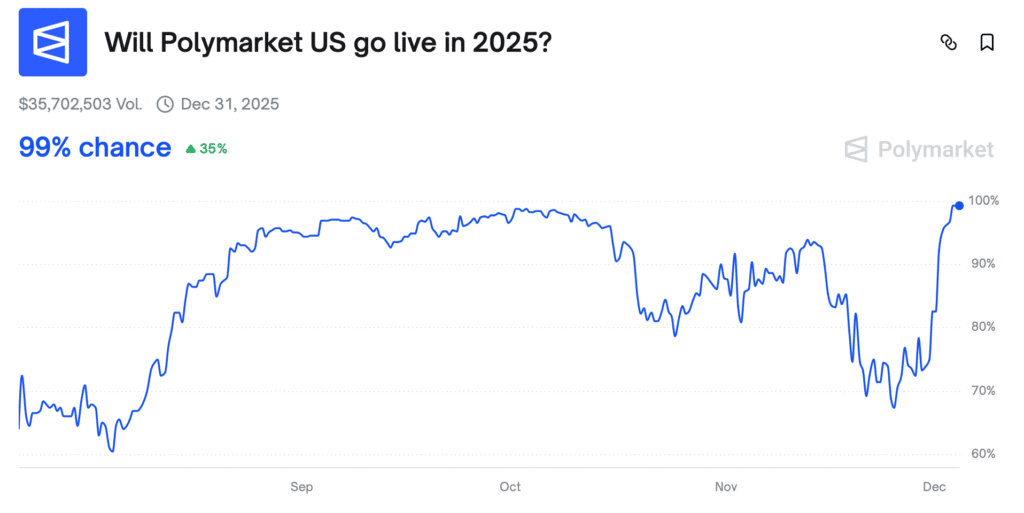
Contract asking if Polymarket US will go live in 2025 (Source: Polymarket)
Mainstream Media Meets Market-Based Forecasting
The CNBC–Kalshi partnership reflects a broader shift in both journalism and financial analysis, where traditional commentary is increasingly supplemented with quantitative forecasting signals.
For global audiences accustomed to polls, analyst notes, and macro commentary, real-time, market-priced probabilities represent a new form of information—one that media organizations are quickly racing to integrate.
Whether driven by demand for more accurate election forecasting, real-time economic sentiment indicators, or simply a desire for more interactive financial data, prediction markets are poised to become a fixture in newsrooms. CNBC’s adoption may mark a tipping point, signaling that probabilistic forecasting is moving from the fringes of crypto and DeFi into the center of mainstream financial reporting.


