
Bitcoin Plunges as Thin Liquidity and Record Leverage Trigger Sudden Weekend Selloff
The Bitcoin price plunged nearly 5% in the past 24 hours to trade at $86,415.88 at press time.
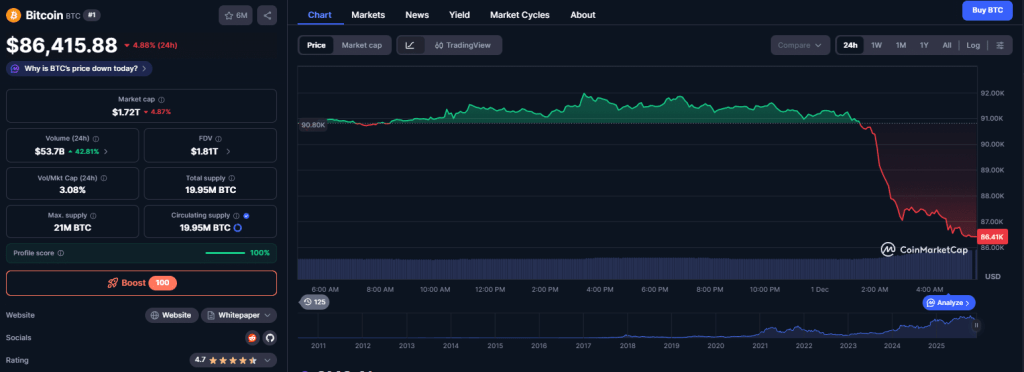
BTC price (Source: CoinMarketCap)
BTC’s latest decline comes at a time when technical momentum is weakening and market liquidity is evaporating—an increasingly dangerous combination that continues to shape short-term price action.
Bitcoin’s sharp drop of several thousand dollars within minutes, despite no accompanying news catalyst, once again highlights the fragile liquidity conditions that have defined much of this year’s trading environment.
This structural liquidity issue was underscored by The Kobeissi Letter, which noted that Friday and Sunday nights have repeatedly produced unusually large crypto moves.
Bitcoin’s sudden multi-thousand-dollar drop “without ANY news at all” was attributed to thin order books and record-high leverage. This environment creates a market where even modest selling volume can cascade into a domino-effect liquidation cycle.
The Kobeissi Letter emphasized that this behavior is “still structural in nature” and “not a fundamental decline.”
Also read: Will Bitcoin Break Down or Bounce? Key Levels Suggest a Big Move Ahead
Momentum Weakens as Bitcoin Pressures Key Trend Levels
Bitcoin has continued to produce lower daily closes, with the price consistently trading below short-term moving averages. The downward slope of the 9-day EMA reflects waning bullish strength, while the declining 20-day EMA confirms that the broader trend has tilted in favor of sellers.
Those conditions have left Bitcoin vulnerable to sharp intraday swings—especially in low-liquidity windows—where thin order books allow the price to move rapidly in either direction.

Daily chart for WBTC/USD (Source: GeckoTerminal)
Despite an earlier slowing of bearish momentum, the MACD profile remains structurally negative. The histogram’s recent contraction indicates a brief pause in selling pressure rather than a sustained recovery.
Meanwhile, the RSI’s slide toward oversold levels signals that bearish pressure has been strong enough to push the market near exhaustion, though not yet at a point that confirms reversal.
In short, technical momentum remains fragile, and the market currently lacks enough liquidity or trend strength to absorb sudden bursts of selling.
Support and Resistance Levels Shape the Immediate Roadmap
Bitcoin now trades just above a cluster of crucial support levels that will determine whether the market stabilizes or spirals lower.
Immediate resistance sits at $86,845.94 and $87,498.16, overlapping with falling short-term moving averages.
Bullish momentum cannot return unless those zones are reclaimed convincingly. A stronger upside shift would require a breakout toward the next major resistance at $94,270, which would mark a meaningful attempt to regain the mid-term trend.
On the downside, Bitcoin’s most important support—between $84,739.74, $84,250.09, and the deeper $82,389.99 level—now represents the final buffer preventing a broader retracement. Liquidity behavior suggests these levels could be tested again if another wave of leveraged liquidations hits the market during thin weekend trading.
Also read: Nasdaq Pushes to Supercharge IBIT Options as Bitcoin Goes Mainstream
Order Book Heatmap Reveals Critical Battle Lines
The order book highlights where liquidity clustering may influence near-term movement:
Bid-side support:
A large bid wall around $86,310 holds meaningful size. If this wall collapses, the price could slip roughly a quarter of a percent before encountering the next support cluster. Additional, smaller bid walls at $86,337.70 and $86,434.06 offer weaker defenses. Should all three walls break, a push toward the deeper support region becomes likely.
Ask-side pressure:
An ask wall at $86,520.37 acts as a short-term ceiling. Clearing it opens the path toward a secondary wall at $86,710.80, which must also be absorbed to attempt a larger recovery. A smaller ask cluster at $86,574.12 may create quick volatility but is unlikely to shift the broader trend by itself.
While the bid side shows more defensive interest, neither side currently has sufficient depth to prevent sharp moves during low-volume sessions—a point echoed by The Kobeissi Letter’s liquidity warning.
Leverage and Thin Liquidity: A Volatile Mix
The Kobeissi Letter’s analysis adds crucial context to Bitcoin’s recent behavior. With leverage across crypto markets sitting at historic highs, liquidation cascades are far easier to trigger. When combined with declining weekend liquidity, even a modest influx of selling can produce a violent multi-thousand-dollar flush.
Those conditions help explain Bitcoin’s sudden drop without a catalyst and reinforce the structural—not fundamental—nature of this crypto market “bear phase.” Until leverage resets and liquidity returns, volatility is likely to remain elevated.
Trade Setups: Longs and Shorts at Critical Levels
For long positions, traders may consider entries in the $84,250–$84,739 support zone, especially if indicators show early reversal signals or if liquidity strengthens during higher-volume market hours. A reclaim of $87,498 with strong momentum could also serve as an upside breakout entry, targeting the region near $94,270.
For short positions, a breakdown below $84,739 would confirm bearish continuation and open a path toward $82,389. Momentum traders may also short failed retests of the 9-day or 20-day EMA, both of which now function as dynamic resistance.
Given the current macro structure—thin liquidity, high leverage, and fragile trend signals—strict risk management is essential on both sides of the market.
Disclaimer: The information presented in this article is for informational and educational purposes only. It does not constitute financial advice. Ecoinimist is not responsible for any losses incurred. Readers should exercise caution before acting on this content.


