
VanEck Threatens to Step Back From Bitcoin as Tech Concerns Grow
Bitcoin’s long-term design came under renewed scrutiny recently after VanEck CEO Jan van Eck questioned whether the world’s largest cryptocurrency offers sufficient encryption and privacy protections.
Speaking on CNBC’s Power Lunch alongside anchor Brian Sullivan, van Eck argued that the challenges facing Bitcoin extend far beyond recent price volatility.
“There’s something else going on within the Bitcoin community that non-crypto people need to know about,” he said, signaling an internal conversation increasingly focused on technological, rather than market-driven, weaknesses.
The remarks reflect VanEck’s view that Bitcoin should be evaluated like any traditional asset—according to its underlying fundamentals.
“Ultimately, VanEck has been around before Bitcoin,” he said. “We will walk away from Bitcoin if we think the thesis is fundamentally broken. We don’t right now, but you always have to look at the underlying technology and the crypto.”
While van Eck did not explicitly define what he meant by “the Bitcoin thesis,” his comments pointed squarely toward several long-term factors: the robustness of Bitcoin’s cryptography, its resistance to future quantum threats, and the adequacy of its privacy model.
Also read: Bitcoin’s Biggest Myth? Nick Szabo Says the Network Isn’t Truly Untouchable
Spotlight on Privacy and Quantum Security
Van Eck suggested that a growing segment of the Bitcoin community now views privacy and encryption strength as existential concerns.
He went so far as to reference Zcash—an asset frequently associated with privacy maximalists—saying some long-time Bitcoin holders are reassessing alternatives.
Following his appearance, van Eck expanded on his warnings in a post on X, claiming that the ongoing Bitcoin bear market reflects “the onchain reality of the halving cycle (bearish for 2026), quantum-breaking-encryption concerns and the better privacy of Zcash.”
He also highlighted advice from VanEck portfolio manager Pranav Kanade to “dollar cost average into bear markets.”
Bitcoin traded around $84,643 during the CNBC interview.
In the last 24 hours, BTC’s price has rebounded to trade at around $87,500 at press time, but still down 10.6% year to date and over 30% below its all-time high of $126,080 set on Oct. 6, 2025.

BTC price (Source: CoinGecko)
Experts Split on the Immediacy of Quantum Threats
The broader industry had already been grappling with similar concerns. At Devconnect in Argentina on Nov. 17, Ethereum co-founder Vitalik Buterin delivered a stark warning about the impact of quantum computing on today’s cryptographic standards.
“Elliptic curves are going to die,” he said, referencing the mathematical foundations securing both Bitcoin and Ethereum.
Meanwhile, in a Nov. 13 blog post, University of Texas at Austin professor and quantum computing researcher Scott Aaronson argued that—given the “staggering rate of hardware progress”—it is “a live possibility” that a fault-tolerant quantum computer capable of running Shor’s algorithm could emerge before the 2028 U.S. presidential election.
Such a breakthrough would allow an attacker to derive private keys from public ones, posing a systemic threat to existing blockchains.
Also read: Fred Thiel Warns Bitcoin Mining Will Become a Battle for Cheap Power
Pushback From Bitcoin Advocates
Not everyone welcomed van Eck’s critique.
Samson Mow, CEO of Bitcoin infrastructure firm JAN3 and one of the network’s most vocal proponents, issued a sharp rebuke.
“You wouldn’t be able to point out a Bitcoin Maxi even if they were standing in front of you,” he wrote on X. “You shouldn’t be speaking on anything Bitcoin whatsoever. You’re a crypto guy, stay in your lane and push the latest shitcoin narrative.”
Mow rejected any suggestion that Bitcoin maximalists are shifting toward privacy-centric alternatives like Zcash.
Zcash Surges as Debate Intensifies
Despite the backlash, Zcash’s ZEC token has rallied sharply amid the renewed focus on privacy features. ZEC is now the 13th-largest cryptocurrency, with a market capitalization of $9.43 billion. It was recently trading at $86.86—up 119% in 30 days and 1,020% year to date. Just two months earlier, on Sept. 24, it traded near $55.
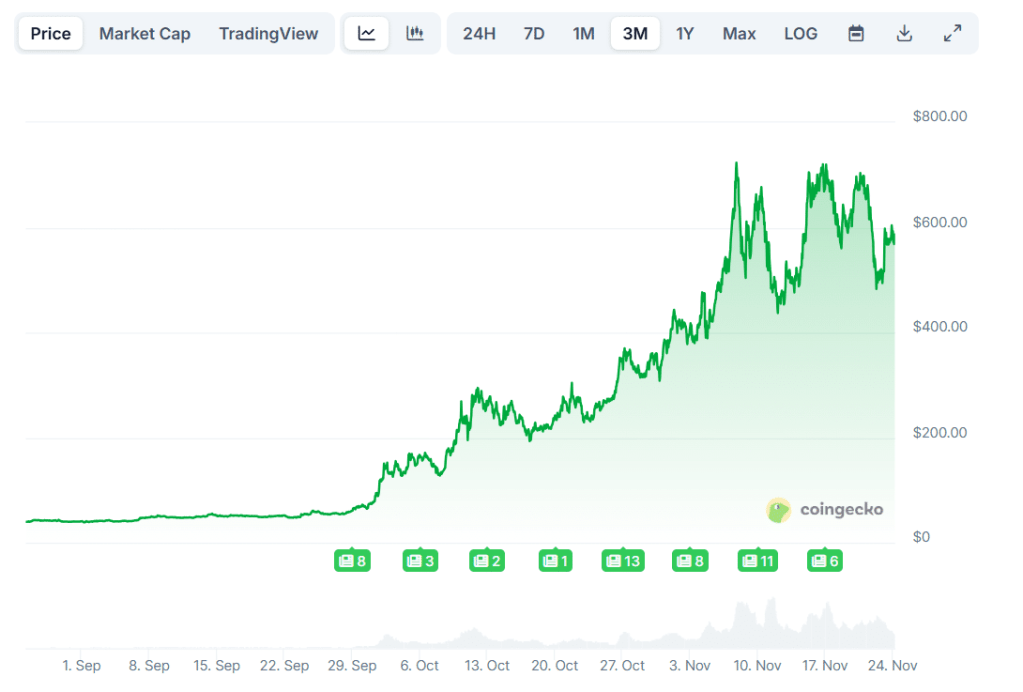
ZEC price performance in the last 3 months (Source: CoinGecko)
The surge underscores how shifting narratives around privacy and quantum resistance can move markets, particularly during periods of broader Bitcoin weakness.
Looking Ahead to 2026
Van Eck’s comments—and the heated reaction that followed—suggest that the debate around Bitcoin’s encryption, privacy guarantees and quantum readiness is entering a new phase.
As traders reassess the role of the halving in the current downturn and look ahead toward 2026, questions about whether Bitcoin’s architecture can withstand the next era of computing may become increasingly central to the market’s outlook.


