Stablecoins Pose Little Threat to Europe, ECB Finds — But Warns Rapid Growth Needs Watching
The European Central Bank (ECB) has concluded that financial stability risks posed by stablecoins within the euro area are currently limited, a finding attributed to both their low adoption rates and the preemptive regulatory framework established by the European Union.
That assessment comes from a financial stability review pre-release published Monday, which specifically devoted its focus to the burgeoning stablecoin market.
Authored by ECB financial stability experts Senne Aerts, Claudia Lambert, and Elisa Reinhold, the comprehensive report delves into the growing ecosystem of stablecoins—digital assets designed to maintain a stable value by being pegged to fiat currencies or commodities.
Also read: Stablecoins Near a Breakout in Emerging Markets, Says Exodus CFO
Stablecoin Growth Surges—But Real-World Use Lags
While acknowledging the rapid growth of this sector, the authors primarily questioned the practical use cases for stablecoins beyond the confines of cryptocurrency trading, ultimately highlighting their minimal immediate threat to financial stability across the euro area.
“Currently, financial stability risks stemming from stablecoins are limited within the euro area, but the rapid growth justifies close monitoring, while risks stemming from cross-border regulatory arbitrage should be resolved,” the report stated, emphasizing a cautious yet calm stance from the bloc’s central bank.
The analysis showed that crypto trading remains the overwhelming primary use case for stablecoins.
“At present, crypto trading constitutes by far the most important use case for stablecoins,” the authors noted, adding that alternative applications, such as cross-border payments, “play only a minor role” in their current operational landscape.
Further illustrating that point, the report referenced a July study by the International Monetary Fund (IMF), which observed a significant proportion of stablecoin flows occurring across borders.
However, the ECB experts found a notable absence of evidence suggesting a systemic linkage between these flows and traditional remittances. This distinction is crucial, as it implies stablecoins are not yet deeply integrated into fundamental global payment infrastructure.
Retail transaction data also presented a picture of limited real-world utility. Drawing on estimates from Visa, the report indicated that a mere 0.5% of stablecoin volumes could be classified as organic, retail-sized transfers, defined as transactions valued at less than $250. This data point reinforces the ECB’s assertion that stablecoins’ role outside the crypto-asset ecosystem remains largely theoretical.

Stablecoin use in retail transactions (Source: Visa)
“The use of stablecoins seems to be primarily driven by their role within the crypto-asset ecosystem, and it remains to be seen whether stablecoins will be adopted widely across other use cases,” the ECB staff concluded, signaling a wait-and-see approach regarding broader integration.
Also read: Stablecoins Now Capture 75% of Crypto Protocol Revenue, Outpacing All Other Sectors
Europe’s Limited Exposure to USDT and USDC Cushions Risk
A key factor contributing to the euro area’s low-risk assessment is the limited interconnection between the dominant US dollar-pegged stablecoins and European financial markets.
While stablecoins such as Tether’s USDt and Circle’s USDC command a substantial 84% share of the global stablecoin market, their direct links to euro area financial infrastructure are not extensive.
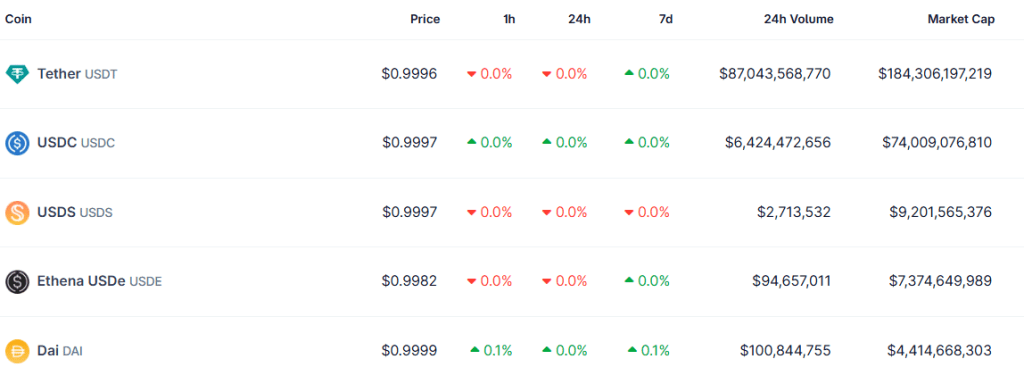
Top 5 stablecoins by market cap (Source: CoinGecko)
That insularity means that even if market volatility were to affect those dollar-denominated assets, the ripple effect on Europe’s financial stability would likely be contained.
Looking ahead, the report identifies the European Union’s landmark Markets in Crypto-Assets Regulation (MiCA) as a pivotal framework for mitigating potential future risks, even if stablecoin adoption and interconnections with the euro area were to grow.
Interest Payment Bans and Global Coordination Take Center Stage
MiCA, which is set to become fully applicable across the EU, is designed to provide a comprehensive regulatory regime for crypto assets, including stablecoins.
Among the specific measures within MiCA highlighted by the authors is the prohibition of interest payments on stablecoin holdings, applicable to both stablecoin issuers and crypto asset service providers.
The report also underscored the necessity for international cooperation to address regulatory disparities, stating, “To mitigate risks posed by cross-border regulatory arbitrage and diminish spillover risks from inadequately regulated jurisdictions, it is vital that regulatory frameworks are further aligned at a global level.”
Interestingly, the report noted similar calls for bans on interest payments on stablecoin holdings in the United States, with banking groups led by the Bank Policy Institute advocating for such measures.
Federal regulators in the U.S. are anticipated to issue final implementing regulations on the stablecoin-focused GENIUS Act between 2026 and 2027, indicating a growing global consensus on certain regulatory approaches for stablecoins.


