
Why Bitcoin’s Drop Isn’t Just Sentiment: NYDIG Warns of Capital Flight
Bitcoin’s pullback toward $84,000 is being driven by structural market reversals rather than mere sentiment, according to Greg Cipolaro, Global Head of Research at NYDIG.
In a new report, Cipolaro warned that several of the key engines that powered the 2024–25 bull cycle have now “shifted into reverse,†creating a self-reinforcing feedback loop of capital outflows, broken arbitrage trades, and weakening liquidity.
BTC has recovered slightly in recent days, and trades around $87,500 at press time.
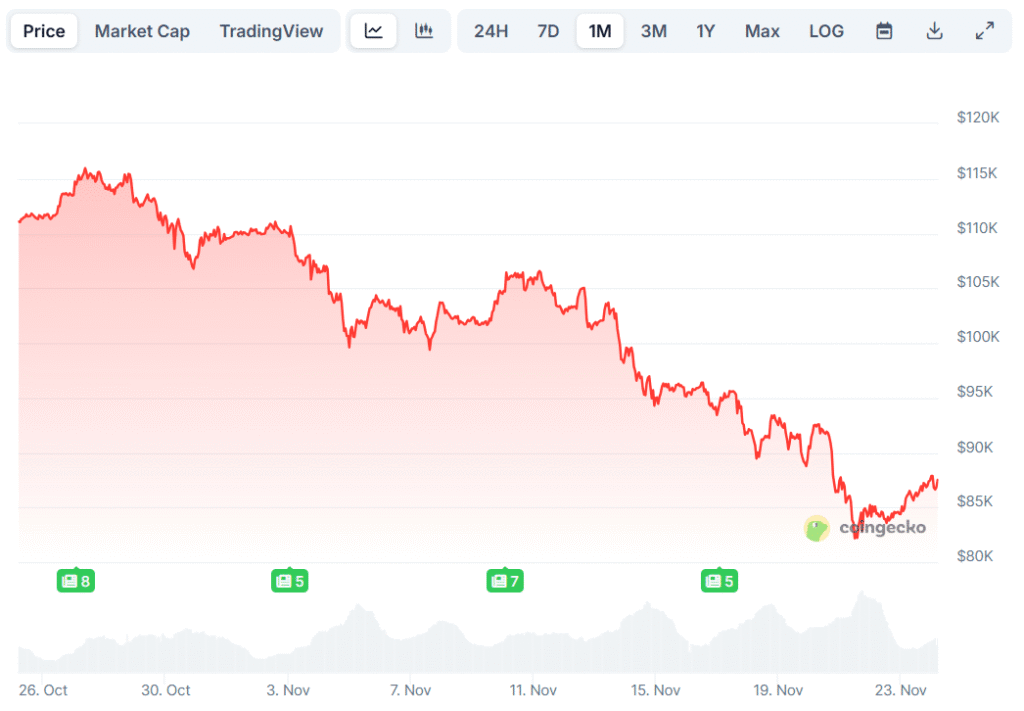
BTC price (Source: CoinGecko)
ETF Demand Turns Negative
Spot bitcoin ETFs—heralded as the most influential demand driver of the year—have entered a sustained period of redemptions. After funneling billions of dollars into BTC during the first half of the year, the sector is now posting persistent outflows.
Trailing five-day ETF flows have turned decisively negative, Cipolaro noted, and the trend is on pace to make November the worst month for redemptions since the funds launched. Data from Farside Investors shows that the vehicles have shed $3.55 billion so far this month, approaching the $3.56 billion record outflow in February.
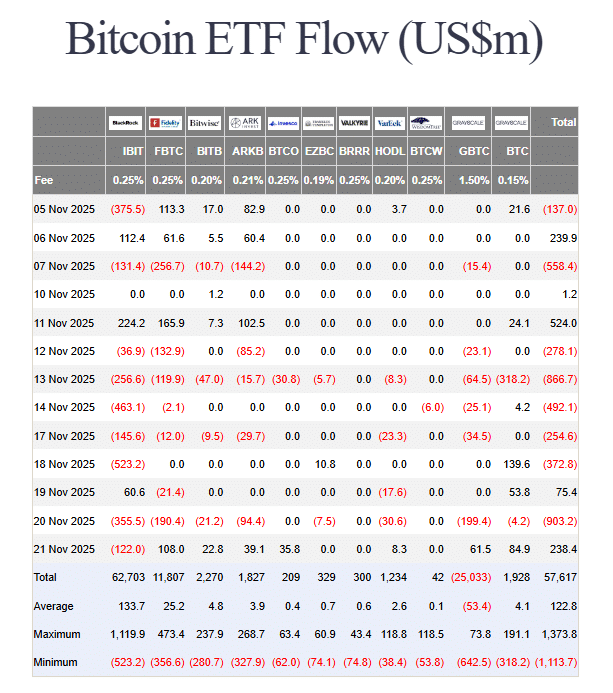
US spot BTC ETF flows (Source: Farside Investors)
Those redemptions dramatically alter the supply-demand balance that supported bitcoin’s earlier climb to record highs. Where ETFs once acted as a steady absorption mechanism for spot supply, they now contribute to selling pressure—even without active selling by issuers—by removing demand that previously supported price stability.
Also read: Kiyosaki Dumps $2.25M in Bitcoin During Market Crash—Here’s Why
Stablecoins Signal Marketwide Retreat
The reversal isn’t limited to ETFs. Stablecoin data is flashing similar warning signs.
The total stablecoin supply has dipped for the first time in months, while the algorithmic stablecoin USDE has seen a collapse in circulating supply after the Oct. 10 liquidation cascade. According to Cipolaro, the token has lost nearly half its outstanding supply since that event—an indication that capital isn’t rotating within crypto, but leaving the ecosystem entirely.
“Given its role in the selloff, where it fell to $0.65 on Binance, its rapid contraction underscores how aggressively capital has been pulled from the system,†he wrote.
Stablecoins often act as dry powder for speculative flows. A shrinking supply suggests fewer buyers on the sidelines, weakening liquidity during periods of stress.
Corporate Treasury Trades Unwind
Cipolaro’s report also highlights the breakdown of corporate treasury trades built around DATs (Digital Asset Treasuries), whose share premiums relative to net asset value once encouraged companies to issue stock and buy bitcoin.
As those premiums flipped to discounts, the incentive reversed. Instead of buying BTC, some firms have begun selling bitcoin or repurchasing shares. Sequans, for example, sold BTC earlier this month to reduce debt obligations.
“Importantly, while these reversals mark a clear shift from a once-strong demand engine to a potential headwind, no DAT has yet shown signs of financial distress,†Cipolaro emphasized. “Leverage remains modest, interest obligations are manageable, and many DAT structures allow issuers to suspend dividend or coupon payments if needed.â€
Even so, the unwind removes yet another source of structural buy-side support for BTC.
Also read: Bitcoin’s Path to $200K May Take 4 More Years, Says Brandt—And a Legendary Whale Just Sold
Dip Buyers Couldn’t Slow the Decline
Large buys during the drawdown—including purchases from Strategy and the government of El Salvador—failed to arrest bitcoin’s fall. Cipolaro sees this as evidence of the scale and strength of the structural retreat.
The fact that “sizable purchases didn’t even slow the decline is telling,†he wrote.
According to him, these reversals form a reflexive cycle that began with the $19 billion liquidation event on Oct. 10, which destabilized leveraged positions across the market. Since then, mechanisms that previously pushed prices upward—ETF inflows, stablecoin expansion, corporate arbitrage trades—have started reinforcing downward motion instead.
“Hope for the Best, Prepare for the Worstâ€
Despite the near-term challenges, Cipolaro stressed that bitcoin’s long-term investment thesis remains intact. The cyclical mechanics driving the correction, he argued, are familiar and historically temporary.
“History suggests the next stretch could be bumpy,†he wrote, “but secular conviction remains an important asset for long-term investors.â€
For now, Cipolaro believes investors should “hope for the best, but prepare for the worst†as liquidity winds, ETF dynamics, and capital flows continue to shape bitcoin’s path in the months ahead.


