
Bitcoin Jumps 2% Off Oversold Lows—Is This the Start of a Relief Rally?
Bitcoin’s 1-day chart continues to exhibit notable weakness, with price action unable to build sustained momentum after several sessions of heavy selling, according to data from the Ecoinimist markets page.
A series of progressively lower closes reflects market hesitation and fading confidence among short-term traders, while the broader trend structure shows BTC pinned under declining short- and medium-term moving averages.
The overall tone remains bearish, but deeply oversold conditions are beginning to emerge—creating the potential for a relief bounce if the right catalysts align.
Bitcoin Trend Structure Turns Heavy as EMAs Steepen Bearishly
The 9-day and 20-day EMAs remain firmly above the current price, acting as dynamic resistance and confirming that bears still hold control over the trend.
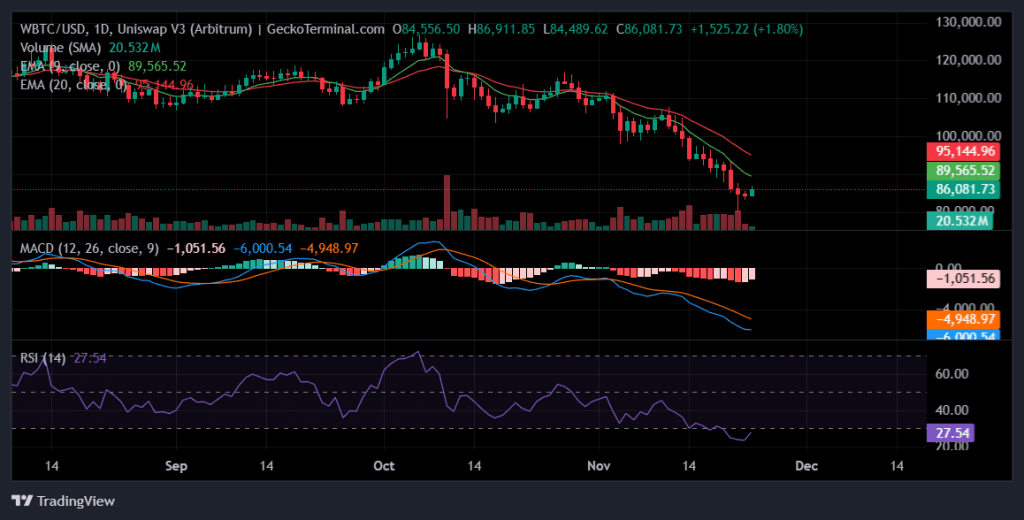
Daily chart for WBTC/USD (Source: GeckoTerminal)
What stands out is how both EMAs continue to slope downward, signaling sustained negative momentum rather than a short-lived corrective dip. When the price remains below both EMAs while the averages widen, it typically reflects growing sell-side dominance and reduces the probability of an immediate recovery.
However, this same structure can also set up the conditions for a sharp rebound once sellers exhaust themselves—especially when the market becomes oversold, as indicators now suggest.
MACD Continues Deepening Into Bearish Territory
Momentum continues to deteriorate, with the MACD drifting further below its signal line across the past several sessions.
The expanding negative histogram underscores the persistence of bearish pressure. This kind of MACD structure often corresponds with markets in prolonged correction phases, where buyers hesitate to engage until signs of stabilization appear.
While this is clearly not a bullish signal, deeply negative momentum sometimes precedes a slow-forming bottom, especially when coupled with oversold oscillators.
RSI Enters Extreme Oversold Levels
The RSI has fallen into deeply oversold territory, spending multiple sessions below levels typically associated with exhaustion. This doesn’t automatically guarantee a reversal—oversold conditions can persist during strong downtrends—but it does signal that sellers may be overextending.
When RSI clusters near extremes while an asset’s price approaches major support levels, markets often become vulnerable to sharp upside reversion. For Bitcoin, this dynamic suggests that although the trend remains bearish, downside momentum may begin to fade if buyers defend key supports.
Support and Resistance Levels Shaping Next Moves
Immediate Bitcoin price behavior will largely depend on how BTC interacts with its nearby support and resistance zones.
The first major support sits near $84,250, followed by deeper cushions around $82,390 and $78,595. With sentiment still fragile, any decisive break below the upper support could accelerate selling toward the lower levels—especially if momentum remains heavy.
On the upside, recovering $86,845 and $87,498 remains essential for bulls to regain short-term control. These resistance areas act as the gateway to a more meaningful test of $94,270, which aligns with broader trend resistance and a psychological recovery zone.
Given the current EMA structure, reclaiming these levels will require sustained buy-side commitment rather than a brief short squeeze.
Order Book Walls Highlight Tight Liquidity Clusters
Order-book data shows tight concentrations of both bid and ask liquidity, suggesting the Bitcoin price may move quickly if either side absorbs these clusters.
On the buy side, strong bid walls sit near $86,106, $86,000, and $85,898. These provide temporary support, though their break would barely move the price initially before exposing deeper liquidity gaps that could accelerate downside. Their presence reflects buyers attempting to stabilize BTC, but the small percentage impact signals more of a soft floor than a hard one.
On the sell side, ask walls at $86,300, $86,255, and $86,257 could cap short-term rallies. Clearing these clusters could lift the price by roughly 0.17%–0.22% toward the next resistance level.
Those order-book dynamics suggest a tightly compressed trading zone—one that could break sharply once either side overwhelms the other.
Potential Trade Setups: Long and Short Scenarios
For long setups, traders may look for confirmation that BTC can hold the $84,250–$82,390 support band.
An oversold bounce becomes more probable if the RSI stabilizes and the price closes back above short-term resistance levels.
A reclaim of the 9-day EMA would be a meaningful early signal that buyers are regaining initiative. Upside exits may be considered near the $86,845 and $87,498 resistance zones, with a stronger continuation possible if the $94,270 level is breached.
For short positions, rallies into overhead resistance remain the cleaner setup. As long as BTC stays pinned below both EMAs and momentum remains negative, sellers may continue to defend these levels aggressively. Failed moves above $86,845 or $87,498 could provide opportunities to target $84,250 initially, followed by deeper supports if bearish momentum persists.
In both cases, risk management remains crucial given the compressed liquidity and elevated volatility that oversold markets typically produce.
Disclaimer: The information presented in this article is for informational and educational purposes only. It does not constitute financial advice. Ecoinimist is not responsible for any losses incurred. Readers should exercise caution before acting on this content.


