
Jefferies Says Tether Is Quietly Driving Gold’s Record-Breaking Rally
Investment bank Jefferies says the breathtaking surge in gold prices this year can no longer be explained by traditional drivers such as central-bank buying, geopolitical risk, or inflation hedging alone.
Instead, the firm points to an unexpected player: Tether.
In a report published Thursday, Jefferies analysts said attestation data and on-chain activity suggest the world’s largest stablecoin issuer has been aggressively accumulating physical gold in recent months — enough, they argue, to materially tighten global supply and help propel the precious metal to record highs. Gold has climbed more than 50% this year and now trades at roughly $4,080 per ounce.
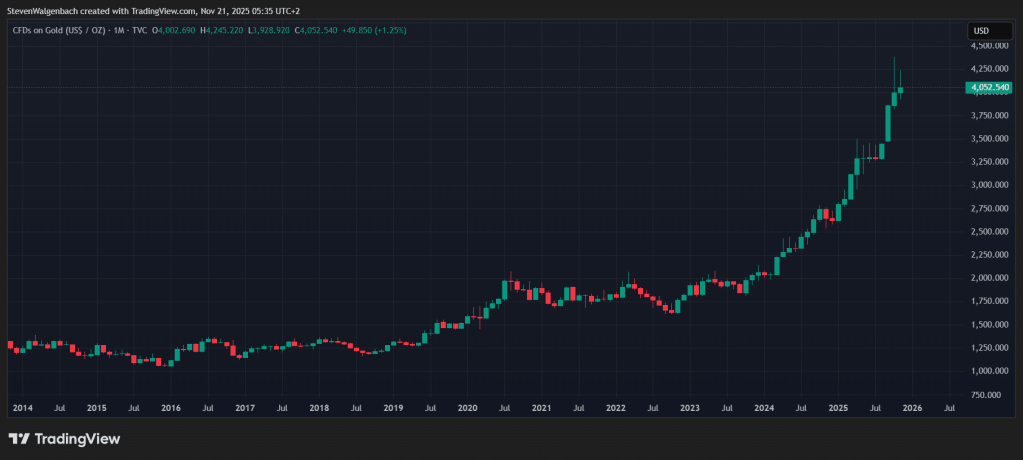
Gold price (Source: TradingView)
From Denver Meetings to a Billion-Dollar Bullion Strategy
Jefferies first grew suspicious of Tether’s gold ambitions last autumn after the company quietly met with miners and royalty firms at an industry gathering in Denver. According to investors who spoke with the bank, Tether signaled plans to buy roughly 100 tons of gold this year.
Those whispers gained credibility after Tether CEO Paolo Ardoino made public comments about expanding the firm’s gold holdings, coinciding with a $1,000-per-ounce spike in prices. Jefferies now estimates that by the end of the third quarter, Tether owned at least 116 tons of gold, placing it on par with some smaller central banks.
Of that total, about 12 tons back Tether’s gold-linked token, XAUt — which itself boasts a market cap of roughly $1.5 billion — while the remaining 104 tons appear to be backing USDT reserves.
Also read: Tether Hits 500M Users Amid Surge in Stablecoin Adoption
A Buying Pace That Rivals Global Demand Growth
What stands out most, Jefferies said, is the speed of accumulation. The firm estimates Tether added around 26 tons in the third quarter alone, equal to roughly 2% of total global gold demand over the same period.
While the volumes are not large enough to overshadow the substantial flows from central banks, they are significant enough to tighten near-term supply — something Jefferies believes played a role in amplifying the year’s rally. Combined with rising investor sentiment around limited supply, Tether’s buying spree may have created a momentum loop in which scarcity concerns reinforced price strength.
The report adds that Tether’s accumulation pattern is likely to continue as long as USDT maintains its rapid growth. The stablecoin issuer typically keeps gold at about 7% of its reserves, meaning rising profit and minting activity naturally translate into larger bullion demand.
Future Demand Could Add Another 60 Tons Per Year
Paolo Ardoino has projected roughly $15 billion in 2025 profits for Tether. Jefferies analysts calculated that if the company allocates even half of that figure to gold — consistent with its reserve-allocation strategy — Tether could add nearly 60 tons of bullion annually.
Such sustained activity would entrench the stablecoin issuer as a structural buyer in the global gold market, potentially influencing price stability and liquidity over the long term.
However, Jefferies noted some uncertainty tied to the company’s forthcoming GENIUS Act-compliant stablecoin, USAT, which will not require gold reserves. Whether this reduces gold-related demand or simply shifts it across Tether’s product suite remains unclear.
A Wider Metals Strategy Emerges
Beyond physical gold purchases, Tether has been expanding deeper into the metals ecosystem. Jefferies highlighted the company’s more than $300 million invested this year in royalty and streaming companies — firms that provide financing to miners in exchange for future production.
The hiring of two senior metals traders from HSBC also signals a rapid scaling effort. To Jefferies, these moves strongly suggest that Tether’s ambitions extend beyond reserve diversification and toward a broader strategic presence in global commodities.
As the stablecoin giant’s reach grows, Jefferies says the gold market must now account for a new and highly capitalized player — one capable of shaping supply-demand dynamics in ways few predicted at the start of the year.


