
Strategy Stock Plunges Over MSCI Index Fears — Could $11.6B Exit Next?
Strategy (MSTR), the $51 billion Bitcoin-treasury giant formerly known as MicroStrategy, could see as much as $2.8 billion in outflows if global finance heavyweight MSCI removes the company from its equity indices — and as much as $11.6 billion if other exchanges and index providers follow suit, according to a Thursday note from JPMorgan.
The investment bank said the recent decline in Strategy’s share price — which has intensified this month — is driven less by Bitcoin’s slump and more by the mounting risk of index exclusion.

Strategy share price performance over the past 6 months (Source: Google Finance)
The Virginia-based firm is currently included in the MSCI indices, the Nasdaq 100, the Russell 1000, and several other major benchmarks that feed both retail and institutional portfolios.
“This index inclusion has enabled Bitcoin exposure to indirectly encroach into both retail and institutional investor portfolios,” JPMorgan analysts wrote. “However, with MSCI now considering removing MicroStrategy and other digital-asset treasury companies from its equity indices, this previous indirect encroachment could go into reverse.”
MSCI’s Proposal Targets Companies With Crypto-Heavy Balance Sheets
MSCI is currently reviewing a proposal that would exclude companies whose primary business model centers on accumulating Bitcoin or other cryptocurrencies, particularly if digital assets comprise at least 50% of their holdings.
In a statement last month, the organization said its industry-wide consultation would run through the end of 2025, with a final decision expected on Jan. 15.
If adopted, the move would strike at the heart of Strategy’s identity and disrupt one of the key channels through which passive investment exposure reaches the stock.
The timing is especially sensitive for Strategy, which has absorbed a steep share-price decline as Bitcoin’s weakness collides with fears of index ejection. The stock closed 5.1% lower on Thursday at $177.13, bringing its one-month plunge to more than 40%, according to Google Finance.
Premium Collapses as Bitcoin Wobbles
Strategy’s massive Bitcoin stockpile — roughly $55.75 billion worth, according to SaylorTracker — has long allowed the company to trade at a noticeable premium relative to its net asset value. That premium, measured by the mNAV multiple, peaked at 2.7 last year but now sits just above 0.90, indicating investors’ sharp repricing of risk.
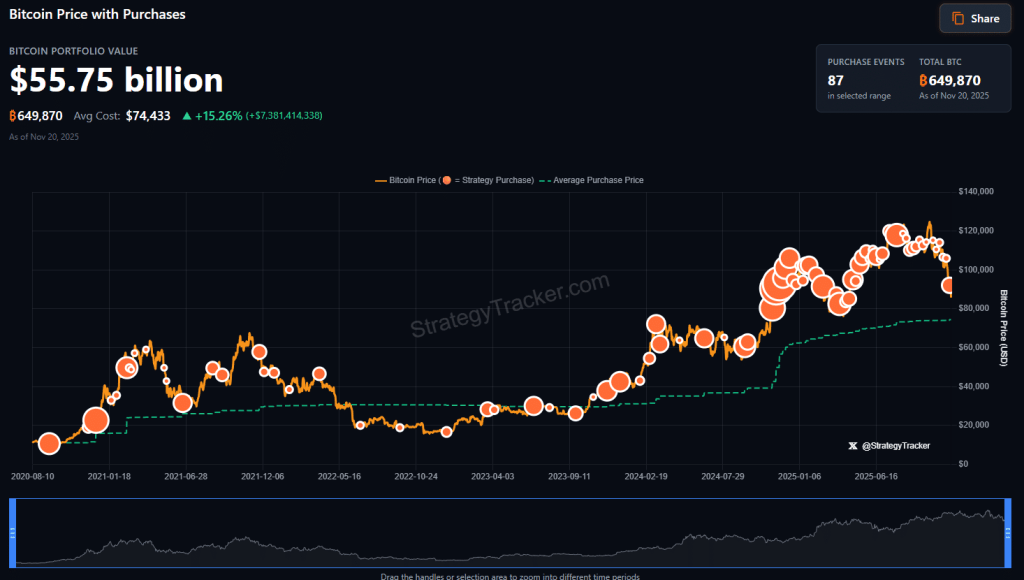
Strategy Bitcoin holdings (Source: SaylorTracker)
The company also spent the past week fighting off speculation that it was selling parts of its Bitcoin holdings. Executive Chair Michael Saylor dismissed the rumors, asserting that Strategy remains committed to its long-standing accumulation approach.
But with index-facing funds holding substantial allocations of Strategy shares, JPMorgan analysts warned that removal from MSCI or other major benchmarks could create forced selling pressure, reduce strategy-linked inflows, and challenge the company’s future ability to raise capital.
“While active managers are not obligated to follow index changes, exclusion from major indices would certainly be viewed negatively by market participants,” analysts wrote. “With less index-related trading, the company may also see lower trading volumes and liquidity, making it even less attractive to large investors.”
Bitcoin’s Weakness Deepens Market Anxiety
Bitcoin itself has not offered much relief. The world’s largest cryptocurrency has fallen below $88K, and is now down more than 21% over the past month. The steep slide has erased its year-to-date gains, a dramatic reversal from early October when it hit a record high.

BTC price (Source: CoinGecko)
Market watchers attribute the broader sell-off to macroeconomic uncertainty, including weaker-than-expected jobs data and reduced expectations of a near-term interest-rate cut — both of which have throttled liquidity in digital-asset markets.
A Turning Point for Bitcoin Treasury Firms
While Strategy is the highest-profile company affected, MSCI’s proposed methodology change could reshape the entire class of Bitcoin-focused treasury companies, many of which have sprung up globally in recent years. Japan’s Metaplanet, for instance, is preparing to issue dividend-paying preferred shares specifically to accumulate more Bitcoin, mirroring Strategy’s long-standing approach.
For now, all eyes remain on MSCI’s January decision — a ruling that could either stabilize Strategy’s outlook or unleash billions in outflows that push the Bitcoin-treasury pioneer into one of the most consequential restructurings of its corporate existence.


