
Revolut Expands Crypto Transfers With New Polygon Stablecoin Support
Revolut is accelerating its move into digital-asset payments through a fresh expansion of its partnership with Polygon Labs.
The upgrade will allow customers across the UK and the European Economic Area (EEA) to send and receive remittances using USDC, USDT and POL directly through the Revolut app, settling on the Polygon blockchain.
The European fintech heavyweight — which now serves more than 65 million users across 38 countries — first enabled stablecoin transfers on Polygon in December 2024.
According to a Tuesday press release, the company has since processed over $690 million worth of Polygon-based transactions, driven by demand for cheaper and faster cross-border payments.
USDC and USDT Go Live on Polygon Inside Revolut
A spokesperson confirmed that this marks the first time USDC and USDT are usable within Revolut on the Polygon network.
“Revolut is now switching on USDC and USDT support on Polygon for customers,†the spokesperson said. “This is the first time those assets are live inside Revolut on Polygon and the first time users can actually send/receive them.â€
The addition of the two most widely used stablecoins significantly expands Revolut’s crypto remittance capabilities, giving users access to faster settlement times and minimal gas fees while abstracting away the usual complexity of blockchain payments.
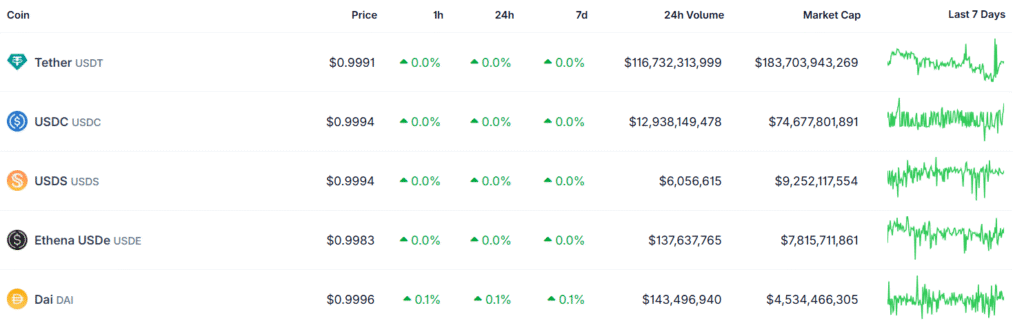
Top 5 stablecoins by market cap (Source: CoinGecko)
Polygon Solidifies Its Position as Financial Infrastructure
Revolut joins a fast-growing roster of major institutions adopting Polygon for payments and money movement.
Companies including Stripe, Flutterwave, DeCard by DCS and Reliance Jio have already integrated with the network, underscoring Polygon’s rapid evolution into a core layer for financial services.
Polygon Labs CEO Marc Boiron said the integration aligns perfectly with the company’s long-term vision of making blockchain payments seamless and invisible to end users.
“This integration with Revolut represents exactly the kind of real-world utility for everyday people we’ve been building toward,†Boiron said. “By making blockchain payments invisible to the end user, integrated with everyday traditional payment experiences, and delivering superior speed and cost efficiency, we’re seeing the future of finance unfold.â€
Regulatory Nuance Shapes Where Remittances Can Be Sent
Revolut clarified that the new remittance feature applies specifically to non-EU countries in the EEA.
This approach takes into account the European Union’s evolving regulatory stance on certain stablecoin providers — particularly Tether’s USDT — under new digital asset rules.
This careful geographic rollout allows Revolut to offer stablecoin remittances where regulatory conditions are clearer while ensuring compliance with the EU’s stricter oversight framework.
A Major Step Forward for Mainstream Stablecoin Remittances
The expansion shows Revolut’s ambition to stay at the forefront of digital finance innovation. For users, the integration promises near-instant settlement, predictable fees and a streamlined experience that removes the technical friction often associated with blockchain transactions.
For Polygon Labs, this adoption adds another high-profile validation of its infrastructure as a backbone for global financial applications. As more fintech firms integrate stablecoin rails, the broader payments industry appears increasingly poised to embrace blockchain-based remittances at scale.


