Cboe Unveils First Long-Term Bitcoin and Ether Continuous Futures
Cboe Global Markets is preparing to roll out a new class of crypto derivatives designed to give investors long-term, perpetual-style exposure to Bitcoin and Ether without the hassle of managing expiring contracts.
The exchange operator announced Monday that its Bitcoin and Ether “Continuous Futures†will go live on Dec. 15, pending final regulatory approval.
The products mark one of the most significant steps yet by a major U.S. exchange toward replicating the functionality of crypto perpetual futures—one of the most heavily traded instruments in digital asset markets but historically restricted under U.S. rules.
Cboe’s new contracts will carry a 10-year term and feature a daily cash adjustment mechanism intended to mimic the economics of perpetual futures. The adjustment removes the need for traders to manually roll positions forward, a key challenge for institutions seeking long-duration exposure to Bitcoin and Ether in regulated markets.
Futures contracts allow traders to buy or sell an asset at a predetermined price on a future date and are widely used across global markets for hedging, speculation, and risk management. Cboe said the structure of its continuous futures is designed to provide the same capital efficiency, volatility hedging, and tactical trading opportunities found in traditional futures—while also enabling investors to take short exposure within a regulated framework.
The contracts will clear through Cboe Clear US, reducing counterparty risk through centralized clearing. Margin requirements will follow Commodity Futures Trading Commission (CFTC) standards, and Cboe said cross-margining with existing Cboe Futures Exchange (CFE) crypto futures may be possible. If approved, trading will run 23 hours a day, five days a week, similar to the schedule used by other CFE crypto products.
Cboe first unveiled plans for continuous Bitcoin and Ether futures in September as part of a broader expansion of its digital asset derivatives lineup. The company operates equities and derivatives exchanges across North America, Europe, and Asia, and has positioned crypto futures as a key pillar of its long-term strategy.
A Shifting U.S. Stance on Crypto Derivatives
For years, U.S. regulators resisted the introduction of new crypto futures and perpetual-style products, citing concerns around leverage, market integrity, and customer protection. But the policy landscape has changed markedly under President Donald Trump’s administration, which has put digital asset innovation near the center of its financial agenda.
In April, the CFTC formally sought public input on the benefits and risks of perpetual futures—an unprecedented step that opened the door to regulated versions of the instrument widely used on offshore exchanges. The agency asked for comment on how perpetuals function, how they could be integrated into U.S. trading and clearing infrastructure, and what safeguards would be necessary to ensure customer protection.
Institutional interest has surged accordingly. In March, Chicago-based Bitnomial became the first U.S. exchange to introduce CFTC-regulated XRP futures, expanding the slate of crypto commodities available to American traders.
In July, Coinbase revealed plans to launch nano-Bitcoin and nano-Ether perpetual contracts, echoing the micro-sized derivatives popularized in traditional equity markets.
A Massive Market to Tap Into
The potential opportunity for regulated perpetual-style products is enormous. As of Monday, open interest on crypto perpetuals stood at about $766.95 billion, according to CoinMarketCap data. Perpetual futures dominate trading volumes on major offshore platforms and are widely seen as the backbone of global crypto derivatives activity.
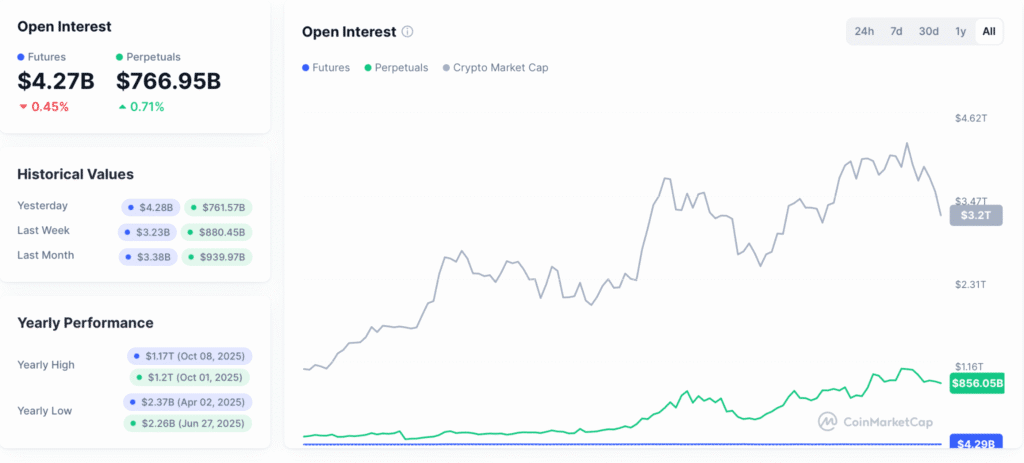
Crypto derivates market overview (Source: CoinMarketCap)
Cboe’s continuous futures won’t perfectly replicate offshore perpetuals—regulatory constraints still limit leverage and mandate clearing—but the exchange believes the decade-long term and daily cash adjustment will deliver a close approximation suitable for institutional investors seeking U.S.-regulated exposure.
Analysts say the launch could appeal to hedge funds, proprietary trading firms, and asset managers looking to express directional views on Bitcoin and Ether without managing the roll schedules required by quarterly futures.
The move may also position Cboe as a central player in a new wave of U.S.-based crypto derivatives offerings, particularly as regulators signal increased openness to structured, risk-controlled versions of products long available abroad.
With the Dec. 15 launch date approaching, all eyes will be on whether the CFTC grants final approval—and how aggressively institutional players adopt a futures model that blends the longevity of traditional contracts with the flexibility of perpetuals.


