Tom Lee Says Ethereum Is Entering a “Supercycle” — But Bitcoin Maxis Aren’t Buying It
Tom Lee, executive chairman of BitMine Immersion Technologies (BMNR) and head of research at Fundstrat Global Advisors, ignited fresh debate on Sunday after suggesting that Ethereum may now be “embarking on that same supercycle” that helped Bitcoin surge 100x since his 2017 client recommendation.
In a post on X, Lee argued that Bitcoin’s meteoric rise over the past eight and a half years was preceded by extreme volatility.
He pointed to six drawdowns of more than 50% and three crashes deeper than 75%, calling them evidence of a market “discounting a massive future.” Investors, he said, were simply forced to hold through “existential moments” to capture the full upside.
Lee believes ether may now be positioned for a similar long-term trajectory, though he admitted the process will not be smooth.
He provided no timeline or valuation targets, reiterating only that “the path higher is not a straight line.”
Bitcoin Maximalists Challenge the Thesis
Lee’s optimism drew immediate criticism from prominent Bitcoin figures.
A well-known influencer who goes by “The Bitcoin Therapist” questioned Ethereum’s long-term moat, asking what utility ether offers that “hundreds of other coins don’t.”
He also argued that Ethereum’s market penetration does not guarantee lasting competitive advantage and cast doubt on the idea that traditional finance institutions would rely on Ethereum for 24/7 asset settlement.
“I would never want my assets on the ethereum blockchain,” he wrote, highlighting concerns that continue to circulate within Bitcoin-focused communities.
The skepticism reflects broader pushback from Bitcoin maximalists, who have long contended that Ethereum’s technical complexity, evolving monetary policy, and shifting roadmap weaken its claim to being the dominant smart-contract platform long-term.
Many also argue that Bitcoin’s security model and monetary characteristics give it advantages that Ethereum cannot match.
Ethereum’s Growth Metrics Provide Supporters With Ammunition
Despite criticism, Lee’s comments echo a growing camp of analysts who argue that Ethereum’s underlying fundamentals continue to strengthen.
Activity across ETH’s Layer-2 rollups now exceeds mainnet activity, pointing to accelerating usage of the broader ecosystem. Developers, meanwhile, are pushing upgrades designed to reduce transaction costs, enhance throughput, and support institutional-scale adoption.
Supporters believe those trends could be early signs of the type of structural growth that has historically preceded major multi-year rallies in crypto assets. They argue that if Ethereum’s network effects continue to deepen—particularly around stablecoins, decentralized finance, tokenization, and enterprise use cases—the asset may indeed be entering the early stages of a new long-term expansion cycle.
Real-World Adoption Remains the Key Test
For Lee’s supercycle thesis to materialize, Ethereum will need to demonstrate durable growth in real-world usage. That includes expanded institutional engagement, rising tokenization of assets, more enterprise-grade applications, and sustained activity across Layer-2 ecosystems.
Whether traditional finance ultimately settles trades or manages tokenized portfolios on Ethereum—or on competing blockchains—remains uncertain.
Critics argue that regulatory constraints and risk management concerns may limit the extent to which public networks are used for core financial infrastructure.
Still, Ethereum’s supporters counter that experimentation from major financial institutions is already underway and could accelerate as blockchain-native settlement becomes more attractive.
A Familiar Debate With Unfinished Answers
Lee’s comments have reopened a long-standing divide in the crypto community: whether Ethereum can chart a breakout trajectory akin to Bitcoin’s historic rise.
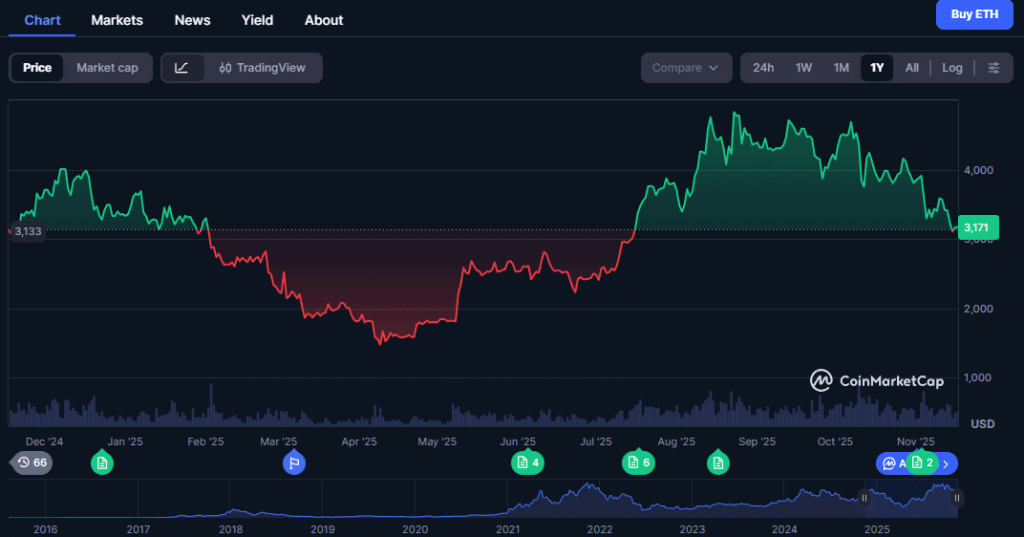
ETH price chart (Source: CoinMarketCap)
Supporters see structural tailwinds setting the stage for a significant expansion in value. Detractors argue that Bitcoin’s dominance and Ethereum’s technical and competitive risks make the comparison flawed.
What both sides acknowledge is that volatility will remain a constant. If history repeats, the coming years will provide clarity—likely through more “existential moments” similar to those Lee referenced.
For now, ether’s potential supercycle remains a thesis in progress, one that hinges on adoption, resilience, and the evolution of global blockchain infrastructure. The debate, as always in crypto, is far from settled.