
After Schiff’s Attacks, Saylor Goes Bigger: Strategy Adds 8,178 BTC
Strategy founder and executive chairman Michael Saylor has doubled down on his Bitcoin-first corporate strategy, announcing that the company acquired 8,178 BTC for approximately $835.6 million at an average price of $102,171 per coin.
The purchase brings Strategy’s total holdings to 649,870 BTC, deepening its position as the world’s largest corporate Bitcoin treasury.
In a post on X, Saylor said the company has now accumulated $48.37 billion worth of Bitcoin at an average cost basis of $74,433, and has delivered a 27.8% Bitcoin yield year-to-date in 2025.
The announcement arrives shortly after gold advocate Peter Schiff renewed attacks on the company’s business model.
While Saylor did not reference Schiff, the move underscores the stark philosophical divide between the two men, and offers an unmistakable counterpoint to Schiff’s criticism: Strategy is still buying, still growing, and still building its corporate future around Bitcoin.
A Major Purchase in the Middle of a Market Pullback
The acquisition comes during a tense period for the crypto sector.
Bitcoin is down more than 20% from its October all-time high above $125,000 and recently dipped below $99,000, its lowest level in months. The decline follows the Oct. 10 flash crash that erased tens of billions in market value, rattling leveraged players and reducing liquidity across major exchanges.
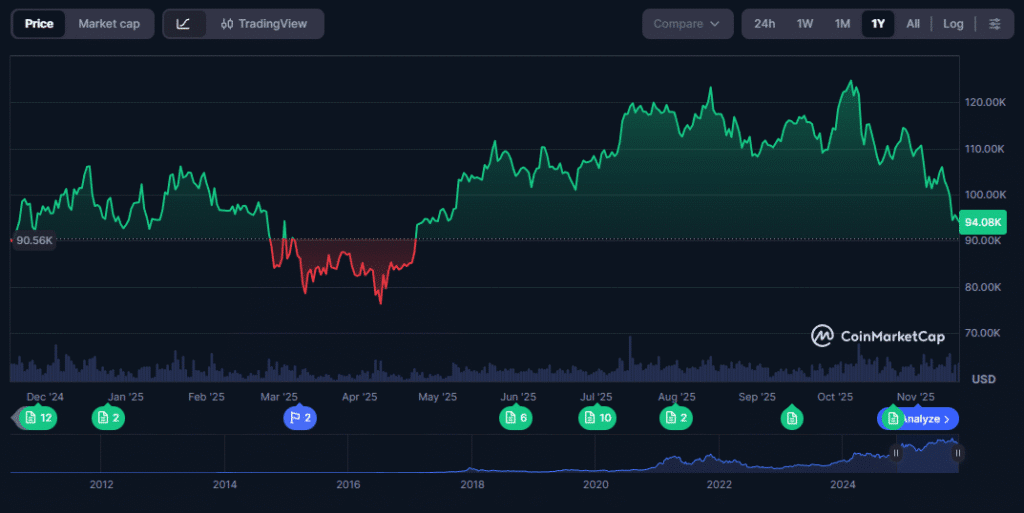
BTC price (Source: CoinMarketCap)
Despite the turbulence — or, in Saylor’s view, because of it — Strategy expanded its treasury.
Saylor has consistently argued that Bitcoin volatility is not a risk but an opportunity, treating corrections as accumulation windows rather than reasons to retreat.
His strategy, repeated over the course of five years, is straightforward: when the market sells off, buy more.
Also read: ‘We’re Buying More’: Saylor Shoots Down Strategy Bitcoin Sell-Off Speculation
Strategy’s Treasury Model Faces Scrutiny, but Saylor Stays the Course
Strategy’s stock performance has mirrored Bitcoin’s volatility.
The company’s shares have fallen more than 50% since July, with investors reacting to both macro pressure and the amplified impact of downturns on companies tied heavily to digital assets.
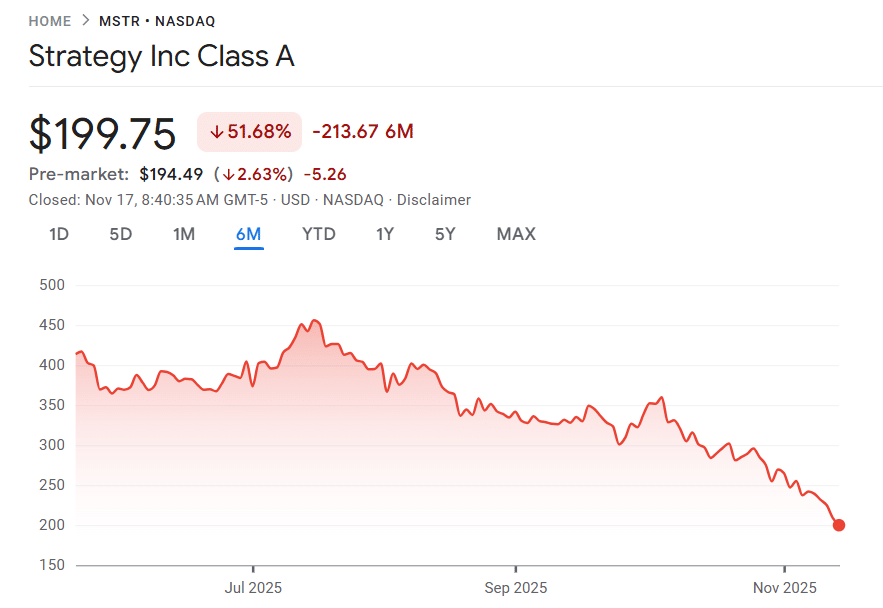
MSTR share price performance over the past 6 months (Source: Google Finance)
One metric analysts watch closely — Strategy’s “mNAV,†or multiple on net asset value — fell below 1 earlier this month, meaning the stock briefly traded at a discount to the value of its underlying Bitcoin.
The metric has since rebounded to 1.20, but remains far below levels seen during previous market expansions when investor confidence ran higher.
Still, Strategy continues to follow the same playbook it has used since 2020, raising capital, acquiring Bitcoin, and positioning itself as the long-term corporate benchmark for BTC adoption.
Schiff: “Strategy’s Business Model Is a Fraudâ€
Schiff, the long-time gold proponent and one of Bitcoin’s harshest critics, escalated his criticism of Strategy yesterday, accusing the company of misleading investors through its preferred-share structure.
According to Schiff, Strategy’s preferred shares — which are marketed as “high-yield†instruments — will not generate the returns income-oriented funds expect.
“MSTR’s business model relies on income-oriented funds buying its ‘high-yield’ preferred shares,†Schiff wrote. “But those published yields will never actually be paid.â€
He warned that if institutional holders begin exiting these preferred shares, Strategy could find it harder to issue new debt, a tool the company has used repeatedly to expand its Bitcoin position. Schiff argued that such a scenario would undermine the sustainability of Strategy’s accumulation model.
While Schiff’s critique is not new, his latest comments gained traction as Bitcoin’s correction intensified and Strategy’s mNAV weakened.
Gold Holds Firm as Bitcoin Stumbles
Schiff’s preference for gold has also gained narrative strength in recent months, with the metal reclaiming the $4,000 per ounce level even after a brief dip.
Gold is currently trading near $4,085, down from October’s record high of roughly $4,380 but holding well above key psychological support.
As Bitcoin struggles to regain momentum after its October peak, gold’s stability has been cited by Schiff and other traditionalist investors as evidence that the metal remains the superior long-term store of value.
Saylor’s Answer: Keep Buying Bitcoin
If Schiff is attempting to discredit Strategy’s treasury strategy, Saylor’s latest move signals that he has no intention of deviating from it.
The company’s nearly 650,000 BTC position represents one of the most aggressive treasury reallocations in corporate history, and Saylor has repeatedly framed it as a multi-decade bet — not a trade, not a hedge, and not a speculative position.
For Saylor, Bitcoin is the best-performing asset of the past decade, the best-performing asset of the past year, and the only monetary network with mathematically enforced scarcity. Strategy’s accumulation strategy is built on that conviction.
For Schiff, the entire structure is precarious, unsustainable, and destined to fail.


