
Berkshire Hathaway’s $4.93B Alphabet Bet Sparks Debate Over AI Spending
Alphabet shares rose more than 3% in pre-market trading today after Berkshire Hathaway disclosed a multibillion-dollar stake in the Google parent, marking what could be one of the final major swing investments made under Warren Buffett’s leadership.
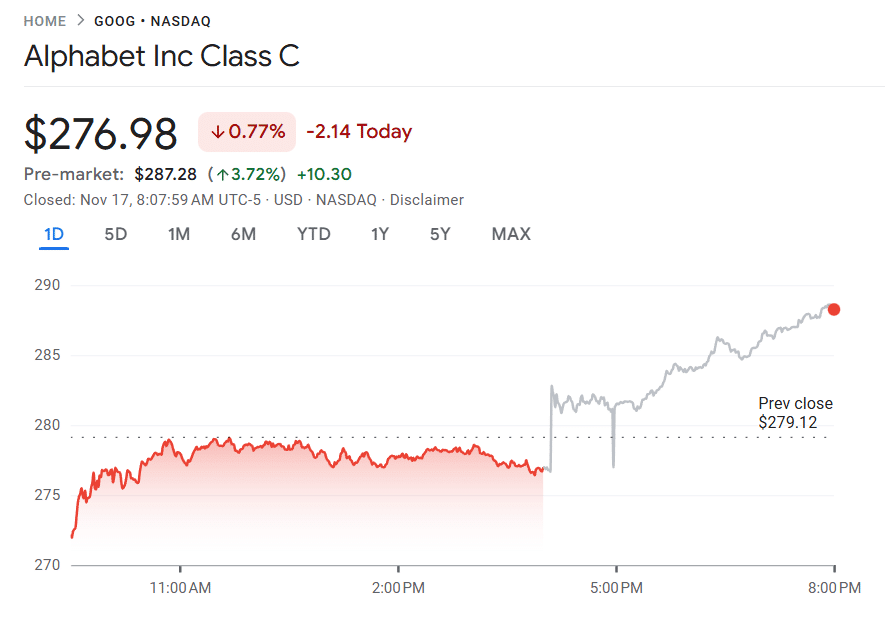
Alphabet share price (Source: Google Finance)
The purchase — worth $4.93 billion at the stock’s most recent close — immediately captured Wall Street’s attention not only because it represents a rare move by Berkshire into mega-cap technology, but because it arrives at a moment when the market is deeply split over whether Big Tech’s heavy AI spending is sustainable.
The focal point of the market reaction centers on a simple but high-stakes question: Is Berkshire’s investment a vote of confidence in the future of artificial intelligence, or a shrewd value-driven play on a tech giant whose fundamentals have been overshadowed by volatility?
Berkshire Hathaway’s Rare Turn Toward Tech
A regulatory filing late Friday showed that Berkshire Hathaway owned 17.85 million Alphabet shares as of Sept. 30. The move startled many long-time Berkshire watchers who have grown accustomed to Buffett’s aversion to most technology bets. Even Apple — now Berkshire’s largest holding — was initially framed by Buffett as a consumer-products play rather than a classic tech position.
This new Alphabet stake breaks from that narrative. The company has long been among the world’s biggest technology innovators, and in the current era, a heavyweight in the AI arms race. Google is spending tens of billions a year on AI infrastructure, cloud expansion, and advanced semiconductors.
Yet, despite leading the development of foundational models and dominating search, Alphabet’s valuation remains more modest than some of its AI rivals.
Alphabet trades at 25x expected earnings over the next year, compared with 30x for Nvidia and nearly 30x for Microsoft.
For a value-centric investor such as Buffett, that pricing gap may have presented an attractive entry point — even if he didn’t personally pull the trigger.
Who Made the Call?
It remains unclear who within Berkshire Hathaway made the Alphabet purchase.Â
Buffett typically oversees Berkshire’s largest moves, but the firm’s portfolio managers Todd Combs and Ted Weschler have increasingly played a hands-on role in equity decisions. Greg Abel — Buffett’s designated successor, set to take over as CEO at the end of 2025 — is another possibility. Berkshire Hathaway has said little about the internal decision-making.
Still, if Buffett played a part, the deal may represent a kind of course correction for a long-acknowledged regret. At Berkshire’s 2019 annual meeting, both Buffett and the late Charlie Munger publicly lamented not investing in Google much earlier, with Munger bluntly stating: “We screwed up.â€
Balancing Fear and Opportunity
The investment comes as Big Tech faces intensifying scrutiny from investors concerned about ballooning AI-related spending.
Companies across the sector are splurging hundreds of billions of dollars on chip purchases and data-center buildouts. While the long-term payoff could be massive, the near-term pressure has triggered pullbacks in several high-growth tech names.
In that environment, Berkshire’s move could be read as contrarian optimism. The conglomerate has been criticized in recent months for allowing its cash reserves to swell to unprecedented levels — a position some investors interpret as Buffett signaling that U.S. equity valuations remain too expensive.
By selectively deploying capital into Alphabet, Berkshire may be signaling a more nuanced view: that even in a heated market, pockets of compelling value persist.
Portfolio Shifts and Strategic Alignment
The Alphabet position lands amid broader adjustments in Berkshire’s portfolio. The conglomerate trimmed its holding in Apple, though the iPhone maker remains by far its most valuable public-equity investment at $64.9 billion. Buffett has repeatedly defended Apple as a consumer-brand powerhouse with unrivaled customer loyalty rather than a risky technology bet.
Berkshire also continued scaling back its stake in Bank of America, part of a drawdown that started last year. Even with these moves, the firm’s holdings remain heavily tilted toward financial services, which accounted for 36.6% of its equity portfolio as of September, according to Morningstar.
Alphabet’s strong year — with shares up 46% so far — underscores the resilience that may have attracted Berkshire. Unlike some AI-focused peers, Alphabet maintains multiple revenue engines, including cloud computing, YouTube, and the dominant global search business.
Its diversified business model and robust cash flow may align more closely with Berkshire’s traditional preference for steady, durable companies.
A Legacy-Defining Moment?
For Buffett, now in the final stretch of his tenure before Greg Abel takes the helm, the Alphabet stake may ultimately be remembered as one of his last major calls — or as one influenced by the next generation already steering the ship. Either way, it injects fresh intrigue into the ongoing debate over how Berkshire Hathaway will evolve post-Buffett.
Many analysts argue that the firm’s future leadership will likely be more comfortable engaging with innovation-driven sectors than Buffett himself was for much of his career. Alphabet, with its dominant position across search, cloud, and AI, could be an early signal of how Berkshire Hathaway adapts to a tech-centric global economy.
For now, markets appear impressed. Alphabet’s jump on Monday suggests that investors view Berkshire’s endorsement as a meaningful counterweight to growing concerns over tech’s spending spree. Whether this becomes a turning point in the debate over AI valuation — or simply the closing chapter of Buffett’s legendary investment run — will unfold over the coming quarters.
But what’s clear is that Berkshire Hathaway’s move, at this particular moment in the AI cycle, is anything but accidental.


