
Tokenization Breaking Free From Bitcoin Price Cycles as Wall Street Doubles Down
The once-predictable link between Bitcoin’s price cycles and Wall Street’s appetite for blockchain technology is fading, according to Galaxy’s head of tokenization, Thomas Cowan — a shift he believes marks the start of a new era of institutional adoption.
Speaking on Wednesday at The Bridge conference in New York City, Cowan said traditional finance is increasingly evaluating tokenization on its own merits rather than treating it as a byproduct of crypto bull markets.
The result, he argued, is a more durable form of industry engagement that stands independent of crypto’s notorious volatility.
Also read: Citi and DTCC Say Tech Is Ready for Tokenization—Regulators Aren’t
A Market No Longer Tied to Bitcoin’s Mood
For years, the rise and fall of Bitcoin served as a temperature gauge for corporate blockchain initiatives. Rallies brought surging interest and ambitious pilot programs; downturns brought layoffs, shuttered divisions, and paused budgets.
Cowan said that trend is now breaking.
“In previous cycles, as Bitcoin and other alts have run up, interest in tokenization has grown right alongside them,” he explained. “But what we’ve seen more recently is a separation — the interest is no longer tied to Bitcoin’s price.”
The timing supports his point. Bitcoin spent 2025 oscillating between extreme highs and steep pullbacks, topping $126,000 in early October before slipping by nearly 20% to the $102,000 range. Yet institutional momentum behind tokenization has accelerated rather than cooled.

Bitcoin price movement in the past year (Source: CoinGecko)
Cowan attributes the shift to a deeper understanding of blockchain’s utility within legacy finance, especially as the Trump administration’s regulatory easing has encouraged traditional firms to expand their on-chain experimentation.
Major players that once viewed tokenization as a cyclical innovation are now treating it as a structural upgrade.
Also read: The $100 Trillion Revolution: Tokenization Set to Redefine Global Finance
Tokenization Hits Its Stride
Tokenization — the process of converting assets like bonds, funds, commodities, or real-world financial instruments into on-chain representations — has become one of 2025’s fastest-growing segments in crypto infrastructure.
Cowan said the last year has seen tangible progress across multiple asset classes as more institutions recognize blockchain as a faster, cheaper, and more transparent settlement layer.
“They just see that technology as something that is going to be the back end of their financial institutions,” Cowan said, emphasizing that banks and asset managers are beginning to think in decades, not months.
Several global firms have launched or expanded tokenization initiatives throughout the year, many of which now span money market funds, U.S. Treasurys, short-term debt instruments, commodities, and cross-border settlement products.
The goal, Cowan stressed, is not to rebrand crypto speculation but to modernize financial plumbing.
Stablecoins Take the Lead as Institutions Go On-Chain
While tokenized bonds and funds are gaining traction, Cowan highlighted stablecoins as the sector’s runaway success story.
Stablecoins surged in popularity after U.S. regulatory clarity earlier this year gave issuers a stronger legal foundation and encouraged corporate adoption.
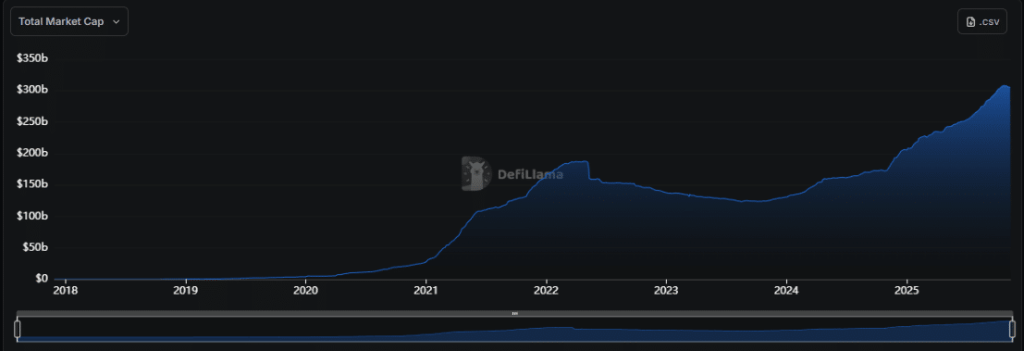
Stablecoins market cap (Source: DefiLlama)
As on-chain transactions grow, stablecoins have become a preferred medium for cross-border transfers, corporate settlements, and liquidity management.
Stablecoins are “off to the races,” Cowan said, calling them one of the clearest examples of blockchain utility recognized across both crypto-native and traditional finance sectors.
Their rise has led institutions to explore additional use cases for fully collateralized, low-risk, tokenized assets. This has pushed money market funds — historically a conservative investment vehicle — into tokenized form as well.
Growth of Tokenized Money Market Funds
Cowan pointed to tokenized money market funds as one of the most compelling developments emerging from the stablecoin boom.
The logic is straightforward: investors holding on-chain dollars forgo the risk-free yield available from government-backed instruments. Tokenized money market funds allow them to retain that yield without leaving the blockchain ecosystem.
“They want that risk-free rate that they’re forgoing when they’re holding stablecoins,” Cowan said. “So the next logical step is moving from stablecoins to money market funds.”
Major asset managers have started responding to this demand. Franklin Templeton, which pioneered tokenized funds early on, recently expanded its Benji platform onto the Canton Network, bringing tokenized fund infrastructure to permissioned institutional rails.
Other firms are following suit as on-chain Treasurys and yield-bearing funds demonstrate real operational efficiency.
Institutions Prepare for a “Transformative” Two Years
A striking theme in Cowan’s comments was the shift in institutional mindset. While early blockchain initiatives were often framed as experiments or “innovation labs,” the tone has now changed.
Cowan said the industry is nearing a point where blockchain technology will begin to prove its value at a scale impossible for traditional firms to ignore.
That conviction stands in contrast to earlier cycles, where price downturns routinely erased institutional enthusiasm. Instead, Cowan noted that tokenization teams at major banks and asset managers have remained intact — and in some cases expanded — despite Bitcoin’s price declines this year.
The industry’s ability to decouple its growth from market volatility, he argued, is a sign of maturity that did not exist in previous cycles.
Long-Term Vision Takes Hold
The broader message from Cowan’s remarks is that tokenization has crossed a psychological threshold on Wall Street.
What was once a speculative concept tethered to crypto market cycles is now viewed as a long-term technological trend with far-reaching implications.
Rather than reacting to Bitcoin’s highs and lows, institutions are now asking how blockchain can rewire custody, settlement, liquidity, and transparency across global markets.
As Cowan noted, these companies think in decades, not quarters — and many now see tokenization as inevitable.
“This is the time to invest,” he reiterated, emphasizing that the next few years could determine which firms lead the transformation.


