Canary Capital’s XRP ETF Could Hit Wall Street This Week
The long-awaited entry of XRP into the U.S. exchange-traded fund (ETF) market could happen as early as Thursday, marking a pivotal moment in the expansion of regulated crypto investment products beyond Bitcoin and Ethereum.
Canary Capital, a crypto-focused investment firm, has filed Form 8-A with the U.S. Securities and Exchange Commission (SEC), a key procedural step required before listing securities on a national exchange.
The filing effectively positions Canary to launch the first U.S. spot XRP ETF, pending final approval from Nasdaq.
A Regulatory Milestone for Altcoins
The Form 8-A submission follows Canary’s earlier move to withdraw the “delaying amendment†from its S-1 registration statement—an action that automatically triggers the 20-day countdown under Section 8(a) of the Securities Act.
If the SEC raises no objections within that period, the registration becomes effective, allowing the product to go live without further delay.
Industry analysts say the latest filing signals that the XRP ETF is nearing completion of its regulatory journey.
Bloomberg ETF analyst Eric Balchunas noted that such filings typically precede a launch within days, calling the process “the final box to check†before trading begins. Based on this timeline, the fund could debut at the market open on Nov. 13.
Canary’s move positions XRP to join a growing roster of altcoin-based ETFs that have debuted in recent weeks, reflecting increasing regulatory comfort and investor appetite for diversified crypto exposure.
Building on Momentum from Recent Altcoin ETFs
The potential XRP fund launch follows a week of landmark ETF activity.
Products tracking Solana (SOL), Litecoin (LTC), and Hedera (HBAR) have all begun trading, with strong early performance underscoring institutional interest in regulated crypto instruments.
Bitwise’s Solana ETF (ticker: BSOL) stood out with $56 million in first-day trading volume, later climbing to $72 million on its second day—a record for an altcoin ETF.
The funds for Litecoin and Hedera recorded more moderate debuts, with first-day volumes of roughly $1 million and $8 million, respectively.
The early success of these products has reinforced confidence among asset managers and investors that the market for non-Bitcoin, non-Ethereum ETFs is maturing rapidly.
The introduction of XRP—a cryptocurrency often viewed as a bridge asset for cross-border payments—would expand that trend to one of the most widely held digital tokens in the U.S.
Also read: BlackRock Shuts Door on Spot XRP ETF—Here’s Why It’s Staying Out of the Game
XRP’s Growing Institutional Appeal
Institutional demand for XRP-based investment products has already shown strong traction.
The REX-Osprey XRPR fund, launched in mid-September 2025, saw $24 million in trading volume within its first 90 minutes—five times the debut activity of previous XRP futures-based products.
By late October, XRPR surpassed $100 million in assets under management, signaling sustained demand for regulated XRP exposure.
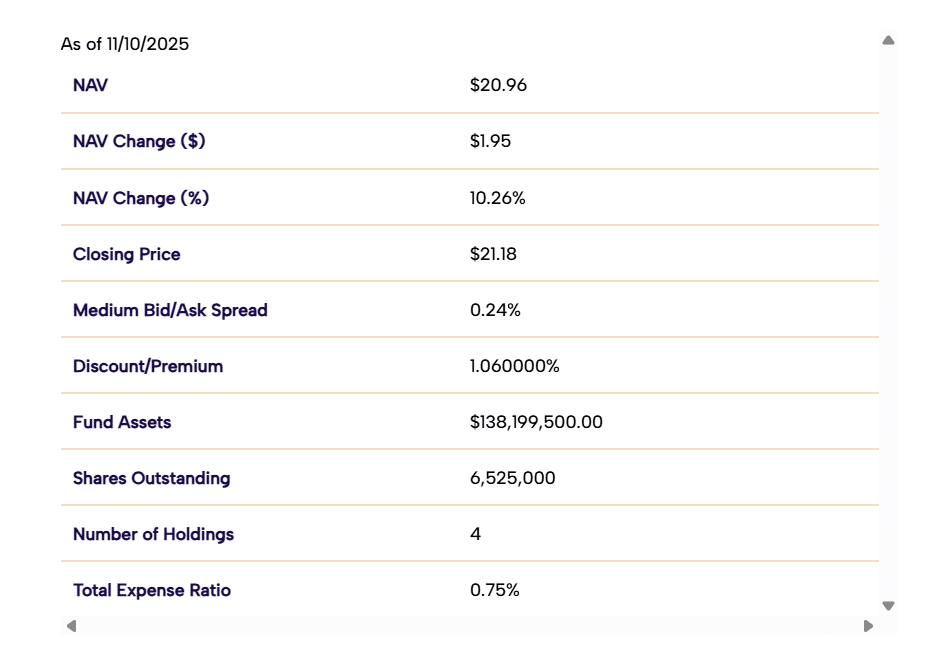
XRPR now has over $138 million in AUM (Source: Rex Shares)
Canary’s spot ETF would give both institutional and retail investors access to XRP’s price performance without requiring direct token custody.
That structure mitigates key risks associated with digital asset storage and exchange reliability—two major barriers for traditional investors entering the crypto market.
For Canary, the XRP ETF marks a strategic expansion following its involvement in other altcoin ETF launches. The firm’s use of the same auto-effective process for its Solana, Litecoin, and Hedera ETFs has demonstrated an efficient path for bringing compliant crypto funds to market.
Broader Implications for the Crypto ETF Landscape
The imminent launch of a spot XRP ETF shows how quickly the U.S. crypto ETF landscape is evolving. What began with Bitcoin futures funds has now extended to multiple altcoin products, challenging the idea that institutional demand is confined to the two largest digital assets.
If approved, Canary’s fund could accelerate the institutionalization of XRP by embedding it within a regulated investment structure familiar to Wall Street. The move would also solidify the narrative that digital assets are entering a new phase of legitimacy and integration into mainstream finance.
However, analysts caution that price reactions may be muted in the short term.
Much of the optimism surrounding the ETF’s launch may already be reflected in XRP’s market valuation. Nonetheless, the broader market implications—greater accessibility, liquidity, and investor diversity—could prove more meaningful in the long run.
The Road Ahead
While Nasdaq’s approval remains the final procedural step, the convergence of recent ETF launches and regulatory momentum suggests that the market environment is increasingly favorable for altcoin investment vehicles.
Should the XRP ETF begin trading on Nov. 13 as anticipated, it would mark a watershed moment—cementing XRP’s transition from a litigated token to a mainstream financial instrument.
For Canary Capital, the launch would position the firm at the forefront of a new wave of crypto ETFs reshaping investor access to digital assets. For XRP, it could represent its most significant step yet toward integration with traditional markets.


