
NEAR Price Wobbles Beneath $3 as Traders Await a Directional Breakout
For traders watching NEAR, the current setup demands patience, structure, and a respect for risk.
After rallying from below $2.00 to just under $3.00, NEAR has entered a consolidation phase that reflects hesitation among both bulls and bears. While the short-term trend still leans upward, momentum is fading — creating a mixed environment where aggressive trading can easily turn into capital erosion.
NEAR’s daily chart tells a story of strong recovery followed by fatigue. The short-term uptrend, supported by the 9-day EMA sitting above the 20-day EMA, is still technically intact. However, the shrinking gap between these moving averages indicates a cooling phase where buyers are losing momentum.
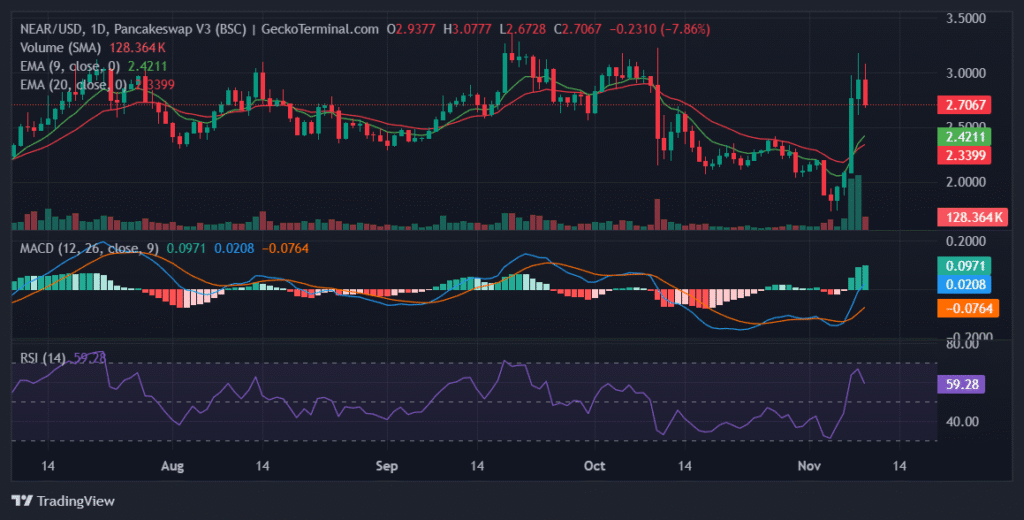
Daily chart for NEAR/USD (Source: GeckoTerminal)
Meanwhile, the MACD recently flipped into positive territory, signaling that the prior downtrend has weakened. But the histogram’s gradual flattening shows that bullish momentum is slowing. The RSI, after peaking near overbought levels, has drifted back toward neutral — evidence that traders are rotating from momentum buying to range trading.
This combination points to consolidation, not collapse. The market is digesting its gains, preparing for a decisive next leg.
For traders, that’s the moment to trade setups — not breakouts — until confirmation arrives.
Also read: Crypto Trading Psychology: Overcoming FOMO, Fear, and Loss Aversion
NEAR Levels to Watch
- Immediate Resistance: $2.79 → $2.87 → $2.99
- Immediate Support: $2.69 → $2.63 → $2.62
A break above $2.99 would mark the first sign of renewed strength, while a sustained close below $2.60 would confirm short-term weakness. Between these zones lies a tight range ripe for structured trading, but also one where impatience often leads to losses.
The NEAR order book offers valuable context on where capital is concentrated:
- Bid Wall at $2.50: 59,914 NEAR (~$149,784) — a crucial liquidity cushion.
- Deeper Bids at $1.90 & $1.80: over 130,000 NEAR combined, representing long-term accumulation zones but warning of heavy drawdowns if tested.
- Ask Walls at $3.20, $3.30 & $3.50: totaling over 345,000 NEAR (~$1.1 million), forming thick resistance layers.
What this means for traders: downside liquidity is supportive in the short term, but upside movement will struggle without significant volume or catalysts. A break above $3.20 could trigger an 18–30% rally, while a loss of the $2.50 bid wall could send the price tumbling toward $2.00.
This liquidity distribution confirms a range-bound equilibrium — strong defense below, heavy resistance above. Traders who respect this balance can profit from volatility without exposing themselves to unnecessary risk.
Also read: Exploring TradeGPT: Revolutionizing Trading Strategies
Long Strategy: Scaling into Strength, Not Hope
For bullish traders, the best approach is to scale in close to support zones and add confirmation-based exposure only after key resistance breaks.
- Entry Zone: $2.63–$2.70, where historical support meets EMA alignment.
- Stop Placement: Below $2.50, allowing for market noise but protecting against structural breakdown.
- Add-on Trigger: A daily close above $2.99 with volume — confirming a breakout from consolidation.
- Profit Targets: Partial take profit at $3.20 (first major ask wall), with extended targets near $3.50 if momentum sustains.
- Risk Management: Move stops to breakeven once price gains 6–8%, securing capital while allowing upside to unfold.
This method suits traders with moderate risk tolerance who prioritize confirmation over prediction. It’s less about catching the bottom and more about entering when the odds align — a hallmark of professional trading.
Also read: Best Laptop for Crypto Trading: Top Choices for Fast & Efficient Trading
Short Strategy: Precision Over Prediction
Bearish setups are valid but require confirmation and discipline. Shorting a market still above key EMAs without breakdown signals is speculative. Instead, the focus should be on confirmed weakness and failed retests.
- Trigger: A daily close below $2.60 with expanding volume.
- Entry Range: $2.58–$2.50, once support turns into resistance.
- Stops: Above $2.70 to minimize exposure against potential fakeouts.
- Targets: $2.10 initially, extending to $1.90 if sell pressure intensifies.
This setup offers a high risk-reward potential only once support fails decisively. Until then, shorting preemptively carries more emotional than technical justification.
Neutral and Risk-Averse Strategy: Range Trading and Patience
For traders prioritizing capital protection, the best move may be to treat NEAR as a range-trading instrument until it proves directionality.
- Buy Near Support: Accumulate light positions around $2.63–$2.70.
- Sell Near Resistance: Take profit around $2.87–$2.97.
- Position Sizing: Limit exposure to 20–25% of trading capital.
- Leverage: Keep to 1–2x maximum or trade spot only.
This approach caters to risk-averse traders who value consistency over velocity. Range-bound markets reward those who fade emotional extremes — buying fear near support and selling greed near resistance.
Multi-Profile Execution Plan
To adapt across different trading temperaments, here’s a quick framework:
- Aggressive Traders: Look for breakouts above $3.00 or breakdowns below $2.60 with confirmation. Scale quickly and trail stops aggressively.
- Moderate Traders: Trade the $2.60–$2.90 range with defined stops and partial profits. Add exposure only after confirmation.
- Conservative Traders: Avoid leverage. Focus on accumulation near strong bids or long-term entries below $2.50. Protect capital first, profit second.
Final Thoughts: Trade the Reaction, Not the Prediction
NEAR’s chart shows balance — neither full bullish conviction nor outright weakness.
The market is recalibrating after a rally, and liquidity patterns suggest that both sides have strong defenses. In such conditions, traders should avoid guessing the next big move and instead react to what the market confirms.
Also read: Essential Strategies for Day Trading Crypto
An approach here would be methodical: buy dips into liquidity, sell into resistance, and stay flat during noise. Trading is not about being right — it’s about staying solvent long enough to capitalize when the odds finally turn in your favor.
Until NEAR either breaks above $3.00 with conviction or loses $2.50 support, this remains a trader’s market — not an investor’s. Patience, position control, and emotional neutrality will outperform any bold prediction.
Join the Ecoinimist Telegram Group
Want to stay ahead of the next big move in Zcash and other top crypto pairs?
Join the free Ecoinimist Telegram Group to get real-time alerts whenever key technical events trigger — including EMA crossovers, RSI shifts, and breakout confirmations.
You’ll receive concise, data-driven updates straight to your phone — helping you act fast while managing risk effectively.
Join here on Telegram to never miss a crucial signal.
Disclaimer: The information presented in this article is for informational and educational purposes only. It does not constitute financial advice. Ecoinimist is not responsible for any losses incurred. Readers should exercise caution before acting on this content.


