
After the Crash, Crypto VCs Hunt for ‘Real Revenue’ and Long-Term Growth
Despite an October wipeout that erased $500 billion from the crypto market, venture capitalists remain undeterred — and in fact, are preparing to double down.
According to Ajna Capital’s Chief Investment Officer, Eva Oberholzer, the selloff has sparked a shift in investor priorities rather than a retreat from the industry.
Investors Seek Fundamentals Over Hype
Oberholzer said that crypto venture capital is entering a new phase where teams with solid revenue models and prudent risk management will rise above speculative projects.
Investors are now shopping for “real revenue, unit economics, and risk controls across treasury, counterparty, and leverage,” she said.
Also read: Crypto VCs Tighten the Belt: No More 80x Revenue Dreams
The October downturn, she explained, triggered a bout of “diligence mode” among funds, forcing investors to closely examine project fundamentals before committing capital. Still, Oberholzer said that high-quality startups — particularly those in blockchain infrastructure and real-world asset tokenization — continue to attract strong interest.
“Base case is a quieter Q4 as diligence bites, then a gradual pickup if markets stabilize,” she added. “Real-money allocators typically act after a reset and two stable quarters, pointing to late Q4 2025 into Q1 2026 for larger allocations.”
$22 Billion in Crypto Funding Despite Market Turmoil
Even with market volatility, the pace of fundraising across the crypto sector has been remarkable. According to data from DeFiLlama, crypto companies raised over $728.5 million in just the first week of November.
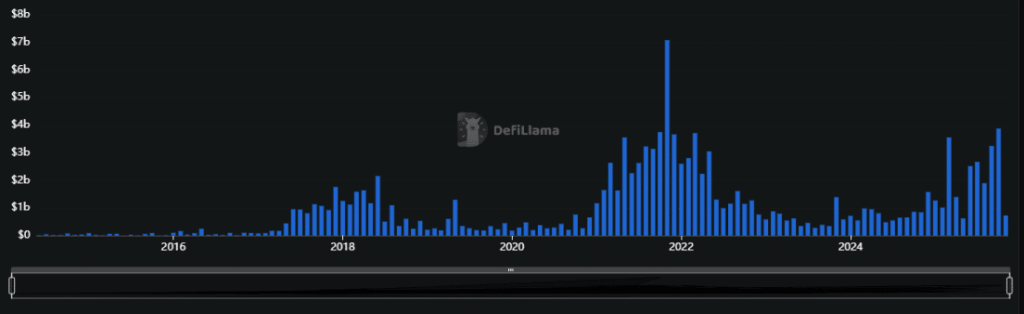
Total raised by crypto companies (Source: DefiLlama)
That brings total funding for crypto startups to $22 billion so far in 2025, double the total raised throughout 2024. Major investors including Codebase Ventures and Galaxy Ventures expect the year-end figure to reach around $25 billion, cementing 2025 as one of the most active funding years in the industry’s history.
Analysts say this sustained capital inflow reflects growing confidence that regulatory progress in the United States will stabilize the market heading into 2026.
Policy Wins Fueling Long-Term Optimism
A series of legislative and political developments has buoyed investor sentiment toward crypto. Pro-industry figures in government, new executive orders supporting digital assets, the passage of a landmark stablecoin law, and an upcoming markets bill have all contributed to renewed optimism.
Adding to that, President Donald Trump’s continued backing of the crypto industry has strengthened the perception that the U.S. regulatory landscape is turning friendlier to digital assets.
Oberholzer said these factors are setting the stage for a “funding resurgence” by mid-2026, with more institutional commitments to crypto-native managers, direct protocol participation, and community engagement expected to accelerate over the next 18 months.
Ripple’s $500 Million Raise Leads the Pack
Among the standout deals in November is Ripple Labs’ $500 million strategic funding round, announced on Nov. 5. The raise, Ripple’s largest since 2019, tripled its valuation to $40 billion.
The round drew heavyweight backers including Citadel Securities, Fortress Investment Group, Pantera Capital, Galaxy Digital, Brevan Howard, and Marshall Wace. Ripple said the funding would help it deepen relationships with financial institutions and expand into new business lines.
The company, founded in 2012, built its foundation on cross-border blockchain payments using the XRP Ledger. However, Ripple has recently pivoted toward broader financial infrastructure. Over the past year, it has acquired GTreasury for $1 billion and non-bank prime broker Hidden Road for $1.25 billion, moves aimed at strengthening its institutional finance and treasury capabilities.
With its latest capital infusion, Ripple is now positioning itself to compete with established players like Circle, Stripe, and Western Union, as global finance moves toward stablecoin-based payment rails.
Canaan and Future Holdings Secure Strategic Backing
Canaan Inc., a Nasdaq-listed crypto mining and high-performance computing company, announced a $72 million strategic equity investment on Nov. 4. The round was backed by Brevan Howard’s BH Digital, Galaxy Digital, and Weiss Asset Management.
The deal involved a direct purchase of 63.7 million American depositary shares at $1.13 each, with no warrants or derivatives. Canaan CEO Nangeng Zhang described it as a “straightforward equity deal” that aligns the company with fundamentals-driven investors and strengthens its commitment to the Bitcoin ecosystem through every market cycle.
Meanwhile, Future Holdings, a Swiss-based Bitcoin treasury company, raised $34 million in strategic funding to build what it calls “Europe’s premier Bitcoin treasury company.” Backed by Fulgur Ventures, Nakamoto, and TOBAM, the firm’s model revolves around offering treasury management, custody, and advisory services to institutions seeking Bitcoin exposure under Switzerland’s regulated framework.
The company’s mission is to connect Bitcoin with global capital markets via a compliant, institutional-grade platform — a signal of Europe’s deepening appetite for Bitcoin-native financial infrastructure.
Eyes on 2026 for the Next Wave
While 2025 has proven to be a surprisingly strong year for crypto fundraising, most analysts agree that the next major growth phase is likely to begin in 2026.
Oberholzer’s timeline — late Q4 2025 through Q1 2026 — coincides with expectations that macroeconomic stability and regulatory clarity will reignite large-scale institutional allocations. The emphasis, she says, will remain on disciplined investment rather than speculation.
In the aftermath of the October correction, that discipline may prove to be crypto’s greatest asset. As Oberholzer put it, the market’s reset has given investors a reason to look past short-term volatility and focus on what truly matters: “real revenue, real value, and real risk management.”


