
American Bitcoin Expands Treasury to 4,004 BTC in Aggressive Accumulation Push
American Bitcoin (NASDAQ: ABTC), the Bitcoin treasury and mining company backed by Eric Trump and Donald Trump Jr., has ramped up its accumulation strategy, bringing its total Bitcoin holdings to 4,004 BTC, worth approximately $415 million as of Friday.
The announcement is part of the company’s growing ambitions to position itself among the largest corporate holders of Bitcoin amid renewed optimism in the broader crypto market.
The company disclosed that between Oct. 24 and Nov. 5, it purchased an additional 139 BTC, now valued at over $14 million, as part of its dual-pronged approach to increase exposure to the world’s leading cryptocurrency. The latest addition cements American Bitcoin’s position as the 25th largest corporate Bitcoin treasury, according to data from Bitcoin Treasuries.
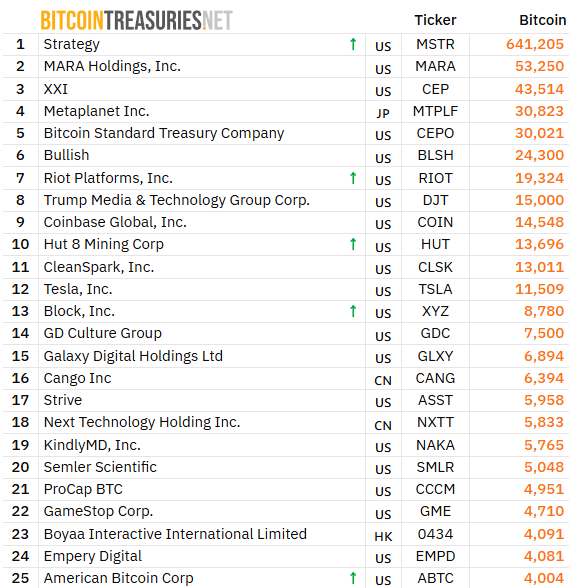
Top 25-largest corporate BTC holders (Source: Bitcoin Treasuries)
“We continue to expand our Bitcoin holdings rapidly and cost-effectively through a dual strategy that integrates scaled Bitcoin mining operations with disciplined at-market purchases,” said Eric Trump, American Bitcoin’s co-founder and Chief Strategy Officer.
Shares of American Bitcoin rose over 2% on Friday afternoon in New York trading, rebounding after dipping earlier in the session.
The stock has attracted attention since the company’s September Nasdaq debut, as investors track the Trump-backed venture’s attempt to blend Bitcoin mining with treasury management.
Bitcoin Market Recovery Fuels Corporate Accumulation
Bitcoin itself was trading near $103,369 at press time, up 3% in 24 hours, as crypto markets bounced following a turbulent October that saw over $500 billion in market capitalization wiped out. Still, the asset remains roughly 18% below its early October peak of $126,000.
The broader market recovery has reignited interest among publicly traded firms looking to mirror the playbook of Strategy (formerly MicroStrategy)—the company that pioneered the corporate Bitcoin treasury model. Strategy currently holds 641,000 BTC, worth over $66 billion, after first shifting its business model toward Bitcoin accumulation in 2020 under co-founder Michael Saylor.
Strategy’s pivot away from enterprise software toward Bitcoin investment was a defining moment for corporate adoption of digital assets. According to a prediction market on Myriad, 95% of participants do not expect Strategy to sell any of its Bitcoin holdings before the end of 2025, reflecting widespread confidence in long-term Bitcoin accumulation as a viable business strategy.
American Bitcoin appears to be following a similar trajectory—albeit with a focus on vertical integration through mining. By combining direct Bitcoin purchases with mining operations, the company aims to reduce acquisition costs while maintaining exposure to price appreciation.
A Complex Lineage of Mergers
American Bitcoin’s corporate lineage is as complex as its ambitions. The firm emerged earlier this year when the Trump brothers merged their business venture with Canadian Bitcoin miner Hut 8, a move that set the stage for a larger consolidation in the digital infrastructure space. The merged entity then combined with Gryphon Digital Mining, another North American miner, through a stock-for-stock merger. Gryphon was already publicly traded, which helped the new entity gain quick access to public markets.
The mergers positioned American Bitcoin as a vertically integrated operation spanning mining, treasury management, and energy efficiency—critical factors in a post-halving environment where profitability hinges on operational excellence.
The company’s leadership has emphasized the importance of “disciplined expansion,” seeking to balance energy costs, capital efficiency, and exposure to Bitcoin’s price cycles.
Mining Sector Adapts to Post-Halving Pressures
The mining industry, however, faces mounting challenges. The April 2024 Bitcoin halving event reduced the block reward for miners from 6.25 BTC to 3.125 BTC, cutting new Bitcoin issuance in half and tightening margins across the sector.
Mining firms—traditionally operating massive data centers filled with specialized computers that validate blockchain transactions—have been forced to innovate or diversify as profitability declines. Some, like Core Scientific and Marathon Digital, have ramped up energy efficiency and renewable power use, while others, including Riot Platforms, have leveraged their infrastructure for high-performance computing (HPC) in the rapidly expanding artificial intelligence (AI) sector.
Benchmark analysts recently raised their price target for Hut 8, one of American Bitcoin’s merger partners, noting that its growing energy capacity could help offset post-halving revenue declines. The shift toward HPC and AI computing has become a survival strategy for many miners as Bitcoin mining alone becomes less profitable.
Trump-Linked Bitcoin Venture Enters a Competitive Arena
American Bitcoin’s emergence in this environment is notable not only for its high-profile backers but also for its timing. The firm’s decision to go public shortly after the halving demonstrates a long-term bet on Bitcoin’s scarcity dynamics and the potential for corporate treasuries to act as a new demand driver.
Eric Trump, who has taken a prominent public role in promoting the venture, has framed Bitcoin as both an investment and a hedge against inflationary fiscal policy. The Trump family’s involvement, though controversial to some investors, has undeniably amplified attention around the firm and its potential political symbolism.
While American Bitcoin’s 4,004 BTC holding remains small compared to Strategy’s enormous cache, its accumulation pace suggests it is positioning itself as a serious player among corporate holders of digital assets. As the company continues to integrate mining and treasury functions, it may serve as a case study for how hybrid Bitcoin corporations navigate the challenges of market volatility and operational scaling.
The Next Corporate Bitcoin Wave
The continued expansion of corporate Bitcoin treasuries signals that institutional adoption of digital assets has entered a more mature phase. What began as a niche strategy during the early pandemic years—when interest rates were near zero and Bitcoin traded under $15,000—has evolved into a strategic asset management approach embraced by firms in diverse industries.
More than 200 publicly traded companies now hold Bitcoin on their balance sheets, ranging from miners and fintech firms to manufacturing and software companies. For many, the move is not merely speculative but reflects a conviction that Bitcoin functions as a long-term treasury reserve asset with asymmetric upside potential.


