
Nations Are Quietly Building Their Financial Futures on Blockchain: Sign CEO Xin Yan
Sign co-founder and CEO Xin Yan says blockchain technology is shifting from crypto-native experiments to powering national financial and identity systems across the developing world.
In a recent interview with Ecoinimist, Yan described how the company is helping governments digitize their monetary and civic infrastructures using blockchain.
From Token Launches to National Infrastructure
Founded as a blockchain application company, Sign originally built on-chain verification and token distribution tools.
Yan said that Sign eventually recognized the need to expand beyond the insular world of Web3 startups amid slow crypto industry growth and adoption.
“Based on our data, the growth of the whole industry is actually very slow,†Yan explained. “If we kept doing the same thing, we were going to starve to death. So we decided to build a bridge between crypto and the real world.â€
That bridge, as it turns out, now runs straight through the halls of government. Sign’s current focus is on helping nations digitize their financial systems, from tokenizing fiat currencies to launching wholesale central bank digital currencies (CBDCs) and stablecoins backed by tangible assets.
Yan cited Kyrgyzstan as a prime example, where Sign assisted in developing the USDKG stablecoin and a wholesale CBDC system connecting the central bank and commercial banks.
The company has also been involved in similar projects in Abu Dhabi, Thailand, South Korea, Sierra Leone, and “many other countries,†with each deployment designed to create blockchain-based systems that retain government oversight while improving efficiency.
Trump’s Crypto Catalyst
Yan attributes part of the global acceleration in government-led blockchain initiatives to an unlikely source—Donald Trump’s embrace of the crypto space.
“When Trump launched his coin, everything changed,†he said. “Governments started to explore what could be done.†Suddenly, everyone had an example to point to, Yan added.
In Yan’s view, Trump’s embrace of crypto gave bureaucrats cover to act.
“Regulators are inherently risk-averse,†he noted. “As long as no one else is doing it, they don’t want to be the first. But when the U.S. does something, it becomes a reference point—they can say, ‘If they’re doing it, we can too.’â€
That shift, he said, has transformed blockchain from a rebellious financial experiment into a pragmatic tool of modernization.
Balancing Decentralization and Control
While Yan and his team were initially drawn to the ideals of decentralization, they have since taken a more nuanced view.
“We realized it’s not about decentralizing everything,†he said.
“We want to build blockchain technology solutions that firstly benefit people, and that are actually facilitating things†while still ensuring that the solutions comply with the laws and the company addresses governments’ concerns, Yan added.
That philosophy underpins Sign’s design principles. The systems it builds allow for privacy-preserving transactions, but also retain the ability for authorities to freeze accounts or exercise oversight—features governments consider essential for stability and compliance.
Bitcoin’s Role: “Digital Gold†on National Balance Sheets
Yan believes that Bitcoin will not serve as a transactional currency in this emerging digital order, but as a global store of value.
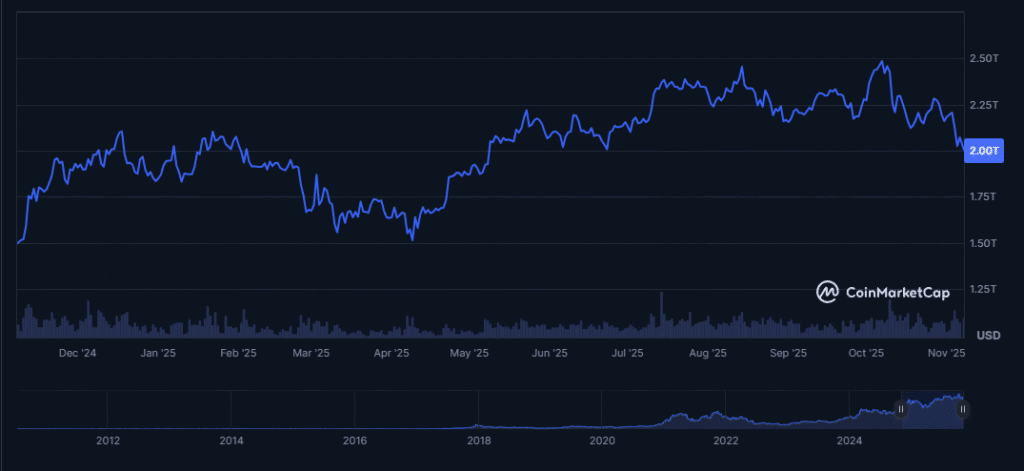
Bitcoin market cap (Source: CoinMarketCap)
“It’s digital gold,†he said. “Many countries, including Kyrgyzstan and others, already include Bitcoin in their national treasuries. It will gradually slide into government balance sheets as a hedge against U.S. dollar risk.â€
He also pointed to the broader trend of de-dollarization, where nations seek to reduce dependence on the greenback by creating their own digital currencies and payment networks. “Stablecoins and CBDCs give countries tools to manage capital flows and resist dollarization,†he explained.
A New Global Payment System
According to Yan, the world is already halfway toward mainstream Bitcoin adoption—not through retail speculation, but institutional integration.
“Governments are buying it, banks are offering it, and companies are holding it,†he said. But the real transformation, he added, lies in the creation of a new global payment system powered by interoperable stablecoins and digital fiat currencies.
He predicted that banks will be the biggest casualties of this shift: “They’re too slow and inefficient. The future belongs to digital currencies—USD, local stablecoins, and even tokens like BNB or Sign’s own, which can function as assets within national treasuries.â€
As Yan wrapped up the interview, he hinted at more government partnerships to come. “We’re signing an MOU every month,†he said. “Things are moving very fast.â€


