
Canada Unveils Bold Stablecoin Regulations in 2025 Budget
Canada’s 2025 federal budget has unveiled a landmark plan to regulate fiat-pegged stablecoins, signaling a major step toward establishing a clear framework for digital money in the country. The move aims to balance innovation with stability as the use of digital assets grows among consumers and businesses.
The federal budget document confirms that upcoming legislation will require stablecoin issuers to maintain adequate reserves, implement redemption policies, develop risk management frameworks, and ensure the protection of personal information.
“The legislation will also include national security safeguards to support the integrity of the framework so that fiat-backed stablecoins are safe and secure for consumers and businesses to use,†the document states.
How Canada Plans to Regulate Stablecoins
The new legislation, detailed in the 2025 budget, outlines a comprehensive approach to stablecoin oversight. At its core, the framework will ensure that issuers of fiat-backed tokens are held to similar standards as traditional financial institutions when it comes to protecting user funds and maintaining transparency.
The Bank of Canada will play a central role in implementing and administering the rules. According to the budget, the central bank will retain $10 million from its Consolidated Revenue Fund remittances over two years beginning in 2026-27 to manage the new framework.
After that initial period, annual administrative costs of around $5 million will be covered through fees imposed on regulated stablecoin issuers.
Expanding Regulation to Payment Providers
In addition to stablecoin issuers, the Canadian government plans to amend the Retail Payment Activities Act. These amendments will extend regulatory coverage to payment service providers that utilize stablecoins, ensuring that every part of the digital payment ecosystem operates under consistent oversight.
The government says the goal of these measures is to “promote safe innovation of digital assets†while protecting Canadians from potential risks associated with unregulated digital currencies.
A Coordinated Effort Behind the Scenes
The push toward formal regulation has been months in the making. Bloomberg recently reported that officials from the Department of Finance Canada and other agencies have engaged in intensive consultations with regulators and industry stakeholders to shape the new framework.
Those discussions reportedly focused on two critical issues: how to classify stablecoins and how to prevent capital flight to U.S. dollar-backed tokens, which dominate the global market.
However, the budget paper stopped short of revealing the government’s conclusions on those points, suggesting that final decisions are still under consideration.
Global Context: Canada Joins the Stablecoin Regulation Movement
Canada’s announcement places it among a growing list of countries introducing regulatory frameworks for stablecoins. The move follows the United States’ GENIUS Stablecoin Act, passed in July 2025 with strong backing from President Donald Trump.
That U.S. law established comprehensive rules for dollar-backed cryptocurrencies, sparking a wave of similar initiatives worldwide. In Europe, the Markets in Crypto-Assets Regulation (MiCA) has already been implemented, while Japan and South Korea are finalizing their own stablecoin oversight systems.
By aligning with these global efforts, Canada aims to ensure that its digital-asset environment remains competitive and safe for both domestic and international players.
Why Stablecoin Regulation Matters
Stablecoins—digital tokens designed to maintain a 1:1 peg with fiat currencies—are increasingly viewed as the bridge between traditional finance and the emerging digital economy.
As of November 4, the total global stablecoin supply stood at over $300 billion, data from DefiLlama shows. The sector remains dominated by U.S. dollar-based tokens, reflecting global demand for stable, liquid digital assets.
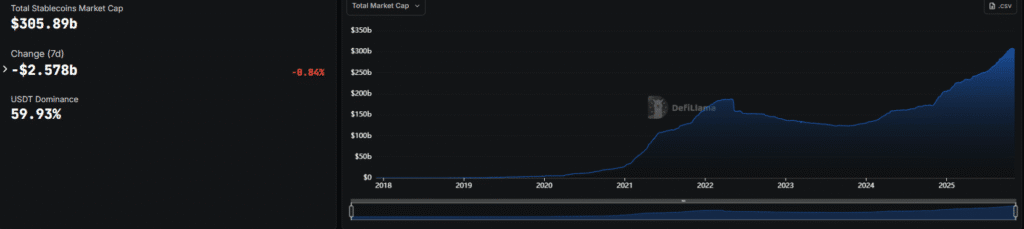
Stablecoin market overview (Source: DefiLlama)
Financial institutions have also begun to warn that the rise of stablecoins could reshape banking dynamics. According to estimates by Standard Chartered, as much as $1 trillion could flow out of emerging market bank deposits into U.S. stablecoins by 2028—a trend that underscores the growing importance of regulation in preventing instability.
Looking Ahead: What It Means for Canadians
The upcoming legislation marks a pivotal moment for Canada’s digital-asset ecosystem. By setting clear standards for reserve management, redemption rights, and risk governance, the government hopes to build public trust in stablecoins and encourage responsible innovation.
While details of classification and enforcement remain to be seen, the direction is clear: Canada intends to create a safe, regulated environment where stablecoins can function as reliable instruments of payment and value storage.
As the world transitions toward digital finance, Canada’s approach could set a precedent for other nations balancing technological advancement with consumer protection.


