Ripple Makes Power Moves With Palisade Acquisition, Ripple Prime Launch
Ripple is rapidly evolving into a full-fledged institutional powerhouse.
The blockchain firm announced the acquisition of crypto wallet provider Palisade alongside the official launch of its U.S. spot prime brokerage service, Ripple Prime, marking a major leap in its mission to build a crypto-native financial ecosystem for banks, corporates, and fintechs.
Ripple Prime Broadens Institutional Market Access
The company’s launch of Ripple Prime introduces a regulated platform that enables U.S. institutional clients to execute over-the-counter (OTC) spot trades in leading digital assets, including XRP and its U.S. dollar-pegged stablecoin RLUSD.Â
The service, which stems from the company’s recent $1.25 billion acquisition of multi-asset brokerage Hidden Road, now offers advanced cross-margining and financing features typically unavailable in traditional crypto brokerages.
The new platform allows for large off-exchange transactions with reduced market impact, multi-asset margining, and compliance-focused infrastructure that meets stringent U.S. regulatory standards.
Ripple Prime is now positioning itself as a direct competitor to Coinbase Prime and Anchorage, expanding the company’s institutional footprint beyond payments and custody.
Palisade Adds Technical Depth to Ripple Custody
Ripple’s acquisition of Palisade brings wallet-as-a-service capabilities to Ripple Custody, its institutional-grade storage platform designed for digital assets, stablecoins, and tokenized real-world assets.
Palisade’s technology supports multi-chain functionality, high-frequency wallet creation, and DeFi protocol integration, enabling secure, scalable infrastructure for enterprises and financial institutions.
The deal enhances Ripple’s capacity to serve fast-moving clients such as fintechs and corporates managing global treasury operations. It also strengthens Ripple’s bid to become the backbone of institutional blockchain infrastructure, offering custody, payments, brokerage, and liquidity solutions under one ecosystem.
Ripple President Monica Long said the company’s expansion aligns with a broader strategy to equip institutions with end-to-end tools for digital asset management.Â
“Palisade offered the best set of capabilities to complement what we have built with Ripple Payments, which has been growing tremendously this year with stablecoin payment proliferation,†she said.
The company now holds over 75 regulatory licenses worldwide, supporting clients including BBVA, DBS, and Societe Generale’s crypto division—a clear signal that its global compliance framework remains a cornerstone of its strategy.
RLUSD Hits $1 Billion Market Cap
Adding momentum to the firm’s institutional expansion, its stablecoin RLUSD has surpassed $1 billion in market capitalization, according to CoinGecko data. The milestone reflects growing adoption among liquidity providers and regulated entities seeking stable, on-chain settlement tools.
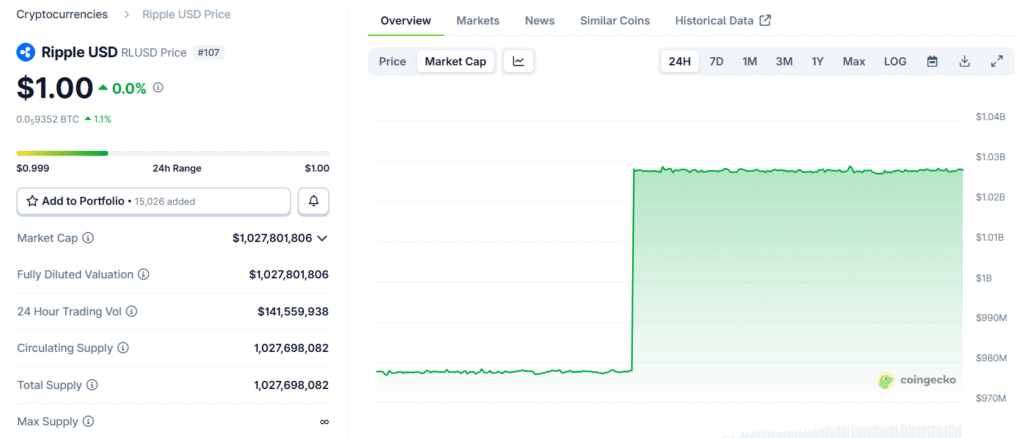
RLUSD market cap (Source: CoinGecko)
Integrating RLUSD within Ripple Prime opens the door for new institutional use cases, including collateralized lending, cross-border settlements, and DeFi-based financial instruments. Analysts suggest that the company’s deepening focus on stablecoin and prime brokerage services marks a turning point in the evolution of its ecosystem.
Institutional Growth and XRP’s Role
However, Ripple’s rapid institutional pivot raises questions about the long-term utility of XRP within its expanding ecosystem as Ripple’s acquisitions of Hidden Road, GTreasury, and now Palisade could gradually reduce XRP’s operational role in favor of broader fintech applications.
While the company continues to emphasize XRP as a global bridge currency, its growing reliance on XRP-linked funding and periodic token sales may redefine the token’s market role. Balancing its institutional ambitions with the token’s original utility will be critical to maintaining XRP’s relevance in the evolving crypto-financial landscape.
A Unified Institutional Vision
Between the launch of Ripple Prime and the integration of Palisade, the firm is methodically building a vertically integrated, institutional-grade crypto infrastructure—covering everything from liquidity to custody, payments, and stablecoin issuance.
The convergence of these efforts shows the company’s transformation from a cross-border payments provider into a comprehensive blockchain financial network, designed to connect the worlds of traditional finance and digital assets.


