
Bitcoin Hits Record Hashrate as Miners Feel the Heat and Prices Hold Above $100K
The Bitcoin network reached an all-time high in computational strength last month, with its average hashrate climbing 5% to 1,082 exahashes per second (EH/s), according to a new JPMorgan report.
The surge reflects growing competition among miners and a new phase of industrial-scale participation in securing the world’s largest blockchain.
Analysts at the bank noted that Bitcoin’s mining difficulty — the algorithm that adjusts to maintain block times — rose 3% from September and stands 80% higher than levels seen before April 2024’s halving.
That event cut the block reward in half, squeezing profits across the mining industry.
Bitcoin Miners Face Profit Pressure Despite Record Network Strength
While the record hashrate underlines Bitcoin’s resilience, JPMorgan’s data also show that mining economics continued to tighten for the third month in a row.
The analysts estimated that miners earned an average of $48,000 per EH/s in daily block rewards during October, 3% less than in September, while gross profit fell 4%.
Market-Cap Gains Led by AI Pivot
Despite the revenue dip, U.S.-listed Bitcoin mining companies saw substantial market-cap gains.
The combined valuation of the 14 miners tracked by JPMorgan rose 25% to $70 billion in October, buoyed by excitement around high-performance computing (HPC) ventures and the sector’s pivot toward AI.
Cipher Mining (CIFR) led the pack with a 48% monthly gain, while Cango Mining (CANG) lagged behind with a 5% drop — the only major miner to underperform Bitcoin itself, which slipped 3.9% in the same period.
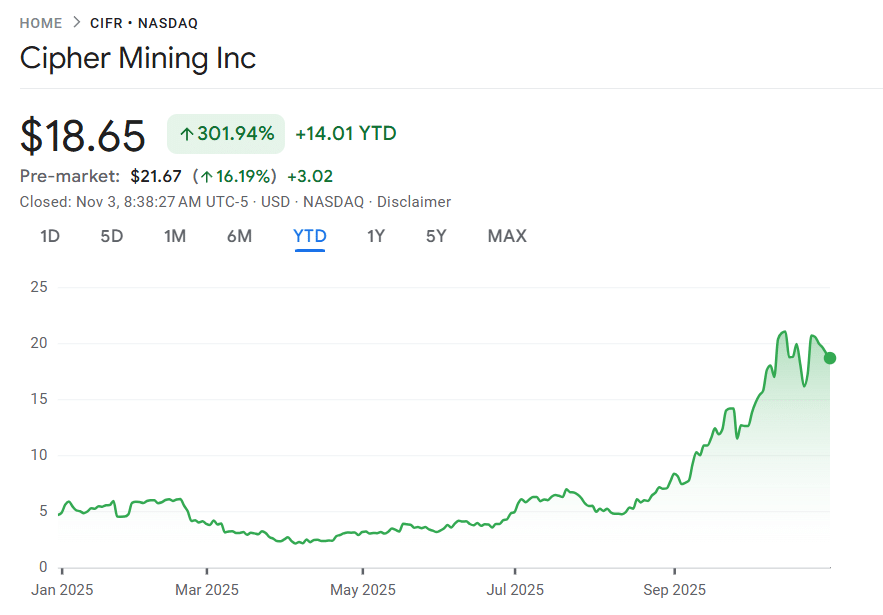
Cipher Mining share price (Source: Google Finance)
Bitcoin Price Holds Above $100,000 Amid Macro Headwinds
According to Nic Puckrin, crypto analyst and co-founder of The Coin Bureau, October wasn’t just a pivotal month for mining — it was a reality check for investors hoping for the usual end-of-year rally.
“October is over, and what a disappointment it was for crypto investors expecting the customary rally,” said Puckrin. “Bitcoin closed October some 3% lower, marking only the third time in its history – 2014 and 2018 – that it didn’t rally during this month.”

Bitcoin’s historical performance (Source: CoinGlass)
He noted that historically, both outcomes have followed. “In 2014, this unexpected down month was followed by a 12.8% rally in November, but 2018 saw a further slide of 36% the month after. So it could still go either way.”
Still, Puckrin remains optimistic that the correction is temporary.
“The market absorbed 405 BTC worth of selling pressure from legacy holders in October – yet the price still held above $100,000,” he said. “It hasn’t dipped below $100k since May 2025. If that’s not a sign of resilience, I don’t know what is.”
Puckrin pointed to lingering macroeconomic uncertainty — including the unresolved U.S. government shutdown and declining odds of a December rate hike — as reasons for short-term volatility.
“This will, no doubt, continue to weigh on sentiment, so we’re in for a choppy November,” he explained. “Eventually, however, the selling will stop. And when it does, the fundamentals remain the same: QT is coming to an end, liquidity is beginning to flow, and global currencies are facing further devaluation. The case for Bitcoin is intact – the selling is just short-term noise.”
Outlook: Strong Fundamentals Beneath the Volatility
Between the record-breaking network strength and the persistent resilience above the $100,000 threshold, Bitcoin’s fundamentals appear robust even as miners and investors face short-term strain.
As competition intensifies and the macro landscape evolves, the coming months may test miners’ efficiency and investors’ patience — but as both JPMorgan’s data and Puckrin’s commentary suggest, the long-term case for Bitcoin remains firmly in place.


