
Core Scientific Shareholders Block $9B AI Merger with CoreWeave
Bitcoin mining giant Core Scientific has scrapped its proposed $9 billion all-stock merger with AI computing firm CoreWeave, after shareholders voted against the deal on Thursday. The decision halts what could have been one of the largest combinations between a crypto mining company and an artificial intelligence infrastructure provider in recent years.
Core Scientific confirmed the vote’s outcome in a Friday announcement, stating that “the Company did not receive the requisite number of votes to approve the previously announced merger agreement with CoreWeave.†Shares of CoreWeave, which focuses on AI cloud computing, fell over 6% following the news, while Core Scientific’s stock edged up by 0.3%.
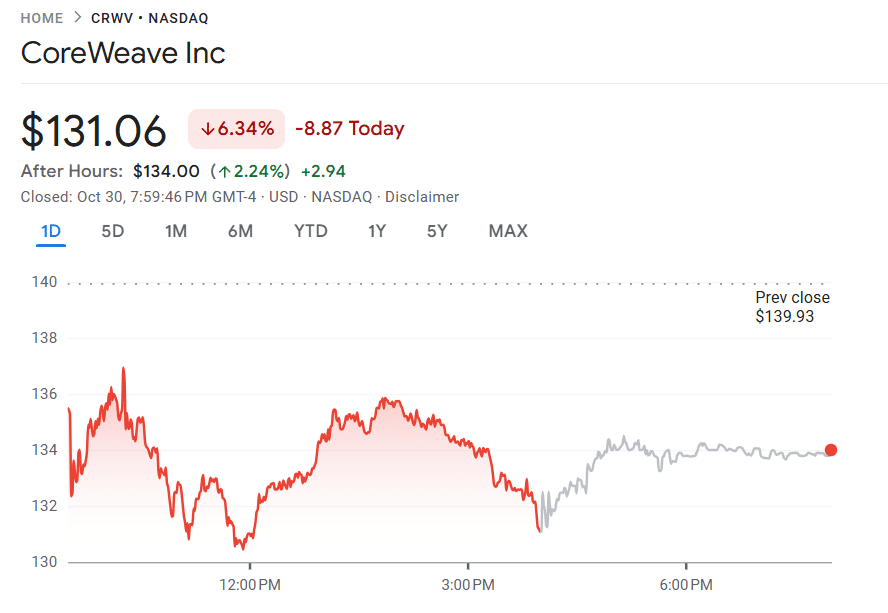
CoreWeave share price (Source: Google Finance)
A Merger That Could Have Redefined Digital Infrastructure
The proposed deal, first unveiled in July, would have given CoreWeave control of 1.3 gigawatts of power capacity across Core Scientific’s nationwide network of data centers, with the option to expand by another gigawatt in the future. Both firms had positioned the transaction as a transformative moment for the intersection of artificial intelligence and blockchain computing.
At the time, CoreWeave CEO Michael Intrator described the partnership as an opportunity to “enhance our performance and expertise as we continue helping customers unleash AI’s full potential.†Meanwhile, Core Scientific CEO Adam Sullivan said the deal would “accelerate the availability of world-class infrastructure for companies innovating with AI while delivering the greatest value for our shareholders.â€
Despite the potential upside, investors appeared skeptical — many believed the offer undervalued Core Scientific, a company that had only recently emerged from bankruptcy earlier in the year.
Shareholder Resistance and a Shifting Mining Landscape
The rejection reflects the tensions between AI infrastructure expansion and traditional Bitcoin mining economics. Mining profitability has suffered since Bitcoin’s most recent halving event, which reduced mining rewards from 6.25 BTC to 3.125 BTC per block, cutting revenue nearly in half even as Bitcoin’s price remained high.
To offset tightening margins, mining firms like Core Scientific have diversified into high-performance computing (HPC) for AI workloads — a move that aligns with the broader trend of Bitcoin miners repositioning themselves as digital infrastructure providers. However, not all shareholders were convinced that pivoting toward AI via an all-stock merger was the right path forward.
While the failed merger may have closed the door on one of the most ambitious AI-crypto collaborations to date, Core Scientific remains well-positioned in both the Bitcoin and data center sectors.
With the company’s deep mining experience, emerging partnerships, and access to large-scale energy resources, investors will be watching closely to see whether Core Scientific can continue its post-bankruptcy revival — without the backing of CoreWeave’s AI cloud infrastructure.


