
Tether Becomes 17th Largest US Debt Holder With $135 Billion in Treasuries
Tether, the world’s largest stablecoin issuer, has quietly become one of America’s biggest creditors.
The company’s U.S. Treasury holdings have surged to an unprecedented $135 billion, officially placing it above South Korea and just behind Brazil in the global rankings of sovereign and institutional holders of U.S. government debt.
Tether Surpasses Nations in US Debt Holdings
The milestone marks an extraordinary leap from early 2025, when Tether’s Treasury portfolio totaled $65 billion. By March, that number had climbed to $98.5 billion, and by the end of Q2 2025, the company’s total exposure exceeded $127 billion, comprising both direct and indirect holdings.
CEO Paolo Ardoino highlighted the achievement on X (formerly Twitter), noting how Tether’s portfolio now rivals those of major economies such as Germany and Saudi Arabia. The company’s rapid accumulation of Treasuries shows how stablecoin issuers have become key players in global liquidity, as traditional foreign holders like China reduce their exposure to U.S. debt—from over $1 trillion to about $756 billion.
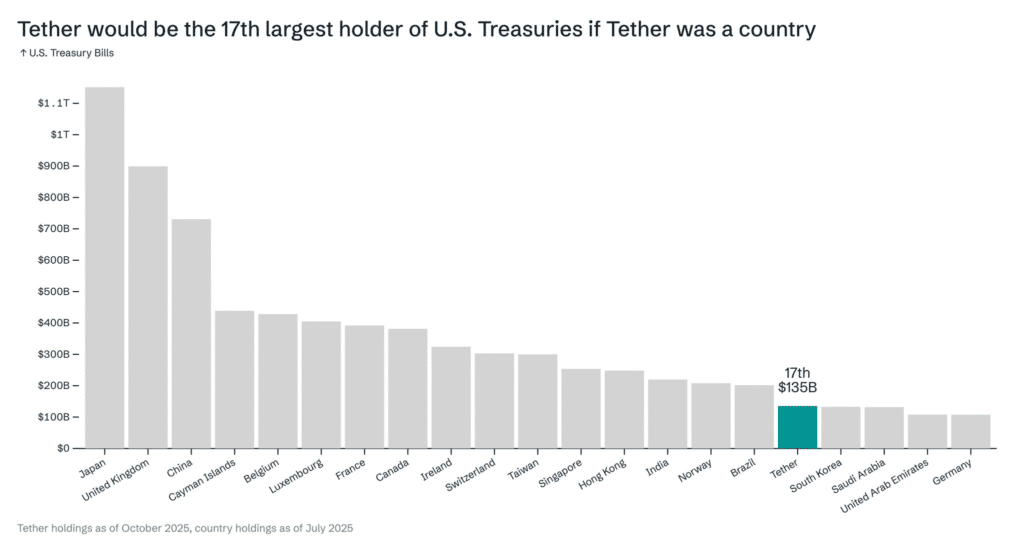
Tether holds $175B in US Treasuries (Source: Tether CEO on X)
Tether’s dominance also reflects new regulatory realities. The GENIUS Act, signed into law in July 2025, mandates that most stablecoin reserves be held in low-risk assets such as Treasuries.
The legislation, coupled with surging corporate adoption, has accelerated the stablecoin industry’s expansion, with forecasts suggesting a total market cap of $2 trillion by 2028, up from $308 billion this year.
Stablecoin peers such as Circle, the issuer of USDC, hold an estimated $45–55 billion in Treasuries—meaning the combined reserves of just two companies now surpass the holdings of many sovereign states. Analysts say this growing demand could help sustain the dollar’s dominance and potentially influence U.S. interest rates.
Tether Gold Crosses $2 Billion Market Cap
In parallel with its bond-buying spree, Tether Gold (XAUâ‚®) has surged past a $2 billion market capitalization, fueled by record-high gold prices and institutional demand for tokenized real-world assets (RWAs).
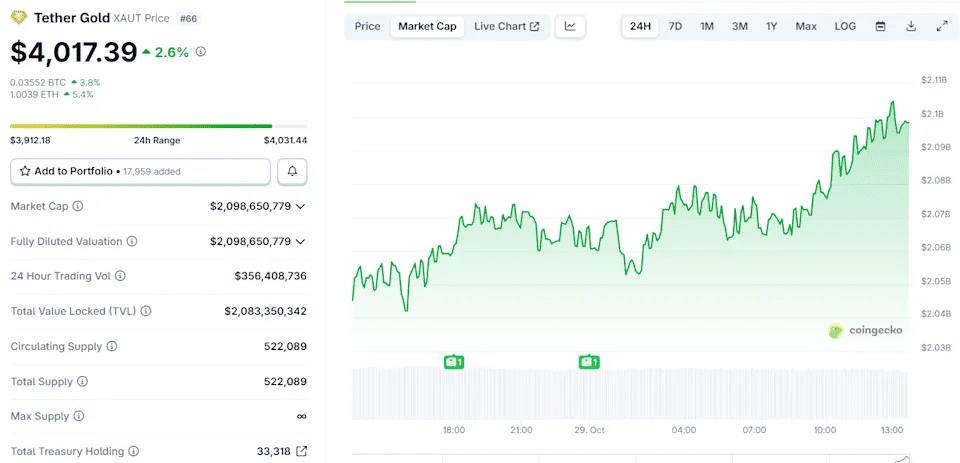
XAUT market cap (Source: CoinGecko)
As of late October 2025, XAU₮ was backed by 375,572 fine troy ounces of gold stored in Switzerland under London Good Delivery standards—up sharply from $1.44 billion in assets just one quarter earlier. Each token represents ownership of one ounce of physical gold, and reserves are transparently auditable on-chain.
The rally came as gold prices reached $3,858.96 per ounce on September 30, reflecting investors’ desire for inflation hedges and geopolitical safety. Ardoino described XAU₮ as “a proof of concept for compliant digital asset ownership,†offering institutional-grade security alongside decentralized accessibility.
Bridging Blockchain and Traditional Finance
Tether’s dual expansion—in U.S. Treasuries and tokenized gold—cements its role at the intersection of traditional finance and blockchain innovation. The company now stands as both a major player in global debt markets and a leader in real-world asset tokenization, bridging two once-separate financial worlds.
Industry observers say stablecoin transactions now rival Visa’s payment volumes, with roughly half of all institutions incorporating stablecoins into their payments and trading systems. Supporters argue that the influx of stablecoin capital into Treasuries reinforces dollar demand and provides a stabilizing influence on rates.
However, critics warn that such large positions could pose liquidity and systemic risks, blurring the line between private fintech powerhouses and sovereign fiscal influence. As stablecoin market caps climb toward the projected $2 trillion mark, the industry’s footprint in global finance—and its potential impact on monetary stability—will only deepen.


