
Bitcoin Is No Inflation Hedge — It’s a Global Liquidity Barometer, Says NYDIG
For years, Bitcoin has been hailed as “digital gold” — a modern store of value meant to protect investors from inflation.
But new research from NYDIG’s Global Head of Research, Greg Cipolaro, suggests that this popular narrative doesn’t hold up under scrutiny.
In NYDIG’s latest weekly digest, Cipolaro analyzed the relationship between Bitcoin and inflation and found that the correlation between the two is both inconsistent and weak.
“We know the community likes to pitch bitcoin as an inflation hedge,” Cipolaro wrote, “but unfortunately, here, the data is just not strongly supportive of that argument. The correlations with inflationary measures are neither consistent nor are they extremely high.”
This finding undercuts one of BTC’s most enduring talking points and signals a potential shift in how investors and analysts interpret the cryptocurrency’s role in global markets.
Gold Doesn’t Pass the Inflation Test Either
Cipolaro’s research didn’t just question Bitcoin’s inflation-hedge narrative — it also found that gold, the traditional benchmark for value preservation, performs no better.
Gold’s correlation with inflation, according to NYDIG’s analysis, has often been negative and fluctuates widely over time. This means that even gold — long viewed as the ultimate safeguard against rising prices — doesn’t consistently increase in value when inflation does.
The data challenges the long-held assumption that inflation automatically drives gold prices higher. “It’s surprising,” Cipolaro noted, “that for gold, inflationary measures are inversely correlated.”
What Really Moves Bitcoin and Gold
If inflation isn’t what drives these assets, then what does? According to Cipolaro, the answer lies in real interest rates and money supply.
For decades, falling real interest rates — those adjusted for inflation — have been a key driver of gold’s price. When real rates decline, the opportunity cost of holding gold decreases, making it more attractive to investors.
Bitcoin, although newer to financial markets, is now showing a similar pattern. Cipolaro found that Bitcoin’s inverse relationship with real interest rates has strengthened in recent years — a sign that the cryptocurrency is becoming more integrated into the broader financial system.
BTC as a Liquidity Barometer
The implications of NYDIG’s findings are significant. If Bitcoin isn’t behaving like an inflation hedge, it may be more accurate to view it as a measure of global liquidity — an asset that moves in response to changes in capital flow and monetary policy, rather than consumer prices.
Cipolaro concluded that, “If we were to summarize how to think about each asset from a macro factor perspective, it is that gold serves as a real-rate hedge, whereas bitcoin has evolved into a liquidity barometer.”
In other words, BTC’s performance appears to reflect how much liquidity — or financial “breathing room” — exists in the global economy. When liquidity expands and real rates fall, Bitcoin tends to rise. When liquidity tightens and real rates climb, it struggles.
The Takeaway
NYDIG’s latest research reshapes how investors might interpret Bitcoin’s role in the financial landscape. Rather than serving as protection against inflation, Bitcoin seems to act as a mirror for the global flow of capital — thriving in times of monetary expansion and faltering when liquidity dries up.
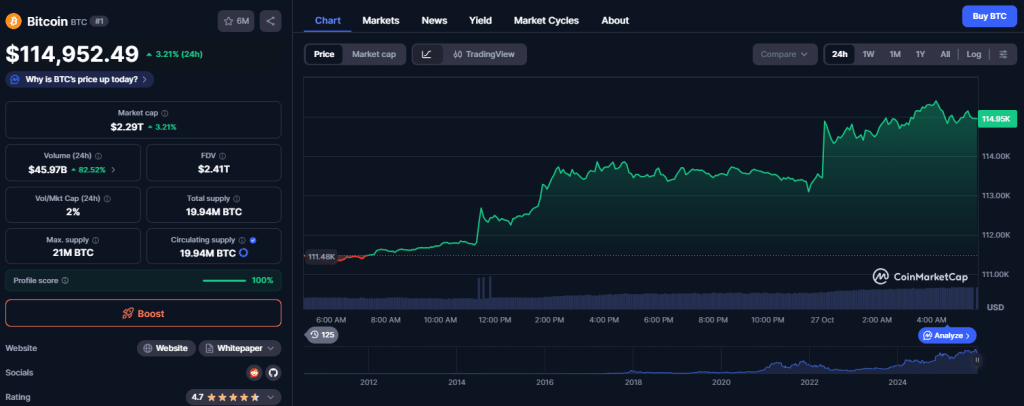
BTC price (Source: CoinMarketCap)
The takeaway is clear: Bitcoin isn’t a hedge against inflation — it’s a barometer for liquidity.


