
As U.S. Debt Soars Past $38 Trillion, Mike Novogratz Doubts Bitcoin Can Hit $250K
Bitcoin (BTC) is consolidating just under the $109,000 mark, grappling with softening momentum and renewed macroeconomic uncertainty as the United States crosses an unprecedented $38 trillion in national debt.
The milestone, revealed in the Treasury Department’s latest report, comes amid a federal government shutdown and marks the fastest trillion-dollar increase outside the COVID-19 pandemic — highlighting the growing strain on America’s fiscal stability.
The ballooning debt figure has reignited conversations about inflation and monetary debasement, both of which have historically strengthened the investment case for Bitcoin.
Yet in the near term, BTC’s technical indicators suggest traders are treading cautiously, with momentum fading and volatility compressing ahead of key resistance levels.
Debt Explosion Fuels Inflation and Economic Strain
Economists warn that the rising debt load poses long-term risks to household purchasing power and broader economic growth. Kent Smetters of the University of Pennsylvania’s Penn Wharton Budget Model cautioned that a heavier debt burden “compounds inflation†and makes it increasingly difficult for future generations to afford homes or maintain living standards.
According to the Government Accountability Office, the debt surge will likely push borrowing costs higher, increase prices for essential goods, and reduce private-sector investment. Michael Peterson, CEO of the Peter G. Peterson Foundation, underscored the urgency, saying, “Reaching $38 trillion in debt during a government shutdown is the latest troubling sign that lawmakers are not meeting their basic fiscal duties.â€
Peterson noted that interest payments have become the fastest-growing part of the federal budget, projected to total $14 trillion over the next decade — more than triple the $4 trillion paid in the last ten years.
The White House, however, maintains that spending cuts and higher revenues have helped narrow the deficit. Treasury Secretary Scott Bessent reported a $468 billion shortfall between April and September — the lowest since 2019 — claiming the administration reduced the deficit by $350 billion compared to last year.
Still, the Joint Economic Committee estimates the debt has been rising at $69,713.82 per second, underscoring the magnitude of America’s fiscal challenge.
Bitcoin Technical Indicators Show Caution Amid Macro Pressure
Bitcoin’s technical landscape mirrors this uncertainty. The RSI remains subdued below the neutral 50 mark, reflecting weakened buying conviction.
Meanwhile, the MACD continues to drift in negative territory, suggesting bearish momentum persists, although the histogram’s flattening hints at possible stabilization. The 9-day EMA slipping under the 20-day EMA confirms a mild bearish bias in the short term.
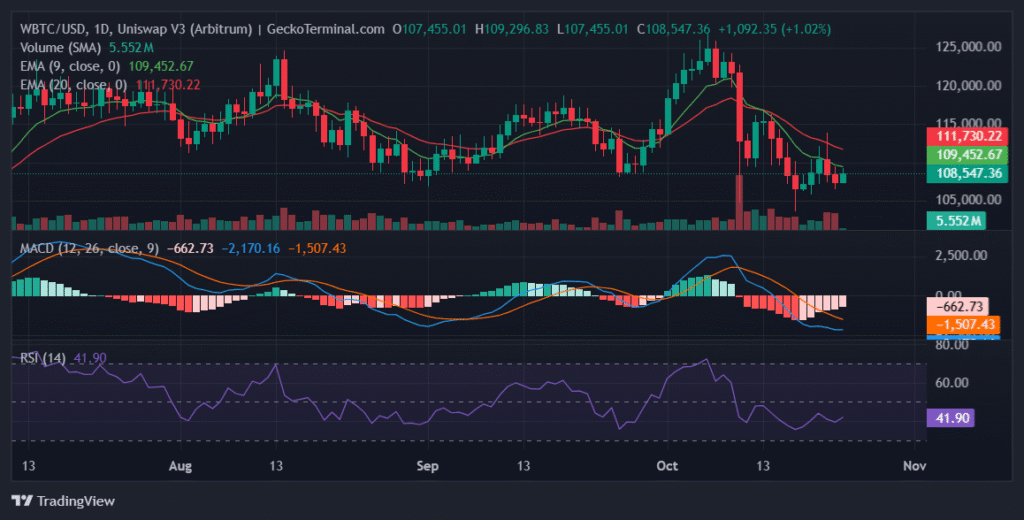
Daily chart for WBCT/USD (Source: GeckoTerminal)
BTC faces stiff resistance between $109,584, $110,274, and $111,696, while support remains solid near $108,246, $106,431, and $105,681.
Order book data reveals dense bid walls at $108,395 and $108,281, collectively worth nearly $1.4 million USDT, signaling buyer interest in defending this region. However, ask walls near $108,524–$108,598 could suppress upside attempts unless absorbed by renewed demand.
If Bitcoin manages to close decisively above $109,584, bulls could eye a recovery toward $111,000, while a drop below $108,200 could expose deeper losses toward $106,400.
Novogratz Says $250K Bitcoin by Year-End ‘Would Take Planetary Alignment’
Despite recent weakness, several prominent crypto executives remain optimistic about Bitcoin’s long-term trajectory. However, Galaxy Digital CEO Mike Novogratz tempered expectations for a parabolic year-end surge, saying “planets would have to align†for Bitcoin to hit $250,000 by December.
“The end of the year is only two and a half months away,†Novogratz told CNBC on Wednesday. “There would have to be a heck of a lot of crazy stuff to really get that kind of momentum.â€
At around $107,600, Bitcoin would need to gain roughly 133% to reach that ambitious target. Novogratz added that in a worst-case scenario, Bitcoin “should hold around $100,000,†calling it a key psychological support level first achieved in December 2024, shortly after Donald Trump’s reelection.
He also emphasized that the market’s upside potential remains limited until Bitcoin clears $125,000, saying, “The most likely outlook is we’re rangy between $100,000 and $125,000 unless we take out the top side.â€
Novogratz pointed to two possible catalysts that could reignite momentum — a premature attempt by the Trump administration to influence the Federal Reserve, or the long-anticipated passage of the CLARITY Act, a crypto market structure bill that could provide regulatory certainty for digital assets.
With 96.7% odds of another Fed rate cut at the October 29 meeting, according to CME’s Fed Watch Tool, the macro environment may soon turn more favorable for risk assets like Bitcoin.
Other crypto figures, including BitMine chair Tom Lee and BitMEX co-founder Arthur Hayes, have reiterated their belief that Bitcoin could still reach between $200,000 and $250,000 this year.
Bitcoin’s Dual Narrative: Caution Now, Hedge Later
As the U.S. debt spirals higher and inflationary pressures build, Bitcoin’s dual identity as both a speculative asset and a long-term hedge becomes increasingly apparent. While near-term technicals suggest consolidation or mild downside, the broader macro picture — rising debt, weakening fiscal discipline, and the looming threat of monetary easing — continues to underpin Bitcoin’s long-term bullish thesis.
For traders, the key will be monitoring the $108,000–$109,500 zone closely for signs of accumulation or rejection, as this range could determine whether Bitcoin’s next major move is a breakout or another leg down.Disclaimer: The information presented in this article is for informational and educational purposes only. It does not constitute financial advice. Ecoinimist is not responsible for any losses incurred. Readers should exercise caution before acting on this content.


