
As Markets Shake, Gold Holds Steady While Bitcoin Offers New Growth Frontiers
As the U.S. government shutdown stretches on and markets swing between volatility and opportunity, investors are rethinking what true diversification looks like.
According to Jonathan Rose, CEO of Genesis Gold Group and BlockTrust IRA, 2025 marks a fundamental shift in how wealth is preserved and grown — one where gold and Bitcoin now coexist as complementary assets rather than competitors.
A Perfect Storm Reshaping Investor Strategy
“In the intricate world of financial markets, 2025 stands as a testament to unprecedented transformation,” Rose said. “The ongoing government shutdown has created a perfect storm of uncertainty, driving investors to seek more resilient investment strategies.”
He believes what is happening now goes beyond traditional asset allocation. “What we’re witnessing is far more sophisticated than simple asset allocation — it’s a nuanced approach to wealth preservation and growth,” he added.
This evolution reflects a broader change in investor psychology. Where once gold symbolized caution and Bitcoin speculation, Rose says the two assets are increasingly viewed as mutually reinforcing parts of a single, modern portfolio strategy.
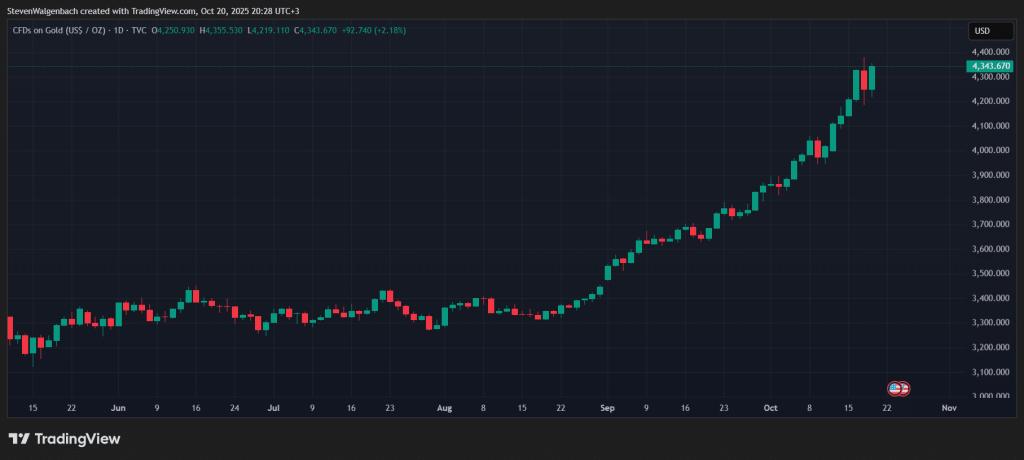
Gold price (Source: TradingView)
Gold and Bitcoin as Complementary Tools
“Investors are no longer viewing gold and Bitcoin as competing assets,” Rose explained, “but as complementary tools in a comprehensive, diversified investment strategy.”
In his view, the traditional boundaries between safe-haven assets and speculative investments “have blurred dramatically,” giving rise to portfolios that reflect “a deep understanding of global economic interconnectedness.”
Rose said many investors now maintain a structure that might include about 60 percent in traditional assets, 15–20 percent in gold, and 5–10 percent in cryptocurrency. “This approach isn’t about maximizing returns,” he emphasized, “but about creating a robust defense against economic unpredictability. The key is flexibility — understanding that each asset serves a unique purpose in the broader investment ecosystem.”
Retirement Portfolios Are Changing
Rose says retirement investors are at the forefront of this shift.
“Retirement investing has undergone a radical transformation,” he explained.
“Conservative investors who once viewed cryptocurrency with skepticism — and a degree of fear — are now implementing measured, strategic approaches. This isn’t about chasing speculative gains, but about adapting to a rapidly changing financial landscape, almost by the day.”
He argues that the old 60/40 portfolio model is “becoming obsolete.” Instead, he’s seeing “more sophisticated strategies that incorporate alternative assets as core components, not peripheral experiments.”
“Gold remains a cornerstone of stability, providing a reliable store of value that has withstood centuries of economic turbulence,” Rose continued.
“Bitcoin, by contrast, offers exposure to technological innovation and potential for exponential growth. In simplistic terms, gold is the slow and steady asset, while crypto is the fast and furious, with occasional unplanned pit stops and U-turns.”
Will Bitcoin’s Seasonal Rally Return?
Discussing Bitcoin’s tendency to rally in October and November, Rose cautioned that the pattern may not hold this year.
“The historical October and November Bitcoin rally presents a fascinating case study in market dynamics,” he said.
“While seasonal patterns have traditionally suggested strong performance during these months, 2025 introduces multiple complicating factors that challenge conventional wisdom.”
He pointed to geopolitical tensions, potential regulatory changes, and global economic uncertainty as reasons why “the days of predictable seasonal trends are behind us.”
“Investors must now approach market cycles with a more holistic understanding, recognizing that past performance is merely a starting point for analysis, not a guarantee of future results,” Rose added.
Why Gold and Bitcoin Work Together
For Rose, gold and Bitcoin are not rivals but allies in building resilient portfolios. “Gold provides historical stability and acts as a traditional hedge against inflation,” he said. “Bitcoin represents technological innovation, offering global transferability and potential for exponential growth.”
“The key is understanding their unique characteristics,” he continued.
“Gold provides a tangible, time-tested store of value, while Bitcoin offers exposure to a potentially transformative technological asset class. Together, they provide a more robust approach to wealth preservation and growth.”
Institutional Gold Demand and Retail Bitcoin Growth
Rose highlighted an important distinction in how the two assets attract investment.
“The demand dynamics between gold and Bitcoin reveal profound insights into institutional investment strategies,” he said.
“Central banks continue to view gold as a critical reserve asset, consistently increasing their holdings during periods of economic uncertainty. Bitcoin, however, represents a more complex narrative — a digital asset that challenges traditional concepts of value and investment.”
While gold’s institutional demand remains steady, Bitcoin’s growth is still largely retail-driven. “Central banks have been purchasing over 1,000 metric tons of gold annually, strategically diversifying away from dollar-denominated assets,” Rose explained. “In contrast, Bitcoin’s demand is more driven by retail investors seeking potential high-growth, accelerated opportunities.”
Bitcoin at $250,000? Rose Explains His Forecast
Rose has predicted that Bitcoin could exceed $250,000 by 2030 — a target he describes as reasoned, not speculative. “My projection of Bitcoin potentially reaching $250,000 by 2030 is not a speculative claim, but a carefully considered forecast,” he said.
He attributes the potential growth to several converging trends: continued institutional adoption, evolving regulatory frameworks, improvements in blockchain infrastructure, and expanding global acceptance.
“The potential for growth is intrinsically linked to broader technological and economic trends,” Rose said. “We’re witnessing a fundamental shift in how we conceptualize value, money, and investment on a global scale.”
The Rise of AI-Powered Investing
As CEO of BlockTrust IRA, Rose also sees artificial intelligence as a defining force in modern portfolio management. “AI-driven investment platforms represent a quantum leap in investment technology,” he explained.
“By leveraging advanced algorithms, we can analyze vast streams of market data, identifying patterns and potential movements that human traders could never consistently detect — 24/7/365.”
He noted that BlockTrust’s Animus AI system has outperformed traditional strategies by simultaneously analyzing thousands of data points.
“The key advantage,” Rose said, “is the ability to process complex, multidimensional market information instantaneously. This allows for more informed, data-driven investment decisions that can adapt to rapidly changing market conditions.”
Political Instability Favors Both Gold and Bitcoin
Rose added that political and fiscal instability — from election cycles to regulatory shifts — tends to benefit both gold and Bitcoin, albeit in different ways.
“Political instability and economic uncertainty have become defining characteristics of the current investment landscape,” he said. “Both gold and Bitcoin benefit from this uncertainty — gold as a traditional safe haven, Bitcoin as a potential hedge against systemic financial risks.”
He emphasized that during such times, “gold tends to see more consistent and sustained institutional demand, while Bitcoin experiences more volatile retail-driven interest. The key is understanding how these assets respond differently to political and economic stress.”