
Circle’s USDC Poised to Lead $670B Stablecoin Market by 2027: Bernstein
Circle’s USD Coin (USDC) could soon become the biggest winner from America’s new stablecoin legislation, according to analysts at research and brokerage firm Bernstein.
In a note to clients, the firm projected that USDC’s supply could nearly triple within two years, with its market share rising to 33% by 2027, up from 29% today.
Circle’s Compliance Edge
Led by analyst Gautam Chhugani, Bernstein’s team credited Circle’s “compliance-first†strategy and extensive exchange integrations for giving it a structural advantage in the evolving regulatory landscape.
The analysts said that USDC already facilitated $3 trillion in transactions in the first half of 2025, marking a 120% jump from 2024’s pace, as demand for regulated, dollar-backed tokens accelerated.
USDC currently represents around $76 billion of the $290 billion stablecoin market, while Tether’s USDT remains dominant with roughly $180 billion, or 62% of total supply. Other major players include USDe ($12.6B), Dai ($5B), and USDS ($4.8B).
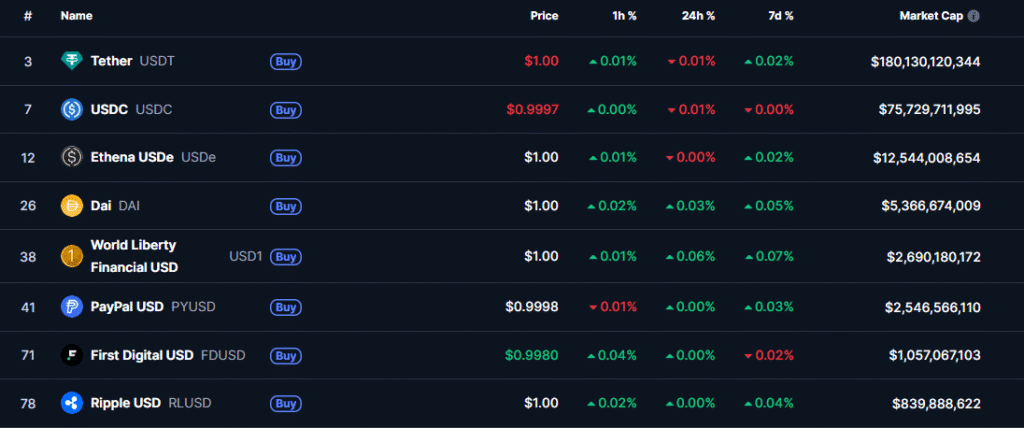
Top stablecoins by market cap (Source: CoinMarketCap)
GENIUS Act Favors U.S.-Based Issuers
Bernstein noted that the GENIUS Act, passed in July, established a federal framework for “payment stablecoins†and limited foreign issuers’ participation. The legislation officially classifies such tokens as digital cash — not securities or deposits — a distinction that strongly benefits U.S. firms like Circle.
Circle’s reserves are fully backed by cash and U.S. Treasurys, with daily transparency reports and independent attestations, setting a standard for regulatory compliance that many competitors lack. The analysts called USDC “the largest regulated stablecoin globally,†emphasizing that it is well-positioned to partner with banks and fintechs that require compliant, onchain settlement rails.
Also read: Circle’s USDC at Risk? JPMorgan Warns of Intense Stablecoin War Ahead
$670 Billion Stablecoin Market by 2027
Bernstein expects the overall stablecoin market to reach $670 billion by 2027, driven by tokenized finance, payments innovation, and remittance use cases. Under that forecast, Circle’s USDC could expand to $220 billion in supply, aided by new integrations with Fiserv, FIS, Corpay, and Shopify.
In contrast, new entrants like PayPal’s PYUSD and Tether’s U.S.-based USAT are expected to face “cold-start†liquidity challenges and limited exchange connectivity.
Revenue Outlook and Rate Impact
While Circle’s business model remains reliant on interest income from reserves, analysts cautioned that rate cuts could affect earnings as the Federal Reserve lowers rates to around 3% by 2027.
However, Bernstein believes Circle’s expanding transaction volumes and non-interest income—including cross-chain transfer fees and network revenue—will offset any decline. These non-interest segments have already grown from 1% of total revenue in 2024 to 4% in the first half of 2025.
The report predicts Circle’s revenue will grow 47% annually through 2027, powered by a 71% CAGR in USDC supply as its infrastructure and payments network scale globally.
The Future of Digital Dollars
Looking ahead, Bernstein forecasts that global stablecoin supply could reach $4 trillion by 2035, with USDC retaining about 30% of the market. Circle’s upcoming initiatives—such as the Circle Payments Network and Arc, its purpose-built blockchain—are seen as critical in establishing digital dollars as the money-rail of the internet.
“Digital dollars will form the money-rail of the internet, and Circle is best positioned given its headstart,†the analysts wrote, reaffirming their outperform rating and setting a $230 price target for Circle’s stock—representing a 67% upside from Monday’s close at $137.47.


