
Wall Street Banks Unite to Launch G7-Backed Stablecoin Initiative
Nine of the world’s largest Wall Street banks have announced plans to jointly develop a reserve-backed stablecoin pegged to major G7 currencies — a move signaling traditional finance’s most ambitious push yet into blockchain-based payments.
According to a Bloomberg report published Friday, the consortium includes Goldman Sachs, Deutsche Bank, Bank of America, Banco Santander, BNP Paribas, Citigroup, MUFG Bank, TD Bank Group, and UBS. The Wall Street banks will explore issuing a blockchain-based digital asset backed one-to-one by fiat currency reserves and available on public networks.
A spokesperson for the coalition confirmed that the group has already opened discussions with regulators and supervisors across key jurisdictions to determine whether the project could enhance competition in the global digital payments landscape.
Wall Street Banks Target a $50 Trillion Digital Payment Opportunity
The move comes as traditional financial institutions accelerate blockchain adoption amid clearer regulatory frameworks in the U.S. and European Union.
Stablecoins — digital assets pegged to fiat — have become a critical bridge between traditional banking and crypto, processing billions of dollars daily with lower fees and faster settlement than legacy payment systems.
Bloomberg Intelligence estimates that stablecoins could handle more than $50 trillion in annual payments by 2030, reshaping the landscape of financial settlements and cross-border transfers.
Current market leaders like Tether Holdings have already demonstrated the profitability of this model. Tether, issuer of the largest stablecoin by circulation, earns billions annually through yields on its Treasury and cash-equivalent reserves. The company is reportedly in the process of raising up to $20 billion in funding, potentially making it one of the world’s most valuable private firms.
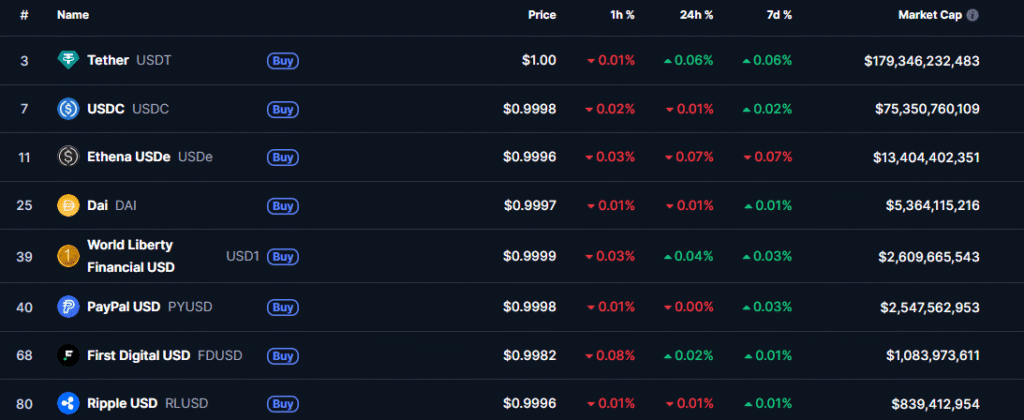
Top stablecoins by market cap (Source: CoinMarketCap)
The entry of major Wall Street banks could represent a seismic shift in how regulated institutions capture this lucrative market. Their joint venture follows similar experiments by BNY Mellon, which has explored tokenized deposits, and JPMorgan, whose JPMD token represents U.S. dollar deposits for institutional clients.
Tokenization and the Next Frontier of Finance
The banks’ ambitions extend beyond stablecoins.
Many see blockchain infrastructure as the foundation for a future financial system that tokenizes traditional assets such as stocks, bonds, and investment funds.
HSBC recently launched a tokenized deposit service for corporate clients, allowing blockchain-based cross-border settlements, while SWIFT has started testing stablecoin-like transactions on Ethereum’s Linea Layer 2 network alongside BNP Paribas and BNY Mellon.
Across Europe, banks are moving even faster. Nine major institutions — including ING, UniCredit, and Deutsche Bank — are working on a MiCA-regulated euro stablecoin, set for release by mid-2026. This follows a trend of increasing regulatory cooperation, particularly in the Eurozone, where digital asset compliance frameworks have become clearer.
Traditional Banks Race to Contain the Stablecoin Threat
Standard Chartered recently warned that the rise of stablecoins could drain over $1 trillion in deposits from emerging market banks by 2028, as consumers in high-inflation economies turn to digital dollars like USDT as safer stores of value.
To counter this trend, regulators in the United Kingdom initially proposed retail holding limits between £10,000 and £20,000 for stablecoins. However, the Bank of England is reportedly preparing to allow exemptions for exchanges and financial institutions that require large token reserves for liquidity and settlement.
Meanwhile, Stripe CEO Patrick Collison recently argued that stablecoins will inevitably push traditional banks to raise deposit yields. He noted that while banks earn roughly $176 billion annually from reserves at the Federal Reserve, U.S. savings accounts still pay just 0.40% interest — creating a massive incentive for users to migrate toward digital alternatives.
The Battle for Digital Dollar Dominance
Competition in the payment space is intensifying beyond the banking sector. Apple, Airbnb, Uber, and X (formerly Twitter) are reportedly exploring stablecoin integrations, while fintechs like BVNK — recently backed by Citigroup — are gaining traction with institutional clients seeking blockchain settlement solutions.
The global banking industry now faces a critical crossroads: partner with established stablecoin issuers, build proprietary tokens, or risk watching trillions in payment revenues migrate to crypto-native firms and technology giants.


