
BNY Mellon Modernizes $2.5 Trillion Payment System Through Tokenization Pilot
BNY Mellon, the world’s largest custodial bank with over $55.8 trillion in assets under custody, is testing tokenized deposits as part of an effort to upgrade its global payment infrastructure and keep pace with the growing adoption of blockchain-based finance.
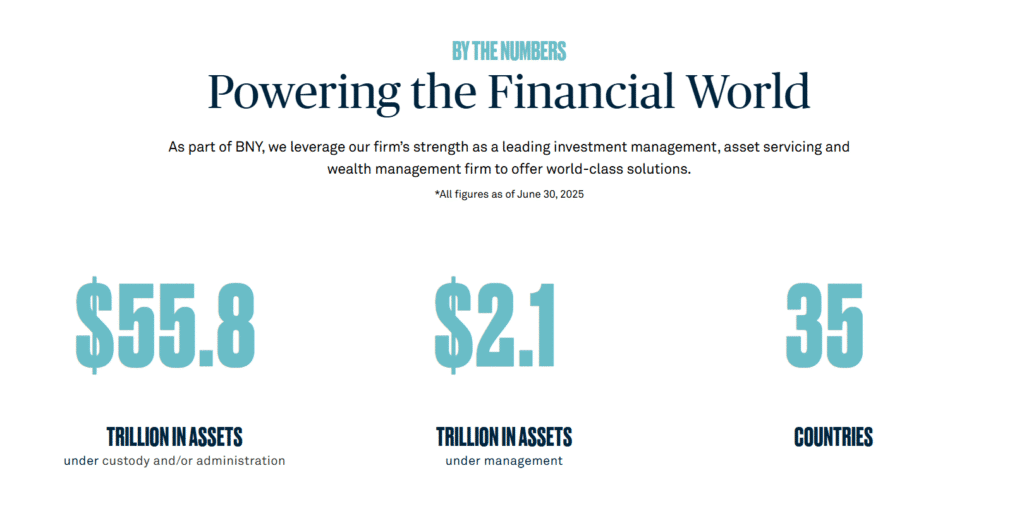
BNY Mellon financial figures (Source: BNY)
According to a Bloomberg report, the pilot initiative is still in its exploratory phase and aims to allow BNY Mellon clients to make payments using tokenized versions of their deposits.
Those deposits would move over a blockchain, enabling near-instant settlement while cutting down on transaction costs — a significant step for a bank that currently processes around $2.5 trillion in payments each day.
Accelerating Payments Through Blockchain
Carl Slabicki, co-head of global payments at BNY Mellon, said the technology could help traditional financial institutions “overcome legacy constraints†that slow down the movement of money.
Blockchain-based settlement could streamline internal transfers within BNY’s networks and eventually extend across the broader financial system, offering faster and more efficient transactions for institutional clients.
This marks a notable milestone in the bank’s broader digital transformation strategy. BNY Mellon has been experimenting with various blockchain applications, including digital asset custody and tokenized investment products.
Part of a Larger Trend Among Global Banks
BNY Mellon’s move mirrors similar efforts from major institutions around the world.
JPMorgan, for instance, began testing its JPMD token on Coinbase’s Base blockchain in June, signaling that tokenized cash systems are gaining traction within traditional finance.
In Europe, a consortium of nine banks is collaborating to create MiCA-compliant euro stablecoins, designed to support regulated on-chain transactions.
Over the summer, BNY Mellon and Goldman Sachs also launched tokenized money market funds for their clients, demonstrating how traditional financial products are being adapted for the blockchain era.
Balancing Innovation and Regulation
Despite these advances, BNY Mellon CEO Robin Vince has previously stated that the bank plans to take a measured approach to digital assets, preferring to move cautiously compared to peers aggressively pursuing crypto deposits.
Still, the growing integration of blockchain into mainstream financial operations indicates that even conservative institutions now view tokenization as an inevitable evolution in banking.
As global finance shifts toward on-chain settlement systems, BNY Mellon’s experimentation with tokenized deposits could position it at the forefront of a new era in institutional payments — one that merges the reliability of legacy banking with the speed and transparency of blockchain technology.


