Ripple CTO Alludes to XRP Supremacy in Global Finance
In a thought-provoking discussion held recently on X (formerly Twitter), David Schwartz, Chief Technology Officer of Ripple, shared a perspective on the evolving landscape of global reserve currencies.
The remarks have sparked renewed debate in the crypto community about the possibility of XRP rising beyond payment rails to a more foundational role.
The conversation was spotlighted by crypto commentator JackTheRippler (@RippleXrpie), who distilled the key takeaways for XRP observers.
Key Takeaways from Ripple CTO’s Remarks
1. The Dollar’s Reserve Status Is Under Question
Schwartz suggested that it’s “quite realistic that a lot of the world is just done with the dollar as the reserve currency.†He acknowledged the advantages the U.S. has accrued from such a status but questioned its long-term sustainability.
He went on to argue that while some major powers might try to promote their own fiat as alternatives, many nations may resist systems controlled by geopolitical rivals — a dynamic reminiscent of banking competition.
2. Rival Fiat Currencies Face Resistance
Drawing on his experience in financial infrastructure, Schwartz likened the potential shift in reserve currency to how smaller banks once balked at being dependent on systems dominated by large institutions like Deutsche Bank or JPMorgan. In his view, nations may similarly avoid adopting a reserve tied to a dominant foreign power.
3. A Neutral Digital Asset Could Be Appealing
As an alternative path, the Ripple CTO floated the idea that countries might converge on “a currency that nobody could control rather than one controlled by their most powerful geopolitical rival.†In that scenario, a neutral digital asset could present a compelling option.
4. XRP as the Best Candidate — for Now
Schwartz argued that among digital assets, XRP stands out due to its architecture designed for global liquidity, fast settlement, low fees, and scalability. Unlike many tokens whose utility is more speculative, XRP’s design is anchored in cross-border financial settlement — making it, in his assessment, a realistic contender to assume a reserve role.
He framed the alternative as avoiding “the old boss with a new boss†— in other words, replacing the U.S. dollar with another sovereign’s currency doesn’t solve the issue of centralized control. Instead, a neutral asset like XRP might overcome that problem.
Context & Contrasting Views
While Schwartz’s remarks have energized parts of the XRP community, they are speculative by nature. Official corporate statements frequently emphasize that XRP is intended as a bridge asset for payments rather than a sovereign-level currency.
Critics may point to several challenges:
- Regulation: The path to acceptance by sovereign nations requires extensive regulatory clarity and institutional trust.
- Volatility & stability: Reserve assets typically demand high stability; digital assets remain subject to market swings.
- Adoption inertia: Changing entrenched global systems (like dollar-based reserves) is extremely complex and politically fraught.
Still, Schwartz’s framing — of nations seeking an asset not controlled by a rival — appeals to a strategic logic often underemphasized in crypto debates.
Why This Matters for Ripple & XRP
If even parts of the global community take seriously the idea of a neutral digital reserve, XRP’s positioning gains fresh relevance. The remarks help fuel narratives around:
- Long-term use case expansion: Not just as a payment tool, but as part of macroeconomic infrastructure.
- Institutional interest: Central banks and multinational financial entities may reexamine XRP in their strategic models.
- Narrative strength: In markets often driven by storytelling, this frames XRP as not just a bridge token but a potential foundation.
Bottom Line
David Schwartz’s comments in the X Space represent one of the more bold and forward-looking proposals about XRP’s future in macrofinance.
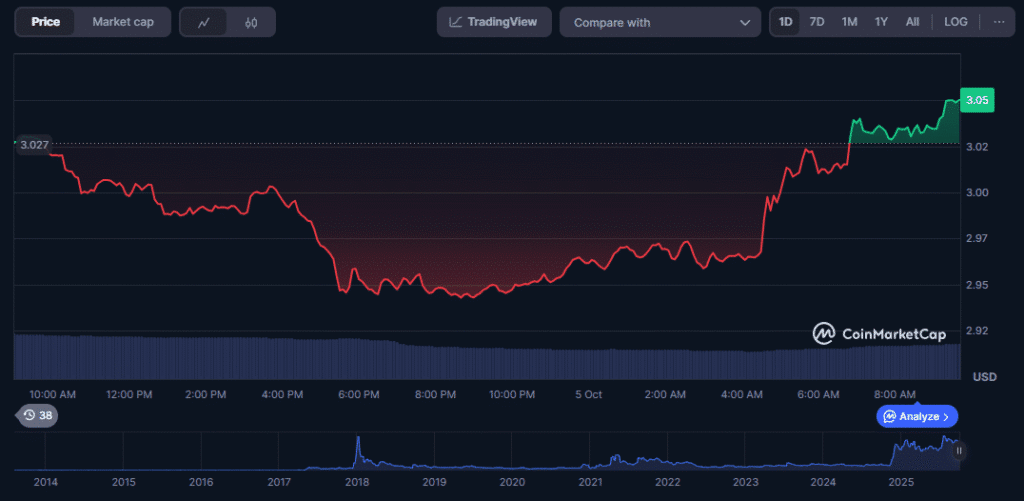
XRP price chart (Source: CoinMarketCap)
While many obstacles remain, the narrative of a neutral digital reserve asset provides a provocative lens through which to view the evolving role of cryptocurrencies.
As the crypto world watches, XRP enthusiasts and critics alike will be dissecting whether these ideas remain rhetorical or begin to influence real policy and institutional design.


