
Ripple CTO David Schwartz to Step Back After 13 Years
Ripple CTO (Chief Technology Officer) David Schwartz has announced that he will step back from his day-to-day role at the end of 2025, marking the end of a 13-year tenure that shaped both the company and the XRP Ledger.Â
The decision, which he described as a “personal inflection point,†was revealed in a post on X this week.
Schwartz, one of the original architects of the XRP Ledger alongside Arthur Britto, Jed McCaleb, and Chris Larsen, emphasized that his departure from daily operations does not signal an exit from the XRP community.
“The time has come for me to step back from my day-to-day duties as Ripple CTO at the end of this year,†he wrote. “But be warned, I’m not going away from the XRP community. You haven’t seen the last of me—now or ever.â€
From NSA Consultant to Ripple CTO
Before Ripple, Schwartz built a career in technology that spanned more than four decades, including work as a consultant for the U.S. National Security Agency. His journey with XRP began in 2011, when he started developing the XRP Ledger, a blockchain designed for fast, low-cost, and enterprise-ready transactions.
Over the years, Schwartz became a prominent figure in the crypto industry, often addressing misconceptions about XRP and defending the ledger’s decentralized design. He has frequently highlighted its real-world applications in tokenization, institutional stablecoins, and enterprise finance.
A New Role as Ripple CTO Emeritus
Although he will no longer manage Ripple’s day-to-day technical operations, Schwartz confirmed he will transition into a CTO emeritus role and join Ripple’s board of directors. In his statement, he expressed confidence in Ripple’s leadership, praising President Monica Long, Executive Chairman Chris Larsen, SVP of Engineering Dennis Jarosch, and the broader XRP developer community.
“I have total confidence in the next generation of leaders and builders, including Dennis Jarosch and far too many others to name in the XRP community who will carry the torch,†Schwartz said.
Looking Ahead: Ripple, XRP, and Tokenization
In an earlier interview, Schwartz outlined his vision for XRP’s future, pointing to the tokenization of real-world assets and enterprise-grade stablecoin adoption as the ledger’s most promising growth areas.
“There will be use cases where digital assets like XRP and Bitcoin make sense—where volatility is either an advantage or not a disadvantage—and other cases where a more stable token like RLUSD or another stablecoin will make more sense,†he explained.
He also pushed back against the long-standing misconception that Ripple controls the XRP Ledger, noting its independent validator base that has been operating since 2012.
A Legacy of Innovation
Calling his time at Ripple “a wild ride,†Schwartz said he plans to spend more time with family while continuing to explore blockchain innovation on the side. In recent months, he has been experimenting with running his own XRPL node and researching new XRP use cases.
As he steps back from one of the highest-profile technical roles in the crypto industry, Schwartz’s influence on Ripple and the broader blockchain ecosystem remains firmly intact.
Following his announcement, the price of XRP dropped over 1% in the past 24 hours. This pullback coincided with a broader crypto market retracement during the same period.
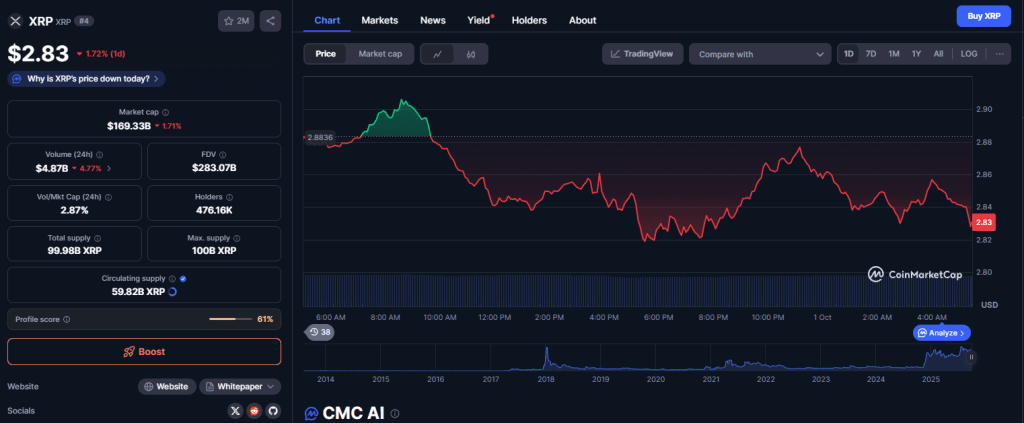
XRP price (Source: CoinMarketCap)


