
Bitcoin Gets a New Treasury Model With $100M BTCS Raise
Bitcoin’s role in corporate treasuries is evolving once again, as BTCS, Europe’s largest publicly listed Digital Asset Treasury Company (DATCO), announces a fresh $100 million Series G raise.
The move comes just weeks after closing its Series F, highlighting growing institutional appetite for strategies that go beyond simply buying and holding BTC.
Bitcoin in Corporate Balance Sheets
BTC has long dominated the conversation around digital asset treasuries, with companies like Strategy setting the tone through aggressive accumulation.Â
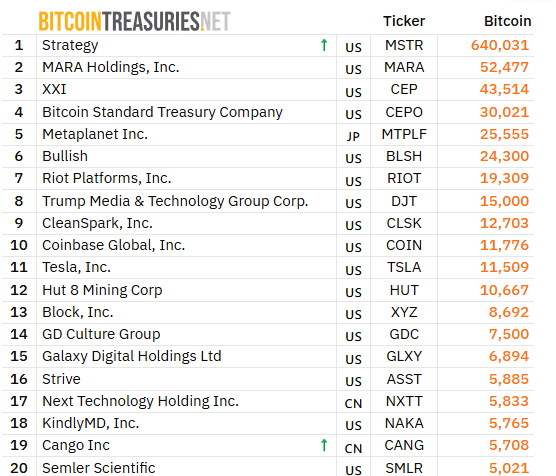
Top 20 corporate BTC holders (Source: Bitcoin Treasuries)
But questions have emerged over whether such passive strategies offer sustainable value beyond short-term market cycles. BTCS is now taking a different path, betting that yield-driven, diversified treasury management can deliver more resilient returns.
Active Treasury Model: 60% Bitcoin, 30% ZIG, 10% CORE
Unlike firms that park cash reserves in BTC alone, BTCS is adopting what it calls an Active Treasury Strategy.
The structure allocates 60% to BTC, 30% to ZIGChain’s native token, and 10% to CORE DAO, while putting those assets to work through validator operations, staking, and DeFi participation.
That means that instead of relying solely on Bitcoin’s price appreciation, BTCS expects to generate ongoing revenue streams from its direct participation in blockchain networks. According to the company, this approach not only delivers yield but also strengthens the very ecosystems it invests in.
A Shift From Passive to Productive Bitcoin Holdings
Most public companies investing in Bitcoin, such as Strategy, are following a passive model—adding BTC to the balance sheet and waiting for long-term appreciation. BTCS, by contrast, is positioning itself as an operator, leveraging validator nodes and staking-as-a-service to generate consistent revenue.
“This next phase builds on the momentum of our Series F and underscores our conviction that the future of digital asset treasuries lies in productive deployment, not passive storage,†said Marlena Lipińska, CEO of BTCS, in an announcement shared with Ecoinimist.
Abdul Rafay Gadit, Co-Founder of ZIGChain and Supervisory Board Member at BTCS, added: “The inclusion of ZIGChain in BTCS’s treasury strategy highlights a broader shift toward productive digital asset treasuries. Unlike passive holdings, validators and staking rewards create recurring revenue streams while directly strengthening the networks themselves.â€
Why It Matters for Bitcoin
Bitcoin remains the anchor of BTCS’s portfolio, reinforcing its role as the institutional standard in digital asset treasuries. But the inclusion of emerging tokens like ZIG and CORE signals that Bitcoin is no longer the sole option for corporations seeking blockchain exposure.
Instead, Bitcoin now sits at the center of a more diverse and revenue-focused approach.
By combining BTC’s established reputation with yield opportunities from newer ecosystems, BTCS is positioning itself as a model for how corporate treasuries may evolve in the next phase of crypto adoption.


