
Hypurr NFTs Drop as Hyperliquid Pushes Stablecoin and Permissionless Trading
Hyperliquid (HYPE) launched a fresh community-driven initiative on Sunday, introducing the Hypurr NFT collection on its HyperEVM to reward early adopters and reaffirm its cultural identity, even as questions about token stability persist.
Hypurr Airdrop for Early Backers
According to the Hyper Foundation, 4,600 Hypurr NFTs were distributed automatically—no minting or user action required. Of the supply, 4,313 went to Genesis Event participants, 144 to the Foundation itself, and 143 to contributors such as Hyperliquid Labs and ecosystem artists.
Each NFT reflects “moods, hobbies, tastes, and quirks†of the Hyperliquid community, with 16 pieces reportedly designed by co-founder and CEO Jeff Yan.
The NFTs were minted directly on HyperEVM, a programmability layer launched in February 2025 that bridges smart contracts with the network’s Layer-1 via HyperBFT consensus. This structure enables developers to tap into HyperCore liquidity while building applications such as lending markets, vault tokenization platforms, and liquid staking tokens.
Permissionless Stablecoin Quotes Go Live
The NFT rollout coincided with Hyperliquid enabling permissionless spot quote assets on mainnet. Under the new rules, stable asset deployers can activate quote status, expanding the range of trading pairs available to users.
Native Markets wasted no time, deploying USDH, Hyperliquid’s native stablecoin backed by cash and U.S. Treasuries, as the first permissionless quote asset. This immediately unlocked HYPE/USDH pairs, with additional assets expected soon.
Analysts suggest USDH could become central to Hyperliquid’s strategy, aligning with a broader industry push for exchanges to issue their own stablecoins to deepen liquidity and strengthen competitiveness.
Market Response and Security Concerns
Following the news, HYPE’s token price gained over 5% in the past 24 hours, trading around $46.99. Rival DEX Aster, backed by YZi Labs, has already overtaken Hyperliquid in weekly trading volumes, highlighting competitive pressure.
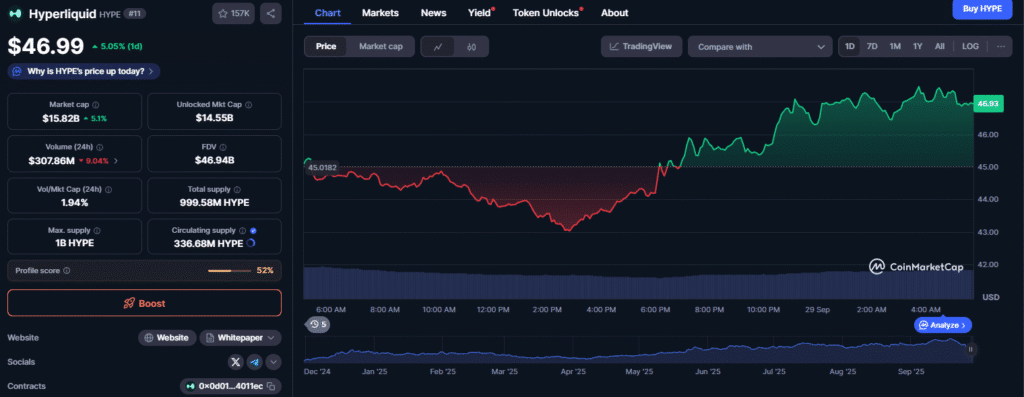
HYPE price chart (Source: CoinMarketCap)
However, security concerns surfaced when blockchain investigator ZachXBT reported that a threat actor stole eight Hypurr NFTs from compromised wallets, netting roughly $400,000.
Meanwhile, analysts warn of potential turbulence from an upcoming $12 billion HYPE token unlock, which could put additional pressure on sentiment.
The Bigger Picture
Hyperliquid’s latest moves reflect a push to reinforce community loyalty and expand infrastructure while battling market uncertainty and rival growth. Hypurr NFTs act as cultural keepsakes, while USDH and permissionless trading broaden practical liquidity options.
Yet challenges remain: the looming token unlock, fragile peg mechanisms, and rising competition pose significant risks. Hyperliquid’s future success will depend on whether its programmatic architecture and community engagement can outweigh market instability.


