
Yearn Finance: Simplifying DeFi Yield Farming for Crypto Investors
Yearn Finance is a decentralized finance (DeFi) protocol designed to help users earn passive income from their cryptocurrency.
In simple terms, Yearn is a yield aggregator – it automates the process of finding the highest returns (yields) for your crypto across many DeFi platforms. Launched in 2020 by developer Andre Cronje, Yearn lets anyone deposit tokens into its smart contracts instead of manually moving funds around.
The system’s “money robots†(automated strategies) then sweep assets between lending protocols, liquidity pools, and other opportunities to maximize interest. Yearn’s goal is to simplify DeFi investing: make high yields accessible even if you’re not a tech expert. It’s often called an “automated crypto savings account†because you just deposit, sit back, and let Yearn work.
Yearn also has its own governance token, YFI, which has a fixed supply of 36,666 coins. YFI holders vote on platform changes and protocol fees, helping steer Yearn’s development.

YFI market overview (Source: CoinGecko)
But you don’t need YFI tokens to start yield farming – they’re mainly for governance and capturing a share of Yearn’s fee revenue.
Yearn’s focus is on making DeFi investing and yield farming simpler and more efficient, so users can earn crypto interest automatically across lending platforms like Aave, Compound, Curve, and more.
What is Yield Farming?
Before diving deeper into Yearn, let’s explain yield farming in plain English. Yield farming (sometimes called liquidity mining) is a way to earn rewards by putting your crypto to work. Instead of letting coins sit idle, you lock or lend them on DeFi platforms so you can earn interest or tokens in return.
Think of it like a bank account or a stock dividend: you provide your crypto to a platform, and you earn extra crypto on top of it. For example, you might lend DAI on a lending market and receive interest, or you might add ETH and USDT into a liquidity pool on a decentralized exchange (DEX) and collect trading fees plus bonus tokens.
In yield farming, users deposit crypto assets into DeFi protocols and earn rewards for providing liquidity. These rewards often come in the protocol’s own tokens (and sometimes also as extra cryptocurrency). The underlying goal is to incentivize people to lock up their funds so that DEXs can trade smoothly or lending markets have liquidity. Yields can be very attractive (sometimes double-digit or even triple-digit annual rates), but they fluctuate as market conditions change.
In essence, yield farming is a way to generate crypto passive income by lending or staking your coins on open platforms. However, it’s not without risks (see below): prices can swing, and smart contract bugs can happen.
How Yearn Finance Works: Vaults and Strategies
Yearn Finance simplifies yield farming by automating it. Instead of manually moving assets from one protocol to another chasing the highest APY, you deposit your tokens into Yearn, and the system does the rest. The heart of Yearn’s system is its Vaults.
Each vault is like a crypto savings account with its own strategy. When you deposit into a vault, Yearn’s smart contracts use that deposit in various DeFi investments. For example, they might lend your tokens on Aave, stake them in Curve liquidity pools, or do other complex sequences of steps to earn the best yield. Once a vault’s strategy earns interest or rewards, those profits are automatically reinvested (compounded) back into the vault, boosting everyone’s returns over time.
In Yearn’s own words, “Vaults allow you to deposit cryptocurrency tokens you own and earn interest on them.†When you deposit, your tokens are pooled with other users’ deposits and directed toward the chosen interest-generating opportunities. In exchange, you receive a vault token (sometimes called a y-token or yv-token) that represents your share of the pool.
For example, if you deposit YFI into a YFI vault, you get back yvYFI tokens. These vault tokens automatically increase in value as the vault earns yield. Yearn’s documentation explains: “If your yVault generates profit, the share price of your yVault tokens will increase… more underlying tokens are in the yVault to redeem upon withdrawal.â€
In practice, this means holding the vault token is like holding your original crypto plus its accrued interest; you can redeem it anytime for the initial deposit plus any earned yield.
Yearn’s vaults are managed by community-vetted strategies.
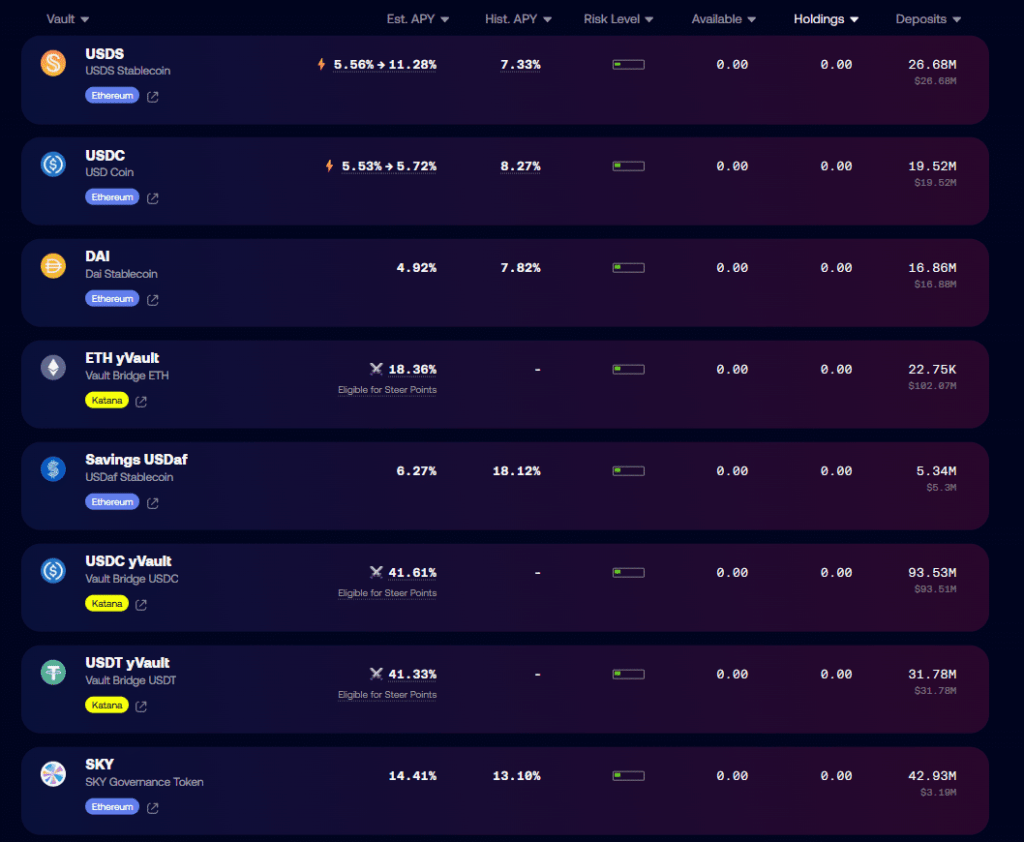
Some of the vaults available (Source: Yearn Finance)
Top DeFi developers in the community design these strategies and submit them to Yearn. Once approved, Yearn’s automated bots run the strategy: moving funds, harvesting rewards, selling one token for another if needed, and reinvesting gains. For example, Gemini explains one strategy: Yearn might deposit GUSD into a Curve stablecoin pool to earn trading fees, stake the pool tokens to earn additional rewards, sell part of those rewards for more stablecoins, and loop the process for extra gains.
As a user, you don’t have to do any of these steps yourself – Yearn’s “money robots†handle the entire process to aim for the “highest returns with the lowest risk.â€
Aside from vaults, Yearn also offers simpler products. Yearn Earn (also known as the “Earn†feature) acts like a high-yield savings account for stablecoins. With Earn, Yearn automatically shifts your deposit between top lending platforms (Compound, Aave, etc.) to always keep you on the highest APY.
You just select a stablecoin or wBTC to deposit, and Yearn’s system farms that deposit across protocols. This is simpler than vaults (which often use Curve strategies) and is mainly for stablecoin holders who want decent yields with lower complexity.
In both cases – Vaults or Earn – Yearn turns multiple DeFi actions into a one-click deposit for the user.
Benefits of Using Yearn Finance
Yearn Finance offers several advantages for yield farmers:
- Automated Yield Optimization: Yearn continuously moves funds to chase the best returns. As the market rates change, Yearn’s smart contracts reallocate deposits in real-time. This means even non-technical users can benefit from complex DeFi strategies without constant monitoring. No need to manually swap tokens or compare APYs – Yearn handles it automatically.
- Simplicity and Convenience: Depositing into a Yearn vault or earn product is as easy as a few clicks. You choose your asset (like DAI, USDC, WETH, etc.), approve the transaction in your wallet, and the Yearn system mints a vault token for you. You then simply hold that vault token. Yearn’s vault tokens are ERC-20 tokens, so you can even trade them or track them like any other crypto. In effect, Yearn bundles all the complicated steps (liquidity providing, reward harvesting, compounding) into a single, user-friendly interface.
- High Potential Returns: Because Yearn taps into the most profitable DeFi strategies, users often earn higher yields than they would by just leaving assets on one platform. Some Yearn vaults have delivered impressively high APYs during market peaks. This is largely because Yearn’s community develops optimized strategies (for example, using boosted Curve pools or leveraging borrowed assets) that can earn extra tokens. Over time, these strategies compound gains, growing the pool larger and raising each depositor’s share value.
- Compounding Interest: Yearn vaults are inherently auto-compounding. Any rewards earned by the vault are automatically reinvested into the vault, so yields compound over time without extra effort. As Shrimpy explains, profits from a vault are used to “increase the size of the vault’s assets… [growing] the vault’s overall yield,†giving you compound interest on a large pooled scale. In contrast, if you manually earned interest or yield, you’d have to withdraw and redeposit it yourself to achieve the same effect.
- No Minimums & Community-Driven: Many Yearn vaults have no or very low minimum deposit, making them accessible. The strategies are created and improved by a decentralized community of DeFi experts. Yearn’s open governance means anyone can propose new vault strategies or changes, and YFI token holders vote on upgrades. This community approach helps Yearn evolve constantly and tailor strategies to market conditions.
- Security and Transparency: Yearn Finance is fully on-chain and non-custodial – you keep custody of your assets in your wallet until you deposit and withdraw. Yearn has a strong focus on security. Its contracts are audited by multiple firms, and the project offers bug bounties to encourage vulnerability reporting. Every transaction Yearn makes is visible on public blockchains, so nothing is hidden. (Of course, no system is 100% foolproof, which leads us to risks below.)
Overall, Yearn streamlines DeFi yield farming into a “set it and forget it†experience. By pooling resources and expertise, it often delivers better risk-adjusted yields than most individuals could easily achieve on their own.
Risks and Considerations
While Yearn can boost returns, it’s crucial for new users to understand the potential risks:
- Market Volatility & Impermanent Loss: Crypto prices can be very volatile. If a vault holds your funds in a liquidity pool (say ETH/DAI), and one asset’s price moves a lot, you might suffer impermanent loss. This means your pooled position could be worth less in dollar terms than just holding the tokens separately, despite earning fees. Coinbase warns that yield farming can have high returns but comes with risks like impermanent loss. Even if you earn rewards, price swings might reduce or eliminate those gains.
- Smart Contract Risk: Yearn and its vault strategies are governed by smart contracts (code on the blockchain). Bugs or vulnerabilities in code can be exploited by hackers, potentially causing loss of funds. This is an inherent risk in DeFi. Yearn’s documentation and others caution that “even after code audits, yearn.finance could not be guaranteed to be 100% safe — DeFi involves inherent risk.†(Note: specific quote from Cronje is not in our sources, but the idea is clear.) Always remember there’s no FDIC insurance here – if something goes wrong in the protocol, you could lose money.
- Strategy Complexity & Liquidity Risk: Some Yearn vaults use complex multi-step strategies, including borrowing or leverage. For instance, the yETH vault borrows DAI against ETH, farms it, and then buys back ETH. As Gemini explains, such strategies “add a layer of complexity†– and if markets move unfavorably (like ETH’s price dropping too much), the vault could face liquidation or forced selling. In short, more complex strategies can be riskier. Yearn tries to manage these risks automatically, but there’s always a chance a strategy underperforms or incurs losses.
- Fees and Gas Costs: Using Yearn isn’t free. Vaults may charge management fees and performance fees on earnings (e.g., a percentage of profits). Also, every deposit or withdrawal requires an Ethereum transaction, which means paying gas fees. These fees can be substantial, especially when the network is busy. Shrimpy’s guide warns that high gas prices can eat into profits, and withdrawing too soon from a vault could be costly. To truly reap the benefit of Yearn, it’s often best to let your deposit sit and compound for a longer period, instead of depositing and withdrawing frequently.
- Liquidity and Exit Risk: In extreme market conditions, it might be hard to withdraw immediately from a vault at its expected value. If many users try to exit a vault at once, or if a vault’s assets become illiquid, you may face delays or slippage. Also, some newer Yearn products (like “Juiced Vaults†on lending protocol Ajna) note that “you may not be able to withdraw funds immediately if there is high borrowing demand.†Always check if there are any lock-up periods or exit conditions.
- Regulatory and Market Risk: The DeFi space is still evolving. Regulatory changes could impact protocols. Yearn was famously a pioneer (its YFI token briefly traded above Bitcoin’s price in 2020), but new competitors can emerge. Keep in mind that high crypto yields often mean higher risk. Treat any yield farming, including with Yearn, like a speculative investment.
In summary, Yearn offers powerful tools, but they come with typical DeFi warnings. Always do your own research, consider how much you can afford to lose, and maybe start with a small test deposit. Diversifying across assets and platforms can also help spread risk.
How to Get Started with Yearn Finance
For beginners ready to try Yearn, here’s a step-by-step guide:
- Set Up a Crypto Wallet: You’ll need a Web3 wallet like MetaMask, Trust Wallet, or Coinbase Wallet. Install the wallet browser extension or mobile app and create an account. Make sure to securely save your seed phrase. This wallet will hold your tokens and interact with Yearn.
- Acquire Crypto Tokens: Yearn runs mainly on the Ethereum network (and some L2s). You’ll need some ETH to pay transaction (gas) fees. You’ll also need tokens to deposit. Common choices include stablecoins (DAI, USDC, USDT) or major crypto (ETH, WBTC). Buy these on a crypto exchange (Binance, Coinbase, etc.) and send them to your wallet address. If you plan to use Yearn’s governance features, you might also acquire some YFI tokens on exchanges (YFI is used for voting and earns a share of protocol fees). But owning YFI is not required just to farm yields.
- Connect to Yearn: Go to the Yearn Finance app website: yearn.finance. This is the official interface. Click “Invest†and then “Vaults†(or “Earn†if using the simpler savings-like product). At the top, connect your wallet (e.g., click the MetaMask button). Your wallet address should appear in the corner once connected.
- Choose a Vault or Earn Product: You’ll see a list of available vaults (e.g., “yvUSDCâ€, “yvETHâ€, etc.) along with their current APYs and strategies. Select one for which you already have the underlying token. For instance, if you have USDC, find the yvUSDC vault. You can also switch to the “Earn†tab to deposit stablecoins into Yearn Earn pools. Each option shows details like minimum deposit, fees, and the estimated yield.
- Deposit Your Tokens: Click on the vault or Earn product, then click “Deposit†or “Investâ€. Enter how much of your token you want to deposit (you can also click “Max†to use all of that token in your wallet). The Yearn app will prompt your wallet to approve the token and then execute the deposit transaction. Confirm both operations in MetaMask (or your wallet). After the transaction completes (which might take seconds to a couple minutes), the vault tokens will appear in your wallet. For example, depositing into the YFI vault might give you yvYFI tokens, or depositing into the CRV vault might give yvCURVE-1 tokens (Yearn’s token names can look a bit technical).
- Watch Your Yield Grow: Once deposited, your vault token’s value will gradually increase as the vault earns returns. You can leave your position running without interacting further. Your Yearn dashboard will show your current balance and the current APY (net of fees). Many users simply check back occasionally or use portfolio trackers that support Yearn vaults.
- Withdrawing Funds: When you want to exit, go back to the same vault page and click “Withdraw†(or use the dashboard’s balance). Specify the amount (or “Maxâ€), confirm the transaction in your wallet, and you’ll get back the original token plus earned interest. The Yearn smart contract burns the vault tokens you return, releasing your share. Keep in mind, as noted above, withdrawing frequently can incur gas costs and might forfeit some yield due to how Yearn’s harvest cycles work.
- Alternative Front-Ends (Optional): Yearn vaults are also accessible through various front-end apps. The Yearn site itself is common, but there are other interfaces like Gimme (simple Yearn UI focusing on certain chains), or dashboards like Zap.fi and V2 (for older vaults). These do the same things but may have different visuals. Always double-check the URL to avoid phishing.
- Stay Informed: Join Yearn’s community on Twitter (X), Discord, or read the Yearn blog and forums for updates. Vault strategies are continuously updated. For example, Yearn moved to v3 vaults which follow the ERC-4626 standard, improving efficiency. Being aware of vault versions and fees helps you make better choices. Also monitor gas prices: on busy days it might be best to wait or skip small transactions.
In summary, the assets flow is: Wallet → Yearn Vault (smart contract) → vault token in wallet → back to wallet with profits on withdrawal. The Yearn app handles the on-chain details. As CMC AI notes, “Yearn’s vaults leverage the ERC-4626 tokenized vault standardâ€, meaning they’re open and composable with other DeFi protocols.
Throughout this process, you use the keywords Yearn Finance, yield farming, DeFi investing, and crypto passive income by simply depositing and holding in Yearn. Over time, this can boost your crypto earnings passively. Remember to always read the info for each vault (some have specific risks or require certain assets) and never invest more than you can afford to lose. With these steps, you’ll be well on your way to exploring yield farming on Yearn Finance.


