
Ethereum Holešky Testnet Nears End Ahead of Fusaka Launch
Ethereum’s largest testnet, Holešky, is preparing to shut down following a planned migration to the newer Hoodi testnet, the Ethereum Foundation confirmed Monday.
The decision comes after several technical issues earlier this year that left Holešky struggling with validator inactivity and exit queues.
The foundation said Holešky will be officially sunset two weeks after the upcoming Fusaka upgrade is finalized on the network, expected sometime in the second half of September.
After this, Holešky will no longer be supported by client, testing or infrastructure teams, the announcement stated. While an exact shutdown date has not been set, Ethereum developers plan to launch Fusaka on mainnet in November, leaving only a short window for the testnet’s final upgrade.
Also read: Will Ethereum Hit 10K? Examining ETH’s Potential
2 Years of Service Come to an End for Holešky
Launched in September 2023, Holešky was designed to provide a large-scale testing ground for Ethereum’s staking infrastructure and validator operations. The network played a key role in stress-testing protocol upgrades, most notably the Dencun and Pectra upgrades.
“The network served its purpose, enabling thousands of validators to test protocol upgrades,†the foundation noted. However, in early 2025 Holešky faced extensive inactivity leaks, leading to long validator exit queues before it eventually recovered.
Hoodi Steps In
To avoid repeating these issues, the Ethereum Foundation launched the Hoodi testnet in March 2025. Hoodi is already live with support for Pectra and is expected to carry forward testing of upcoming forks, including the Fusaka upgrade. Infrastructure operators and staking providers will now migrate their Holešky setups to Hoodi as part of the transition.
For smart contract and dApp testing, the foundation has recommended Sepolia as the go-to testnet, ensuring developers still have a reliable environment as Holešky winds down.
What’s Next: Fusaka and Beyond
The Ethereum roadmap remains packed. Fusaka — short for “Fulu-Osaka†— is scheduled to launch on mainnet in November 2025. The hard fork will focus on improving rollup efficiency by distributing data availability workloads more evenly across validators, potentially lowering costs and boosting scalability for layer-2 networks. In total, Fusaka will include 11 Ethereum Improvement Proposals (EIPs).
Looking further ahead, Ethereum developers are also working on the “Glamsterdam†upgrade planned for 2026. Among other changes, it proposes halving block times to 6 seconds under EIP-7782, a shift that could speed up transaction finality while providing more room for zero-knowledge proof computation.
Market Context
Ethereum’s ongoing upgrades aren’t just technical — they’re beginning to ripple into financial markets as well. In recent months, several publicly traded companies have added Ether (ETH) to their treasuries, helping fuel a rally of more than 200% since April, with ETH recently trading at $4,373.
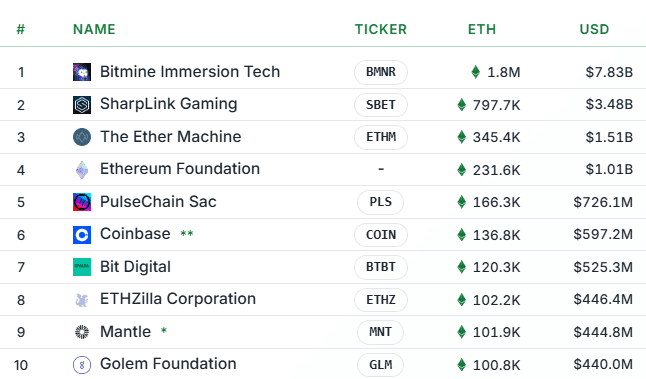
Top 10 largest ETH treasury holders (Source: StrategicETHReserve)
The shutdown of Holešky marks the end of a chapter in Ethereum’s development, but with Hoodi stepping up, the network’s testing environment appears stronger and more resilient for the next wave of upgrades.


