Tron Slashes Network Costs by 60% to Ride $82B Stablecoin Wave
Tron, the blockchain network behind TRX, has become significantly cheaper to use after its community of token holders voted to slash transaction fees by 60%.
The move, announced by the project’s founder Justin Sun on X, took effect Friday and marks one of the most aggressive fee reductions seen across major blockchains.
Sun, the billionaire crypto entrepreneur behind several digital asset ventures, framed the decision as a win for users—even if it impacts Tron’s bottom line in the short term.
“For users, this fee reduction is a real benefit,†Sun wrote. “Cutting fees by 60% is bold and rare for any network. In the short term, Tron’s profitability will be affected, since network fees are directly reduced by 60%. However, in the long run, profitability will improve as more users and more transactions take place on the Tron network.â€
Tron’s Rising Fee Problem
The project has historically been one of the cheapest blockchains to transact on, but average costs have been climbing in recent months. According to Token Terminal, the average fee to process a transaction on the network rose to $1.70, spiking as high as $2.50 in December.
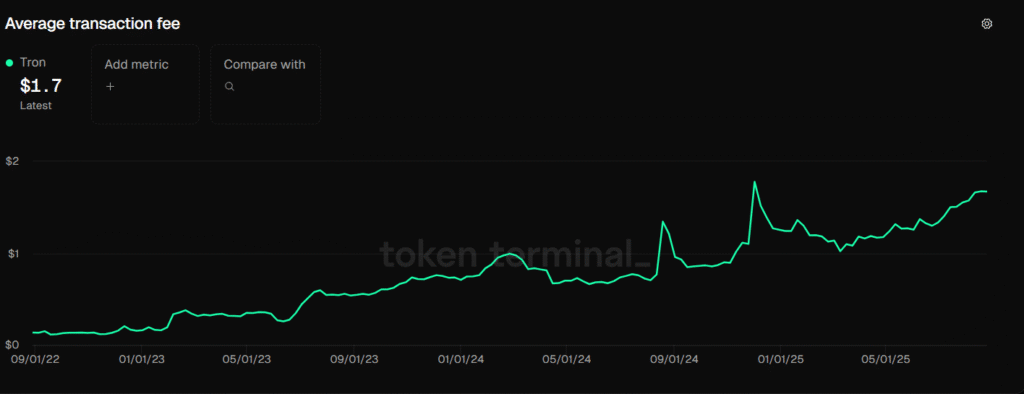
Average TRX transaction fee (Source: Token Terminal)
By comparison, Ethereum—the largest blockchain for stablecoins and decentralized finance—often sees transaction fees reach double-digit dollar amounts during peak demand, though its recent scaling efforts have brought some relief.
With the new fee structure, Tron hopes to reclaim its reputation as a low-cost, fast settlement layer for crypto transactions.
Stablecoin Powerhouse
The fee cut comes as Tron cements its position as a leading blockchain for stablecoins, the dollar-pegged tokens widely used across the crypto economy for payments, trading, and decentralized finance (DeFi).
According to DeFiLlama, the blockchain hosts over $82 billion worth of stablecoins, making it the second-largest network for stablecoins after Ethereum’s $148.5 billion.Â
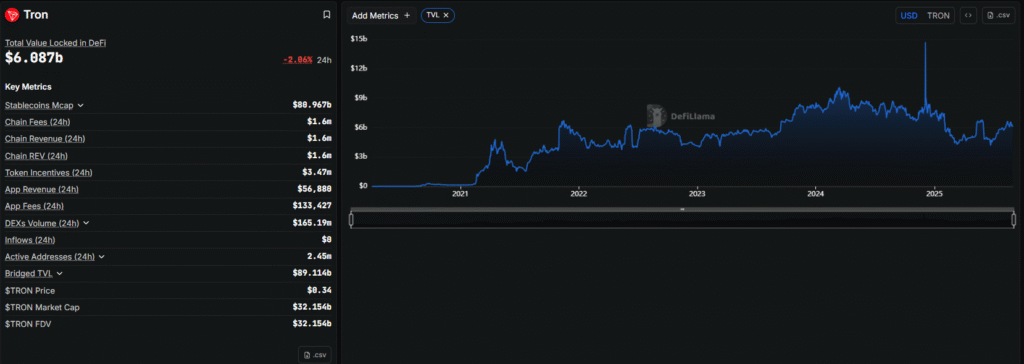
TVL overview (Source: DefiLlama)
Together, the two chains account for nearly 80% of the global stablecoin market. Tron’s share alone represents close to 30% of the $283.3 billion total stablecoin market cap across all networks.
Major issuers such as Tether (USDT) and Circle (USDC) support their tokens on Tron, making the blockchain one of the most widely used for cross-border stablecoin transfers. Its appeal lies in its speed and affordability, a combination now reinforced by this latest fee reduction.
The fee slash reflects a broader trend in crypto where networks compete on cost efficiency to attract users, liquidity, and developers. While the move could dent its immediate profitability, Sun is betting that cheaper transactions will lead to greater adoption, especially among the millions of users who rely on stablecoins for payments and trading outside traditional banking rails.
As stablecoin adoption continues to expand globally—both in DeFi and as a tool for cross-border remittances—Tron’s bold gamble could solidify its status as the go-to low-cost network for dollar-pegged assets.


