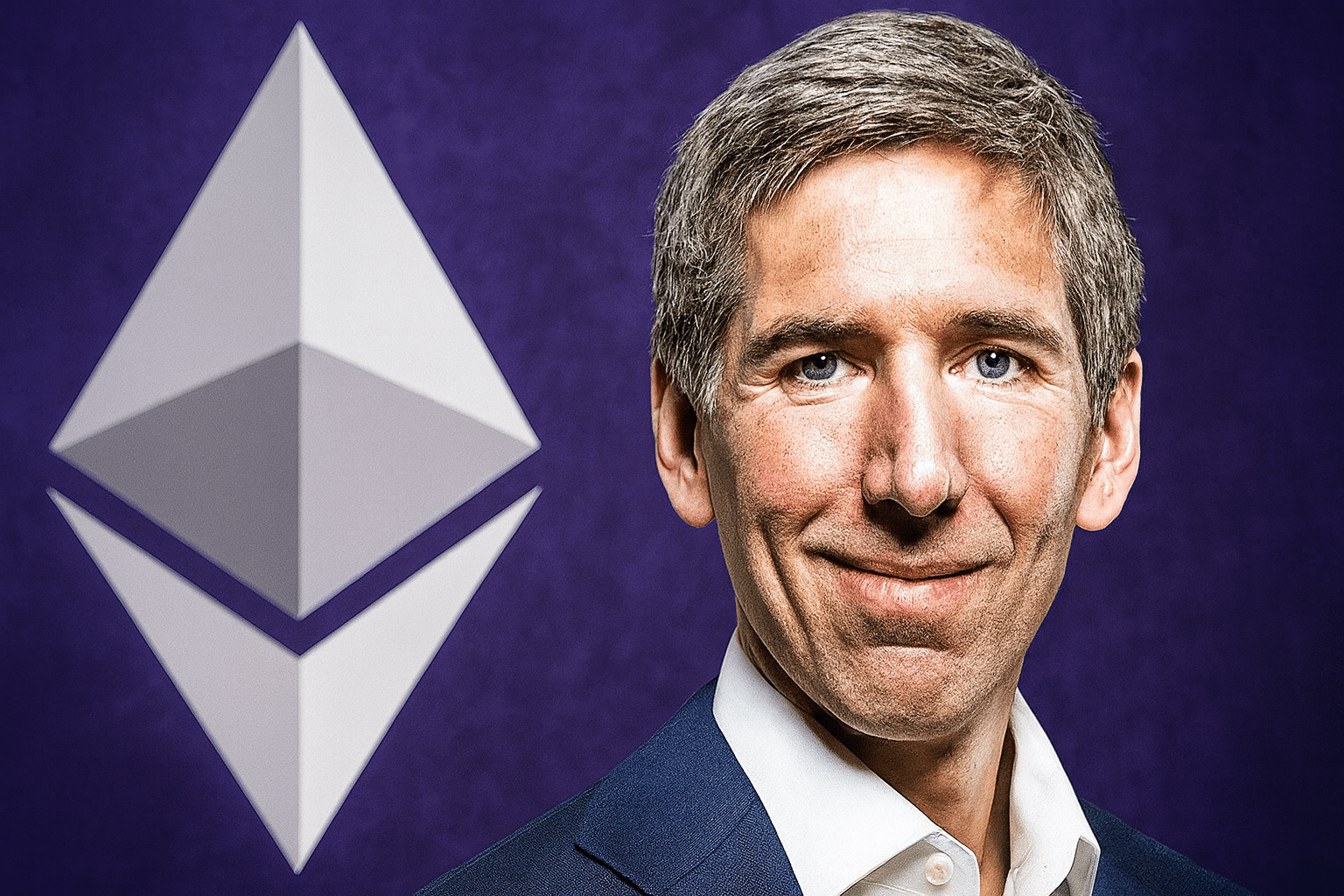
Matt Hougan: Ethereum Is Becoming Wall Street-Ready
Ethereum (ETH) has recently been progressively gaining ground with institutional investors as treasury and holding companies address its long-standing “narrative problem,” according to Bitwise Chief Investment Officer Matt Hougan.
By structuring ETH in equity-like assets, these companies are backing ETH with traditional finance, bringing high capital inflows and solidifying its status in institutional portfolios a decade after its mainnet launch.
Ethereum Gains Attention with Traditional Finance
Ethereum’s multi-use cases—from decentralized apps to smart contracts and staking—have historically been difficult for traditional investors to adopt.
Hougan explains that treasury and holding companies have solved this challenge by packaging ETH into structures that generate staking yields, similar to dividends or interest that are familiar to Wall Street.
This “equity-wrapper” approach has positioned ETH as an institutional-grade asset, attracting substantial capital.
Bitwise data shows that since May 15, 2025, exchange-traded products (ETPs) and corporate treasuries have acquired 2.73 million ETH, worth over $10 billion, representing 32 times the net new ETH issuance.

Amount of ETH held by companies (Source: StrategicETHReserve)
SharpLink Gaming, led by Ethereum co-founder Joseph Lubin, recently raised $413 million to buy 74,656 ETH, increasing its holdings to 280,706 ETH, worth approximately $840 million. Similarly, BitMine Immersion Tech added over $1 billion in ETH, bringing its total to 300,657 ETH.
These acquisitions show the growing corporate interest in Ethereum as a strategic asset.
Ethereum’s Rise in Institutional Portfolios
ETH’s institutional adoption is in line with its strong market activity.
The cryptocurrency recorded $58 billion in altcoin futures open interest, surpassing Bitcoin’s perpetual futures volume for the first time since 2022, as reported by Ecoinimist. This is in line with $5 billion in ETP inflows since May 2025, including $2 billion from ETFs.
Ethereum also holds a major share of tokenized real-world assets (RWAs), with Bitwise estimating 60% market dominance.
Traditional finance’s exploration of Ethereum layer-2 solutions for tokenizing trillions in RWAs further solidifies ETH’s role in bridging crypto and traditional markets. Such dynamics are proof of Ethereum’s evolution as a premier asset class for institutional portfolios.
Will Growth Outweigh the Risks?
Despite the momentum, there are challenges. Ethereum’s volatility poses challenges for short-term investors, while treasury companies must carefully manage debt to avoid overleveraging.
Hougan suggests that small, long-term ETH allocations can serve as an inflation hedge, reducing volatility concerns.
The risk of a “catastrophic unwind”—a forced liquidation of crypto assets to satisfy debt—is low due to staggered debt maturities, although partial unwinds are still plausible under unfavorable circumstances.
Bitwise’s Jeff Park made a speculative guess in a YouTube interview that ETH could reach $10,000 in 2025, though Standard Chartered’s $4,000 target offers a more conservative outlook.
With firms like BlackRock and BTCS Inc. increasing ETH holdings, and Bitwise projecting $20 billion in additional inflows, Ethereum’s institutional trajectory appears strong, provided volatility and debt risks are managed effectively.


