
Ethereum for Beginners: Guide to Ethereum Price, Blockchain, DeFi, and How to Buy
Ethereum is a decentralized, open-source blockchain platform launched in 2015 by a team led by Vitalik Buterin.
Unlike Bitcoin’s focus on digital money, Ethereum was designed to be a “global computer” powering decentralized applications via smart contracts. In simple terms, Ethereum lets anyone run code on a distributed network of computers, enabling features like programmable transactions, decentralized finance (DeFi), nonfungible tokens (NFTs), and more. Its native cryptocurrency is Ether (ETH), which is used to pay transaction fees (called “gas”) and secure the network through staking. Overall, Ethereum has grown into the second-largest cryptocurrency platform in the world, with a vibrant ecosystem of developers, users, and applications.
Ethereum’s appeal lies in its versatility and community. Developers can build decentralized applications (DApps) on Ethereum’s blockchain, which means these apps run without any central authority. This innovation has unlocked use cases far beyond simple payments – from decentralized lending platforms to NFT marketplaces.
Many consider Ethereum as a foundational platform for Web3, the next generation of the internet that emphasizes decentralization and user control. For newcomers, it’s important to understand that “Ethereum” refers to the network or platform, while “Ether (ETH)” is the currency that powers it. In the following sections, we’ll break down Ethereum’s price history, latest developments as of mid-2025, its role in DeFi, how its technology works (including upcoming upgrades), a brief history of how it came to be, steps on how to buy and store ETH, and answers to frequently asked questions.
Also read: Is Ethereum the Next Amazon?
Ethereum Price Performance (2015–2025)
Ethereum’s price history has been marked by dramatic growth cycles and volatility. Launched in 2015 with an initial value of under $1, Ether remained relatively cheap in its early years (trading around $0.30 at launch). It wasn’t until 2017 that ETH began gaining major traction, entering a series of boom-and-bust cycles over the subsequent years:
- 2015–2016: After the network went live in July 2015, Ether traded below $1 for months. By early 2016 it was still only a few dollars, reflecting its niche status at the time.
- 2017 Bull Run: Ethereum’s breakthrough came during the 2017 crypto bull market. ETH skyrocketed from around $8 in early 2017 to over $1,400 by January 2018, one of the best-performing assets of that rally. This surge was fueled by initial coin offerings (ICOs) launching on Ethereum and growing mainstream awareness.
- 2018 Crash: Following the peak, Ethereum (like most cryptocurrencies) entered a deep bear market. ETH plummeted roughly 94% from its high, hitting lows around $80 in December 2018. In other words, by late 2018 Ether had lost almost all the gains of the previous year, demonstrating the extreme volatility of crypto markets.
- 2019–2020 Recovery: Ethereum stabilized in 2019 and early 2020, generally trading in the $100–$300 range during this period. Behind the scenes, development continued (e.g. work on Ethereum 2.0) and early DeFi projects on Ethereum started to attract users.
- 2021 Surge: Another massive rally came in 2021. Ether hit a new all-time high around $4,800 in November 2021, driven by a wave of institutional investment, the explosion of DeFi and NFTs, and overall crypto market euphoria. Ethereum’s market cap soared, solidifying its status as the #2 cryptocurrency.
- 2022 Downturn: In 2022 the crypto market turned bearish amid macroeconomic tightening and some high-profile industry collapses. Ethereum was not spared – ETH fell from the ~$4,800 peak to below $1,000 at its worst point in mid-2022, a drop of around 80%. Notably, 2022 also saw the successful implementation of The Merge (more on this later), which helped Ethereum weather the storm by improving its sustainability and narrative.
- 2023–Mid 2025: Through 2023 and into 2024, Ethereum’s price gradually recovered alongside the broader market. By early 2024, optimism returned with developments like Ethereum exchange-traded funds (ETFs) launching in the U.S. (July 2024) and upgrades improving the network. As of mid-2025, Ether trades around the $2,500 range, reflecting renewed confidence and increased network usage, though still about 50% below the 2021 peak. This price is significantly higher than just a couple of years prior, showcasing Ethereum’s long-term growth despite shorter-term volatility.
In Summary
| Year | Start Price (USD) | End Price (USD) | Key Highlights |
| 2015 | ~$0.30 | ~$0.90 | Ethereum launches in July; early adoption stage. |
| 2016 | ~$0.90 | ~$8.00 | Gradual growth, The DAO hack and subsequent hard fork create Ethereum Classic. |
| 2017 | ~$8.00 | ~$740 | ICO boom drives massive demand; ETH hits ~$1,400 in Jan 2018. |
| 2018 | ~$740 | ~$135 | Post-ICO crash; ETH drops over 90% from ATH. |
| 2019 | ~$135 | ~$130 | Sideways market; development focused on ETH 2.0. |
| 2020 | ~$130 | ~$730 | “DeFi Summer” starts; ETH usage and price rise. |
| 2021 | ~$730 | ~$3,700 | NFTs explode; ETH hits ATH ~$4,800 in Nov. |
| 2022 | ~$3,700 | ~$1,200 | Market crash; The Merge transitions ETH to proof-of-stake. |
| 2023 | ~$1,200 | ~$2,300 | Recovery year; Shanghai upgrade enables staked ETH withdrawals. |
| 2024 | ~$2,300 | ~$2,900 | Dencun upgrade lowers L2 costs; spot ETH ETFs approved in US. |
| 2025 | ~$2,900 | ~$2,500 (mid-year) | Record ETH staking; rising L2 usage and regulatory clarity. |
Overall, Ethereum’s price performance from 2015 to 2025 can be characterized by extreme volatility with an upward trajectory over the long run. Early investors who bought ETH for mere cents or dollars have seen astronomical percentage gains.
However, newcomers should note that Ethereum has experienced multiple 70–90% drawdowns in its history before recovering. This cyclical behavior underlines the speculative and high-risk nature of cryptocurrency markets.
Also read: Will Ethereum Hit 10K? Examining ETH’s Potential
Still, Ethereum’s strong rebound from each downturn (2018 and 2022) and its sustained developer activity indicate a resilient ecosystem. Long-term holders often point out that Ethereum’s fundamentals – such as network usage and upgrades – have improved even as the price fluctuates. In summary, ETH’s journey from nearly worthless in 2015 to thousands of dollars today is a testament to both the potential and the volatility inherent in crypto investing.
Latest Ethereum News and Developments (July 2025)
As of July 2025, Ethereum is experiencing significant developments in both its technology roadmap and its adoption.
One of the biggest stories is the success of Ethereum’s transition to proof-of-stake and the growth of staking on the network. By mid-2025, more than 35 million ETH (over 28% of the total supply) is locked up in staking contracts, indicating many investors are committing to Ethereum long-term.
That has reduced the liquid supply of ETH available on the market, which some analysts say is contributing to price stability and a “supply squeeze” effect.
Meanwhile, in a positive regulatory development, U.S. authorities have provided clarity on staking: the SEC stated in May 2025 that certain “protocol staking” activities (where users lock up crypto to secure a PoS network) do not need to be registered as securities offerings. This guidance was seen as a win for Ethereum and the crypto industry, as it removes some uncertainty around the legality of staking for U.S. participants.
Also read: Etherscan: Your Ultimate Ethereum Blockchain Explorer Guide
However, the SEC has delayed approval of any Ether staking yield ETFs so far, meaning investors cannot yet buy a fund that directly yields ETH staking rewards. Despite that, the overall regulatory outlook by mid-2025 is cautiously optimistic, with clearer rules gradually forming around Ethereum’s new PoS-based features.
Another headline is the continued mainstream financial integration of Ethereum. In July 2024, the first U.S. spot Ethereum Exchange-Traded Funds (ETFs) were approved and launched, allowing investors to gain ETH exposure through traditional stock markets.
Products from firms like BlackRock and VanEck began trading, reflecting growing institutional acceptance of ETH as an asset class. This followed the earlier introduction of futures-based Ethereum ETFs in 2023.
The availability of ETFs has made it easier for retail and institutional investors to invest in Ethereum without managing crypto wallets, potentially broadening the investor base.
Additionally, at least one publicly listed company has embraced Ethereum for its corporate treasury: in July 2025, SharpLink Gaming announced it adopted ETH as its primary reserve asset and is staking its holdings to earn yield, calling Ethereum the “foundational layer for global finance” in its strategy. This move – akin to companies that hold Bitcoin as a treasury reserve – signals confidence in Ethereum’s long-term value proposition.
Together, these developments show that Ethereum is not only evolving technologically but also gaining credibility in traditional finance.
On the technology front, Ethereum’s developers continue to push upgrades to improve scalability and usability. In March 2024, the network implemented the “Dencun” upgrade (Cancun + Deneb hard forks) which introduced several Ethereum Improvement Proposals (EIPs), most notably EIP-4844 (proto-danksharding). This upgrade added “blob” data transactions that make it much cheaper for layer-2 rollups to publish data to Ethereum, thereby reducing transaction fees on layer-2 networks and moving closer to the vision of sharding.
In plainer terms, Ethereum is laying the groundwork for sharding, a technique that will split the blockchain’s load into smaller parts to greatly increase throughput. By mid-2025, most user activity growth is happening on layer-2 networks (like Optimism, Arbitrum, Polygon) that benefit from these upgrades, helping Ethereum scale.
The core developers are now working on the next stages of the roadmap (often dubbed the Surge, Verge, Purge, and Splurge phases) which will further improve scalability, verifiability, and efficiency of the Ethereum protocol. Each successful upgrade (e.g. the Merge in 2022, Shanghai in 2023, Dencun in 2024) builds confidence that Ethereum can eventually handle mass adoption without prohibitive fees or slow speeds.
Users can look forward to forthcoming enhancements such as full shard chains and improvements to the Ethereum Virtual Machine, which aim to cement Ethereum’s position as the leading smart contract platform.
In summary, the state of Ethereum in mid-2025 is one of continued progress and maturation. The network is more secure and energy-efficient after the switch to proof-of-stake, a large portion of ETH is now staked by holders betting on its future, and institutional adoption is rising through avenues like ETFs and corporate treasury usage.
At the same time, Ethereum’s developers aren’t resting – they are actively delivering upgrades that address the network’s historic pain points (high fees and congestion). Ethereum’s co-founder Vitalik Buterin has often framed 2022–2025 as the years of achieving “Ethereum 2.0”, and indeed many of those goals (proof-of-stake, lower fees via rollups, etc.) are being realized. For crypto enthusiasts and beginners, Ethereum’s latest developments reinforce that it remains at the forefront of blockchain innovation, while also increasingly intertwined with the traditional financial world.
Ethereum’s Role in Decentralized Finance (DeFi)
Ethereum is widely considered the birthplace of decentralized finance, and it continues to be the leading platform for most DeFi applications.
In contrast to traditional finance, DeFi refers to financial services – like lending, borrowing, trading, and investing – that operate on blockchain networks without centralized intermediaries. Ethereum’s smart contract functionality enabled developers to recreate many financial instruments in a transparent and permissionless way, open to anyone with an Internet connection.
Starting around 2018 and exploding in 2020’s “DeFi summer,” dozens of protocols built on Ethereum showed what an open financial system could look like. Users could lend their crypto assets and earn interest, trade tokens on decentralized exchanges, or collateralize ETH to borrow stablecoins – all through code rather than through banks or brokers.
During the DeFi boom of summer 2020, Ethereum suddenly became a hotbed of experimentation in finance. New users flocked to the network to try protocols like Compound and Aave (for lending/borrowing) and Uniswap (for token swaps), among hundreds of others.
This sparked a surge in borrowing, lending, and trading of digital assets across Ethereum, with many protocols incentivizing participation by issuing their own governance tokens. Yield farming – chasing high returns by providing liquidity to DeFi platforms – became a popular strategy, drawing even more capital into the ecosystem.
Also read: How to Invest in DeFi: A Guide to Decentralized Finance
By late 2021, the total value locked (TVL) in Ethereum DeFi protocols had grown to tens of billions of dollars, and Ethereum accounted for the majority of DeFi activity across all blockchains. Even after market cycles, Ethereum still dominates DeFi with over 50% of all value locked in 2025, reflecting its network effect and first-mover advantage in this sector.
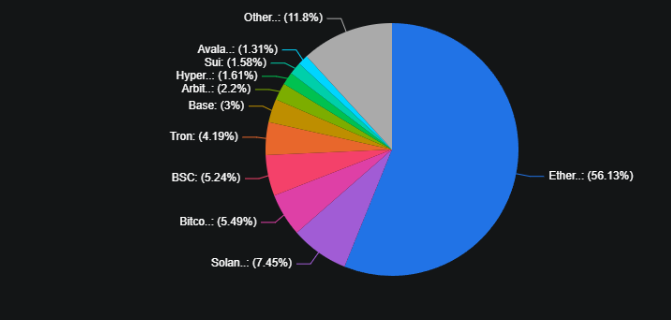
DeFi TVL by chain (Source: DefiLlama)
Ethereum’s role in DeFi is fundamental because it provides the base layer infrastructure: its security and decentralization underwrite the trustlessness of DeFi applications. Most DeFi protocols rely on Ethereum’s blockchain for settlement and on Ether as either a reserve asset or for paying gas fees. For example, MakerDAO – the protocol behind the DAI stablecoin – uses ETH as primary collateral for loans, and Uniswap’s liquidity pools often involve ETH pairs. The composability of Ethereum’s smart contracts means these applications can interconnect; users can, for instance, deposit ETH into a lending platform and receive tokens that they then use on another platform, all seamlessly on Ethereum.
This has led to a “money lego” effect where innovation compounds. However, this activity is not without challenges: at times of peak usage (e.g. bull markets), Ethereum’s network became congested and gas fees (transaction fees) spiked to very high levels, making small DeFi transactions impractical. This is one reason why scaling solutions and Ethereum upgrades are so crucial for DeFi’s future growth.
Despite competition from other smart contract chains, Ethereum still anchors the DeFi landscape. As of 2025, it boasts the richest ecosystem of DeFi dApps and the deepest liquidity. For instance, protocols like Aave and Compound each have on the order of $5–10+ billion in TVL (even after a crypto bear market) and handle hundreds of millions in daily volume.

Ethereum on-chain statistics (Source: DefiLlama)
Decentralized exchanges on Ethereum (including layer-2 versions) facilitate a significant portion of global crypto trading. Moreover, Ethereum’s security (backed by thousands of validators worldwide) offers DeFi users stronger assurances against hacks or failures compared to newer, less decentralized chains. It’s also worth noting Ethereum’s central role in the stablecoin economy – popular stablecoins such as USDC, USDT, and DAI largely use Ethereum as their main chain, and they are integral to most DeFi operations.
In summary, Ethereum can be seen as the decentralized Wall Street of the crypto world: it’s where the largest array of financial applications live, enabling a parallel financial system that is open and programmable.
For beginners interested in DeFi, learning Ethereum basics is a great first step, since most foundational DeFi apps (lending pools, DEXs, yield optimizers, etc.) were built on Ethereum and often still launch there first before expanding to other chains.
How the Ethereum Blockchain Works (Smart Contracts & Upgrades)
At its core, Ethereum works like a distributed computer that anyone can use but no single entity controls. Thousands of independent nodes (computers running Ethereum client software) maintain a shared ledger known as the blockchain, which records all transactions and smart contract code executions. Every Ethereum node stores a copy of the blockchain and the current state of all smart contracts, and they all must consensus – agree on any change by validating blocks of new transactions.
Originally, Ethereum used a proof-of-work (PoW) consensus mechanism (similar to Bitcoin’s) where miners expended computing power to secure the network. However, in September 2022, Ethereum completed “The Merge” upgrade which transitioned the network to proof-of-stake (PoS) consensus. In PoS, security is provided by validators who lock up ETH (stake it) and run software to propose/attest to new blocks. This change was monumental – it reduced Ethereum’s energy consumption by >99% (ending the need for energy-intensive mining) and set the stage for better scalability.
| Feature | Proof of Work (PoW) | Proof of Stake (PoS) |
| Used By Ethereum Until | September 2022 | Active since The Merge (Sept 2022) |
| Validation Mechanism | Miners solve complex puzzles to add blocks | Validators stake ETH and are randomly selected |
| Energy Consumption | Very high (uses significant electricity) | Very low (over 99% reduction from PoW) |
| Equipment Needed | Specialized mining hardware (GPUs/ASICs) | Standard computer + 32 ETH (or use staking pool) |
| Security Model | Based on computing power (hash rate) | Based on economic stake and slashing penalties |
| Incentive to Participate | Mining rewards + transaction fees | Staking rewards + transaction fees |
| Attack Resistance | Expensive to attack due to energy cost | Costly to attack due to required staked ETH |
| Decentralization Risk | Can lead to mining centralization | More inclusive via staking pools and services |
| Environmental Impact | High carbon footprint | Eco-friendly and sustainable |
| Ethereum’s Current Model | Deprecated | Active since September 2022 |
Smart contracts are the defining feature of Ethereum. A smart contract is basically a program or set of rules stored on the blockchain that automatically executes when its conditions are met. These contracts are immutable (cannot be changed once deployed) and self-enforcing, which means they enable trustless agreements and applications.
Vitalik Buterin’s 2013 white paper introduced smart contracts as “automated, immutable if-then statements” on the blockchain. For example, a simple smart contract might stipulate “If Person A sends 1 ETH to the contract, then Person B will receive a certain digital asset.” Once such a contract is deployed, the Ethereum network will ensure its instructions execute exactly as written, without needing any middleman. This programmatic flexibility allows developers to create tokens, financial instruments, games, identity systems – virtually any application logic – directly on the Ethereum blockchain.
Solidity, Ethereum’s primary programming language, is used to write smart contracts, which are then compiled to Ethereum Virtual Machine (EVM) bytecode and deployed. Every time a smart contract function is invoked (for instance, a token transfer or a trade on a DEX), each node runs the contract code on the EVM to verify the outcome, and the user must pay “gas” fees in ETH proportional to the computing resources used. Gas ensures transactions are not free (preventing spam) and miners/validators are rewarded for processing computations.
One important aspect of using Ethereum is gas fees and network congestion. Each block on Ethereum has a limited capacity measured in “gas.” When the network is very busy (many people transacting or interacting with contracts at once), users compete by offering higher gas fees to get their transactions included faster.
As a result, gas prices (denominated in gwei, a fraction of ETH) can skyrocket during peaks, sometimes making transactions costly. Ethereum partially addressed this with the EIP-1559 fee burn mechanism in 2021, which introduced a base fee that is burned (reducing ETH supply) and a tip to incentivize miners/validators. While EIP-1559 made fees more predictable and even turned ETH into a deflationary asset at times, high demand can still lead to expensive fees. This is where the ongoing upgrades come in.
Ethereum’s developers have a long-term roadmap to drastically improve the network’s scalability and efficiency, often referred to as Ethereum 2.0 (though that term is being phased out in favor of just “the consensus layer” upgrades). The key upgrade completed so far is The Merge, which as mentioned, moved Ethereum to PoS. Next on the roadmap is sharding, which aims to split the blockchain’s data processing across 64 or more shard chains to multiply capacity. Instead of every node having to process every single transaction, shards will allow parallel processing, with a coordination mechanism to keep everything secure and consistent.
Implementing sharding is complex, so Ethereum is taking a phased approach. In the interim, the strategy has shifted to a “rollup-centric” approach: encouraging use of layer-2 solutions (like Optimistic and ZK-Rollups) that handle transactions off-chain and post summarized data to Ethereum. The recent proto-danksharding (EIP-4844) is a step towards full sharding, making these rollups significantly cheaper by allowing blocks to carry temporary blob data for rollups at low cost. Beyond the Surge (sharding), later roadmap stages include the Verge (introducing Verkle trees to lighten node storage requirements), the Purge (pruning old history to reduce node bloat), and the Splurge (miscellaneous improvements for long-term efficiency). These upgrades, with whimsical names, all serve the serious purpose of ensuring Ethereum can scale to billions of users while remaining decentralized and secure.

Blockchain sharding (Source: Medium)
To put it simply for a beginner: Ethereum today works like a global, decentralized computer powered by ETH, where you pay ETH to run programs (smart contracts) that can enforce agreements without middlemen. The community is constantly improving this computer – making it faster, cheaper, and more powerful – through carefully planned upgrades. Thanks to the switch to proof-of-stake, anyone can participate in securing Ethereum by staking 32 ETH to become a validator (or smaller amounts via staking pools or services). Stakers earn rewards in ETH for helping run the network, taking over the role miners used to play.
The combination of EIP-1559 (burning fees) and staking has even introduced an element of deflation to Ether’s economics, as sometimes more ETH is burned than issued in rewards, causing the supply to decline slowly. Ethereum’s architecture and continuous upgrades underscore an important point: it is not static. It’s an evolving platform, and that adaptability is a big reason it remains the leading smart contract blockchain even as new competitors emerge. For users, this means Ethereum should become more user-friendly over time, with the high gas fees of the past hopefully becoming a rare occurrence as innovations like sharding and rollups take effect.

Brief History of Ethereum (Founding & Major Milestones)
Ethereum’s journey from an idea to a multi-billion-dollar network is a story of rapid innovation and some dramatic moments. Here’s a brief history of the major milestones in Ethereum’s evolution:
- Founding (2013–2014): Ethereum was first conceived by Vitalik Buterin, a young programmer who had been involved with Bitcoin. In late 2013, at just 19 years old, Buterin published the Ethereum white paper outlining a “next-generation smart contract and decentralized application platform” to overcome Bitcoin’s limitations. He envisioned a blockchain not just for currency, but for programmable money and applications – often explaining the difference by analogy: “Bitcoin is like a calculator, Ethereum is like a smartphone” that can run many apps. In 2014, Vitalik and several co-founders (including Gavin Wood, Charles Hoskinson, and Joseph Lubin) formally established the project and the Ethereum Foundation. They decided Ethereum would be developed as a non-profit platform (famously settling disputes in a meeting nicknamed the “Red Wedding” where some co-founders, like Hoskinson, departed over this vision). To fund development, Ethereum conducted an initial coin offering (ICO) in mid-2014, selling ETH tokens to the public. The ICO raised about $18 million worth of Bitcoin (a huge sum at the time) between July and September 2014. Early investors could buy 1 ETH for around $0.30 in the crowdsale.
- Launch and Early Growth (2015–2016): The Ethereum network officially launched on July 30, 2015, an event known as the Frontier release. This marked the mining of the genesis block and the beginning of real ETH trading (initial price was about $0.31 per ETH on day one). Developers and tinkerers began deploying smart contracts, and the first decentralized applications (like simple games and tokens) were created. In 2016, Ethereum hit its first real test and crisis. A user-built venture fund on Ethereum called The DAO (Decentralized Autonomous Organization) raised ~$150 million in ETH from the community, aiming to democratically invest in projects. However, on June 17, 2016, The DAO was hacked due to a flaw in its smart contract – an attacker stole 3.6 million ETH (worth around $60M at the time). This was a massive blow, causing ETH’s price to plunge from about $20 to $9 in 48 hours and a huge controversy over what to do next. The Ethereum community faced a philosophical dilemma: Should they “roll back” the hack by altering the blockchain history to return the stolen funds, or should they accept the immutability of the ledger (code is law) even though it meant the hacker kept the money? After intense debate, the majority decided to execute a hard fork in July 2016 to reverse the DAO theft. This created a new version of the Ethereum chain where the stolen ETH was refunded to a recovery contract, retaining the name Ethereum (ETH). A minority who objected continued on the original, unaltered chain, which became known as Ethereum Classic (ETC). This was a pivotal moment that established Ethereum’s social governance: the community chose to intervene in extreme circumstances, a decision still discussed in crypto ethics circles.
- Entering the Mainstream (2017–2018): After surviving the DAO fork, Ethereum began to gain mainstream attention. 2017 was the year of the ICO boom, and Ethereum was the platform of choice for launching new tokens. Hundreds of projects created ERC-20 tokens (a standard for tokens on Ethereum) and raised funds, driving demand for ETH (which you needed to buy into ICOs). This speculative mania pushed ETH’s price from under $10 at the start of 2017 to about $1,400 by January 2018. Ethereum’s market capitalization soared and it firmly became the #2 cryptocurrency after Bitcoin. However, this rapid growth also highlighted Ethereum’s scalability issues: as usage spiked, the network became congested and fees rose. One famous incident was CryptoKitties in late 2017, one of the first NFT projects, where users bred and traded unique digital cats. CryptoKitties became so popular that it “broke” Ethereum’s network capacity in December 2017, significantly slowing down transactions. This showed both the potential (a fun new use case: NFTs) and the challenges (congestion) of Ethereum. By 2018, as regulatory scrutiny of ICOs increased and the crypto market cooled, Ethereum entered a downturn. Many ICO projects failed or sold off their ETH, contributing to a price collapse of over 90% from the peak. By December 2018, ETH traded around $80, erasing much of the previous year’s gains. This period tested the resolve of Ethereum developers and believers, but development continued through the crypto winter.
- Building and Upgrading (2019–2021): In 2019, Ethereum developers regrouped to focus on the planned upgrades (at that time often called Ethereum 2.0). Multiple network upgrades (Byzantium, Constantinople, etc.) were implemented to tweak protocol parameters and improve efficiency in small ways. In 2020, despite low prices, a renaissance for Ethereum began in the form of DeFi. Protocols like Compound, Aave, Uniswap, and Yearn.finance took off, and “DeFi Summer 2020” brought a surge of on-chain activity and innovation. This set the stage for the next bull market. By late 2020 and into 2021, crypto markets boomed again, and Ethereum was a major beneficiary. Institutional investors started taking note (CME launched ETH futures in Feb 2021, for example). The rise of NFTs in 2021, from art (like Beeple’s $69M NFT sale) to collectibles (CryptoPunks, Bored Ape Yacht Club), all largely on Ethereum, drove tons of new users to the platform. In November 2021, ETH reached a new all-time high around $4,850, reflecting these trends. A significant upgrade was deployed in August 2021: EIP-1559 as part of the London hard fork, which introduced fee burning. This started reducing ETH supply with each transaction, laying groundwork for “ultrasound money” (a term for ETH potentially becoming deflationary). By the end of 2021, Ethereum was handling billions of dollars in daily transaction volume and had a more robust ecosystem than ever, but high gas fees were pricing out many retail users, highlighting the urgent need for scaling solutions.
- The Merge and Aftermath (2022–2023): Ethereum’s most anticipated upgrade, The Merge, finally took place on September 15, 2022. This event merged the legacy Ethereum mainnet with the new Beacon Chain (the PoS chain that had been running in parallel since Dec 2020) – resulting in a full switch to proof-of-stake consensus for block production. The network continued operating seamlessly but with over 99% less energy consumption and dramatically lower carbon footprint. The Merge was arguably one of the biggest achievements in crypto history given the complexity of changing the engine of a live $200B network without downtime. It also changed ETH’s issuance: instead of paying miners ~4% inflation, Ethereum started issuing much less ETH to stakers (around 0.5%–1% net, often offset by fee burning). In the immediate aftermath, crypto markets were bearish (2022 saw events like Terra/Luna collapse and FTX’s failure). ETH’s price fell below $1,000 during the worst of 2022, but the network itself functioned smoothly and stakers kept joining. By April 2023, the Shanghai (Shapella) upgrade was activated, enabling staked ETH withdrawals for the first time. This successfully allowed those who had staked ETH (some since late 2020) to unstake if they wished, adding flexibility to the PoS system. Contrary to some fears, Shanghai did not trigger a massive sell-off; in fact, Ethereum staking participation increased after withdrawals became possible, as investors gained confidence they could enter and exit staking freely. Through late 2023, Ethereum development focused on the upcoming proto-danksharding (EIP-4844) to cut L2 fees, while L2 networks themselves grew rapidly.
- Recent Milestones (2024–2025): In March 2024, the “Dencun” upgrade (a dual upgrade named Cancun/Deneb) went live, introducing EIP-4844 on mainnet which brought the cost of L2 transactions down significantly. This was a major step in the Surge (scalability) phase of Ethereum’s roadmap. By mid-2024, Ethereum’s usage metrics were on the rise again, and crucially, the U.S. SEC approved several spot Ether ETFs in July 2024, marking the first time retail investors could buy ETH through stock exchanges. Ethereum’s price rallied in early 2024, potentially aided by the ETF news and the improving macro climate, and briefly crossed $3,000 in Q1 2025. In June 2025, the amount of ETH staked hit record highs (over 35 million ETH) as mentioned, showing strong holder conviction. The network is now on a path to implement full sharding in the coming years (possibly by 2026), and the ecosystem continues to expand into new areas like decentralized social media, gaming, and web3 applications – all built on the foundation that Ethereum created. After nine years, Ethereum has cemented itself as the leading smart contract platform, overcoming early controversies and scaling challenges through continuous innovation and a robust community.
Ethereum’s history is dense, but for beginners, the key takeaways are: it was born from a bold idea to expand blockchain’s capabilities, it went through trials like the DAO hack that shaped its governance, it drove huge waves of innovation (ICOs, DeFi, NFTs), and it’s constantly evolving via major upgrades (from proof-of-work to proof-of-stake, and ongoing scaling improvements).
Also read: How To Grow a Crypto Passive Income Stream
Each chapter – 2015 launch, 2016 fork, 2017 ICO boom, 2020 DeFi, 2022 Merge – has added to Ethereum’s story and resilience. Understanding this context can give you a greater appreciation for why Ethereum is valued and how it might develop in the future.
How to Buy Ethereum (Exchanges, Wallets, and Security Tips)
Buying Ether (ETH) for the first time is a straightforward process, but it’s important to follow best practices to ensure a smooth and secure experience.
Here’s a step-by-step guide for beginners on how to buy Ethereum:
- Choose a Cryptocurrency Exchange: Since you generally can’t buy ETH from a traditional bank or broker, the usual method is to use a crypto exchange. There are many exchanges available; popular beginner-friendly options include Coinbase, Binance, Kraken, and others. When choosing an exchange, consider factors like ease of use, fees, security record, and whether it supports your local currency and country.
- Sign Up and Verify Your Account: Create an account on the chosen exchange by providing an email and creating a password. To comply with regulations, most exchanges will require you to complete KYC (Know Your Customer) verification. This typically means you’ll submit personal information (full name, address, etc.) and upload identification documents (like a passport or driver’s license). The exchange uses this to verify your identity. Verification can take anywhere from a few minutes to a couple of days.
- Deposit Funds (Fiat or Crypto): Once your account is verified, you need to deposit money into it. You can usually deposit fiat currency (like USD, EUR, etc.) via bank transfer, credit/debit card, or other payment methods, depending on the platform. Some methods (like bank transfers) may have lower fees but take a bit longer, whereas card purchases are instant but often come with higher fees. Alternatively, if you already have some Bitcoin or another crypto, you could deposit that and trade it for ETH.
- Place an Order to Buy ETH: With funds in your exchange account, you’re ready to purchase Ethereum. Navigate to the trading section and select the appropriate trading pair (e.g., USD/ETH if you deposited USD). Then you can place an order. For beginners, a market order is simplest – this will buy Ether at the current market price. Enter the amount of USD (or other currency) you want to spend, or the amount of ETH you want to buy, and confirm the order. The exchange will execute the trade, and you’ll see ETH in your account balance shortly. (On some simple brokerage-style platforms, you might just click “Buy” and enter an amount, and the platform handles the order details for you.)
- Secure Your ETH in a Wallet: After buying ETH, you have the option to leave it on the exchange or move it to your own wallet. If you bought only a small amount and plan to trade frequently, keeping it in your exchange account might be convenient. However, for better security of larger holdings, it’s recommended to transfer your Ether to a personal Ethereum wallet where you control the private keys. You can choose between different types of wallets:
- Software wallets: These are apps or programs (for desktop or mobile) like MetaMask, Trust Wallet, or Exodus. They are free and relatively easy to use. Ensure you safely back up your wallet’s recovery seed phrase offline.
- Hardware wallets: Physical devices like the Ledger Nano or Trezor, which store your keys offline for enhanced security. These cost money but are generally considered the most secure way to store crypto long-term.
- Paper wallets: Storing your keys or seed phrase on paper (offline). This avoids digital hacking but comes with risks (paper can be lost or damaged).
When you have a wallet set up, you’d withdraw your ETH from the exchange to your wallet address. Be cautious to copy the address exactly (a mistake here could result in loss of funds). With your ETH in a self-custody wallet, you truly own it, and it’s protected from any exchange hacks or freezes.
- Software wallets: These are apps or programs (for desktop or mobile) like MetaMask, Trust Wallet, or Exodus. They are free and relatively easy to use. Ensure you safely back up your wallet’s recovery seed phrase offline.
- Follow Security Best Practices: No matter where you store your ETH, take security seriously. Use strong, unique passwords for your exchange account and wallet. Enable two-factor authentication (2FA) on your exchange account (and any wallet that supports it) for an extra layer of login security. Be wary of phishing attempts – always make sure you’re on the real exchange site or wallet app. Never give your seed phrase or private keys to anyone, and never enter them on any website; those keys control access to your funds. If you use a hardware wallet, keep the device and backup seed phrase safe. For long-term investors, transferring to a hardware wallet and disconnecting it from any internet access unless needed is a solid approach to security.
- Consider Your Investment and Plan: As a final note, remember that investing in Ethereum (or any cryptocurrency) carries risk. Prices can be volatile. It’s wise not to invest more than you can afford to lose and to have a plan – whether it’s a long-term hold because you believe in Ethereum’s future, or a shorter-term strategy. Do your own research on Ethereum’s prospects and understand that crypto markets can swing widely. If you’re holding ETH, you also have options to use it beyond just holding – for example, some exchanges or platforms allow you to stake ETH or lend it to potentially earn interest (yield). These can be worth exploring once you’re comfortable, but make sure to use reputable platforms and understand any lock-up or risks involved.
Also read: How to Create an Ethereum Wallet: A Step-by-Step Guide
In summary, buying Ethereum involves choosing a reliable exchange, going through a sign-up and funding process, executing a trade for ETH, and then securing your ETH in a wallet. The process is getting easier as crypto adoption grows, but always double-check details at each step to avoid errors. If you take control of your own wallet, you become your own bank, so practice good security habits. With these steps, even a beginner can safely acquire Ether and begin exploring the Ethereum ecosystem or simply hold it as an investment.
FAQ: Common Questions About Ethereum
What’s the difference between Ethereum and Ether (ETH)?
Ethereum is the name of the blockchain platform itself – the network that runs code and smart contracts – while Ether (ETH) is the cryptocurrency (token) used by that platform. In other words, Ether is the currency of the Ethereum network (similar to how Bitcoin is the currency of the Bitcoin network). People often use “Ethereum” to refer to the currency casually, but technically Ethereum is the system and ETH is the asset. You need ETH to pay for transaction fees (gas) on Ethereum, so owning ETH is necessary to use the network’s features.
How is Ethereum different from Bitcoin?
Bitcoin was the first cryptocurrency and is mainly designed to be digital money – a store of value and peer-to-peer cash system. Ethereum, while inspired by Bitcoin, has different goals and technology. Ethereum is programmable; it supports smart contracts, meaning it can run applications and not just handle payments. Think of Bitcoin as a very secure but specialized calculator, whereas Ethereum is a flexible computer that can do many things (including what Bitcoin does). Another difference is the supply and economics: Bitcoin has a fixed supply of 21 million coins and uses proof-of-work mining, while Ethereum’s supply is not capped (though issuance has slowed post-Merge) and now uses proof-of-stake consensus. In summary, Bitcoin focuses on being sound money, whereas Ethereum aims to be a decentralized application platform (often described as “digital oil” to Bitcoin’s “digital gold”).
What are gas fees and why are they sometimes so high?
“Gas” in Ethereum refers to the fee required to perform a transaction or execute a smart contract. Every operation on Ethereum (like sending ETH or interacting with a DeFi app) consumes a certain amount of gas, and users pay for gas in ETH. Gas fees compensate miners/validators for the work of including your transaction. Fees can increase when the network is busy because users bid up fees to get their transactions processed. Ethereum blocks have limited space (measured in gas units), so when there’s more demand than capacity, the base fee rises automatically (per EIP-1559) and users often add tips to prioritize their transactions. This is why during popular NFT drops or DeFi yield farms, gas fees have spiked to very high levels (costing tens or even hundreds of dollars per transaction). Ethereum is actively working on scaling solutions (like layer-2 rollups and sharding) to alleviate this. In recent times, many users have moved to layer-2 networks on Ethereum which offer much lower fees, while the main Ethereum chain fee can also drop during periods of low activity. But as a rule of thumb, always check the current gas prices (many wallet apps show this) – if they are high, you might choose to wait for off-peak times or use a layer-2 to save on costs.
Can I still mine Ethereum to earn ETH?
No – Ethereum can no longer be mined. In September 2022, Ethereum switched from proof-of-work (mining) to proof-of-stake (staking) in the event known as The Merge. This means Ethereum no longer rewards miners for producing blocks. Instead, ETH can be earned by staking, which involves locking up ETH and running a validator node to help secure the network. To become a full validator, one needs to stake 32 ETH and run the Ethereum client software continuously. If you don’t have 32 ETH or the technical desire to run a node, you can still participate in staking through pooled staking services or exchanges that offer staking – these let you stake smaller amounts and receive a share of the rewards. Staking yields typically a few percent annual return in ETH. But the key point for newcomers is: you cannot mine ETH with GPUs or ASICs anymore, and any such operations or “Ethereum miners” are now defunct (some miners moved to Ethereum Classic or other PoW coins). Be cautious of anyone claiming you can mine Ethereum – they’re likely referring to Ethereum Classic or it could be a scam.
What are smart contracts in plain terms?
Smart contracts are simply programs stored on the blockchain that execute automatically when certain conditions are met. They are called “contracts” because they can facilitate or enforce agreements – like holding funds in escrow, releasing them on a trigger, swapping assets, etc. Unlike traditional software, a smart contract’s code cannot be altered once it’s on the blockchain, and it will run exactly as programmed, which removes the need to trust a middleman. For example, a smart contract might say: if Person A sends 1 ETH to the contract, then on date X the contract will send 1 ETH to Person B. If Person A executes that, the contract will eventually (on date X) do what it was programmed to do, no one can stop it or change it. Ethereum introduced smart contracts to a broad audience, which is why we have things like DeFi and NFTs. In plain terms: smart contracts are like self-executing scripts on Ethereum – they ensure that “if X happens, then do Y” with guaranteed execution. Users typically interact with smart contracts through a normal interface (like a web DApp or wallet), but behind the scenes it’s the Ethereum blockchain carrying out the contract’s instructions.
What are NFTs and how do they relate to Ethereum?
NFT stands for non-fungible token, which is a unique digital asset represented on a blockchain. “Non-fungible” means each token is one-of-a-kind and not interchangeable 1:1 with another (unlike ETH or dollars which are fungible/mutually exchangeable). NFTs can represent things like digital art, collectibles, game items, domain names, music, and more. Ethereum was the pioneer of the NFT craze – the ERC-721 standard (and later ERC-1155) was developed on Ethereum to define NFTs. Early famous NFTs like CryptoKitties (2017) were on Ethereum and demonstrated the concept by allowing people to collect and breed unique digital cats. In 2021, NFTs exploded into mainstream awareness, with many high-value art collections (CryptoPunks, Bored Ape Yacht Club, etc.) and a wide creator community on Ethereum. When you buy an NFT on Ethereum, you are essentially purchasing a token on Ethereum that is uniquely identified and linked to some metadata (often an image or media file hosted off-chain or on IPFS). Because Ethereum is decentralized, owning an NFT means you truly own that token and it can be traded peer-to-peer without any centralized platform (though marketplaces like OpenSea make discovery and trading easier). Ethereum’s security and widespread adoption made it the primary home for NFTs, though due to high fees, some NFT activity has moved to layer-2 networks (like Polygon) or other blockchains. For beginners: if you hear about NFT art or collectibles, there’s a good chance they are on Ethereum or compatible with Ethereum. To interact with NFTs, one usually uses an Ethereum wallet (like MetaMask) and visits an NFT marketplace. Just be mindful that, like all crypto, NFTs live in your wallet and you must guard your private keys – and also NFTs can be very volatile in price, so do your research before buying.
How do I keep my Ethereum safe?
Keeping your ETH (and any crypto) safe comes down to controlling your private keys and practicing good security hygiene. If you store ETH on an exchange, your main protections are your account’s security (so use strong passwords and 2FA, and withdraw to your own wallet if possible). If you use your own wallet: never share your wallet’s seed phrase or private key with anyone – those can access your funds. Back up your seed phrase carefully (write on paper or metal and store in a secure place; don’t just save it in a cloud or photo). Be cautious of phishing: malicious websites or emails might try to trick you into entering your wallet phrase – don’t! Always double-check URLs for wallets like MetaMask or exchange sites. Use official app stores or links. If using a hardware wallet, keep the device and backup phrase safe from theft, loss, or destruction (some people get bank safety deposit boxes for backups, for instance). It’s also wise to keep your computer and phone free of malware – consider using a reputable antivirus and be careful installing browser extensions (which have been attack vectors for wallet info). In Ethereum, transactions are irreversible – if your account is compromised or you send funds to a wrong address, there’s no bank to revert it. So security rests on you. The upside is, by following best practices, you truly control your assets. Many crypto users take pride in being their own bank, but with that comes the responsibility of personal security. In short: use strong passwords, enable 2FA, safeguard your keys offline, double-check addresses before sending, and you’ll significantly mitigate risks.


