
JPMorgan Crushes Q1 Earnings—But Dimon Says Economic Turbulence Is Coming
JPMorgan Chase kicked off earnings season with a strong showing, topping first-quarter profit estimates on the back of record-breaking equities trading and robust investment banking revenues.
Yet despite the impressive financial performance, CEO Jamie Dimon struck a markedly cautious tone, warning of “considerable turbulence” ahead due to escalating trade tensions, sticky inflation, and growing recession fears.
The largest U.S. bank reported earnings of $14.6 billion, or $5.07 per share, for the three months ending March 31, up from $13.4 billion, or $4.44 per share, in the same quarter a year ago. Excluding one-time costs, earnings stood at $4.91 per share, well above analyst estimates of $4.61, according to LSEG data.
Also read: Is a U.S. Recession Coming? Prediction Markets Cross 50% Probability
The strong results posted by JPMorgan were propelled by a 21% surge in trading revenue to $9.7 billion. Equities trading soared 48% to a record $3.8 billion, as heightened market volatility prompted investors to reposition their portfolios swiftly. Meanwhile, investment banking fees climbed 12% to $2.2 billion, driven by gains in debt underwriting and merger advisory services.

Economic Uncertainty Clouds Record JPMorgan Performance
Despite the upbeat numbers from JPMorgan, Dimon focused on the risks looming over the global economy. “Clients have become more cautious amid an increase in market volatility driven by geopolitical and trade-related tensions,” he said, pointing specifically to the fallout from President Donald Trump’s aggressive tariff strategy.
While Trump’s return to the White House initially boosted business optimism, policy uncertainty—particularly steep reciprocal tariffs announced and then partially paused—has cast a shadow over that enthusiasm.
JPMorgan shares have dropped around 8% since the tariff announcements, reaching a seven-month low earlier this week.
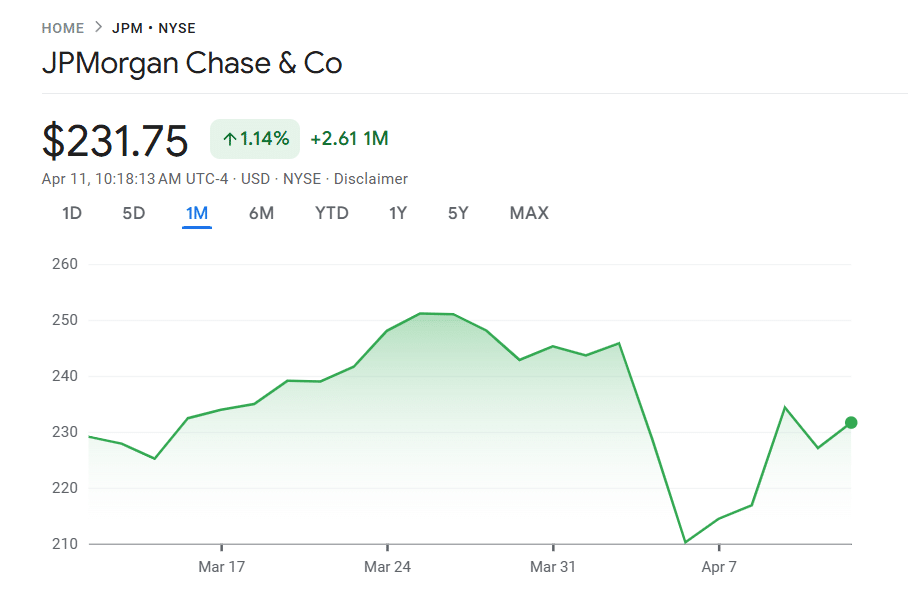
JPMorgan share price (Source: Google Finance)
Also read: Recession Fears Soar: Markets Tumble as JPMorgan Raises Odds to 40%
Dimon acknowledged that the short-term policy shifts have injected volatility into the markets and raised inflationary pressure, reigniting fears of an economic slowdown.
“The economy is facing considerable turbulence, including geopolitics,” he noted, adding that the bank continues to maintain excess capital and liquidity in anticipation of more challenging conditions.
Rising Credit Risk as Tariffs Weigh on Consumers
As a sign of its defensive posture, JPMorgan increased its provisions for credit losses to $3.3 billion, up sharply from $1.9 billion a year ago. This move reflects growing concern that U.S. consumers and businesses could face difficulty repaying loans if tariffs exacerbate inflation and suppress economic activity.
Also read: Inflation Eases Now, But Trump’s Trade War Could Undo It All
U.S. consumer confidence fell to its lowest level in over four years in March, further underscoring the unease across Main Street. Dimon warned shareholders earlier in the week that prolonged trade disputes could cause lasting harm, including elevated inflation and unsustainable fiscal deficits, which would in turn place pressure on borrowers and increase the likelihood of loan defaults.
Although JPMorgan has not yet observed a significant uptick in defaults, Dimon said he expects credit issues to emerge.
“Not yet, but I expect them,” he told Fox Business earlier in the week. The bank is also witnessing signs of caution from clients, with some pulling back from deals and delaying financing decisions.
Also read: Crypto Chaos: US Tariff Surge Sends Bitcoin and Ethereum Into Tailspin
Net Interest Income and Outlook Stay Strong
In more positive news, net interest income (NII)—a key metric for banks—rose 1% to $23.4 billion in the first quarter. The bank revised its full-year NII forecast slightly upward to $94.5 billion, from the previous estimate of $94 billion. Excluding market-related effects, the NII guidance remained unchanged at $90 billion.
While trading and banking revenue bolstered the bank’s bottom line, the broader implications of current macroeconomic trends were front and center during Dimon’s post-earnings commentary. He reiterated that the bank is preparing for a wide range of outcomes and remains focused on serving clients through all economic cycles.
Dimon also addressed concerns surrounding the bond market, which has been in flux following rising Treasury yields. He described the bank’s monitoring of the situation as near constant, saying he was watching developments “every minute.”
Wall Street Responds to Policy Jitters
Other Wall Street leaders echoed Dimon’s cautious stance. BlackRock CEO Larry Fink described client sentiment as increasingly dominated by anxiety about market direction.
Robin Vince, CEO of BNY Mellon, noted that the operating environment is becoming more unpredictable. Wells Fargo CFO Mike Santomassimo added that many customers are re-evaluating growth plans in light of new tariffs, with some putting projects on hold.
While the administration’s temporary pause on many of the new tariffs has offered a glimmer of hope for de-escalation, tensions with China—one of the key targets of the trade actions—remain unresolved. Analysts warn that continued strain on U.S.-China relations could further disrupt supply chains and push up costs.
For now, JPMorgan’s diversified revenue streams and strong capital position provide a buffer against the immediate fallout. But as Dimon emphasized, the economic clouds are gathering. “We hope for the best but prepare the firm for a wide range of scenarios,” he said.


