
ChatGPT’s Biggest Threat? Shocking Deepseek User Reviews
The artificial intelligence landscape has long been dominated by major players like OpenAI’s ChatGPT, but a new challenger, DeepSeek, is sparking conversations across social media.
With claims of affordability, efficiency, and high performance, this emerging AI model has piqued the interest of tech enthusiasts and AI professionals alike.
Also read: Crypto AI Agents: A Booming but Speculative Trend, Says Sygnum Bank
To gauge public sentiment, TopView analyzed 2,347 tweets from Jan. 20 to Jan. 29, providing insights into user reactions, preferences, and debates surrounding DeepSeek’s capabilities. The results reveal a mix of excitement, skepticism, and concerns over censorship and accuracy.

User Sentiment Analysis: Is DeepSeek Winning Over AI Users?
Based on the sentiment analysis of the tweets, the user reception was distributed as follows:
- Positive: 911 tweets (38.8%)
- Neutral: 1,109 tweets (47.3%)
- Negative: 327 tweets (13.9%)
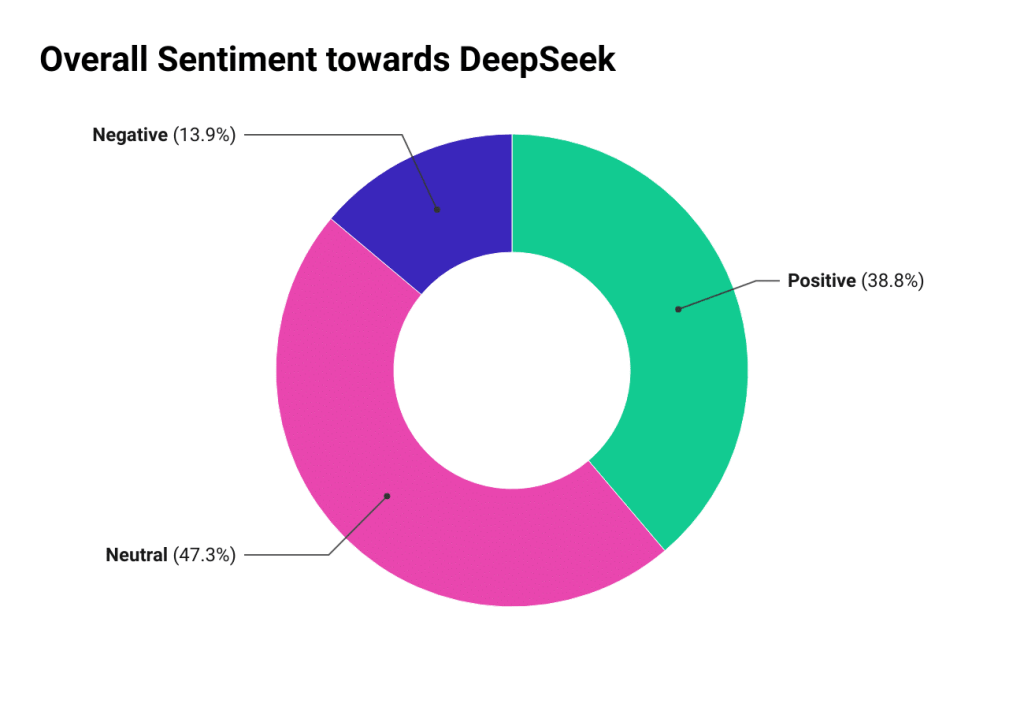
Sentiment Towards DeepDeek (Source: TopView)
A substantial portion of users expressed optimism about the new model, citing its cost-effectiveness and performance as key advantages over existing models. However, skepticism remains, particularly around issues of accuracy, content moderation, and censorship.
User Preferences: DeepSeek vs. ChatGPT and Other AI Models
Among the analyzed tweets, 372 users explicitly compared the new model with other large language models (LLMs) and indicated a preference:
- DeepSeek: 323 users (86.8%)
- ChatGPT: 45 users (12.1%)
- Claude: 3 users (0.8%)
- Gemini: 1 user (0.3%)
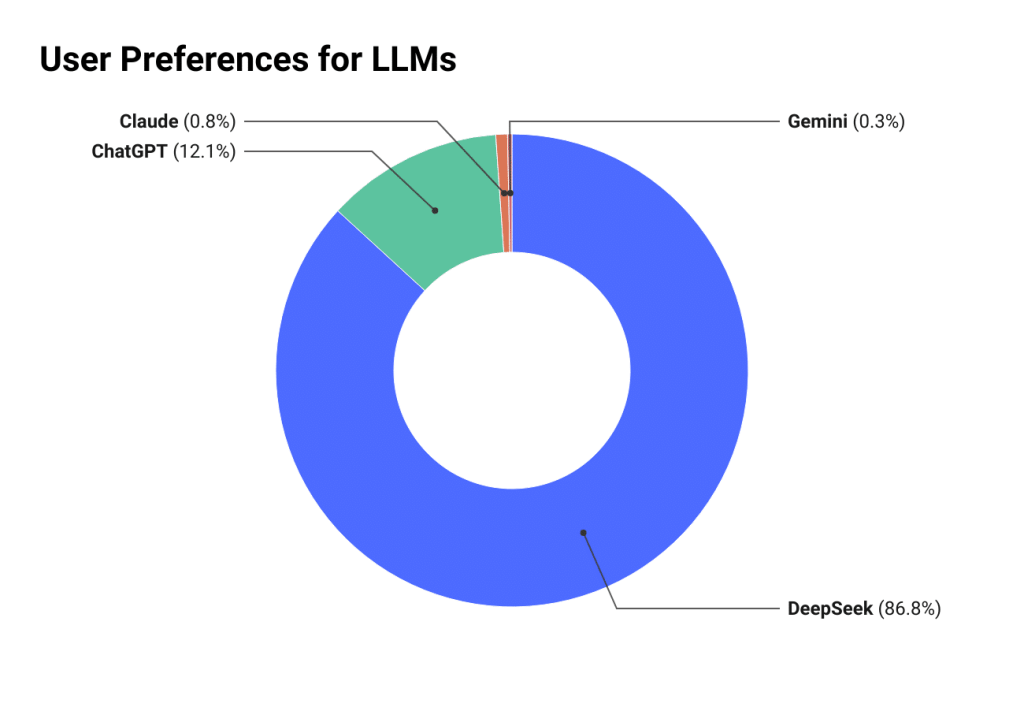
User preference for LLMs (Source: TopView)
This data suggests that DeepSeek is resonating with AI users, particularly those looking for a cheaper alternative to ChatGPT. The AI’s affordability appears to be a driving factor behind its growing popularity.
Also read: DeepSeek AI: Exploring the Capabilities
However, not all feedback was positive. Some users raised concerns about the new model’s strict content filtering, leading to frustration over limited responses to certain topics.
DeepSeek vs. ChatGPT: A Battle of Features
The comparison between DeepSeek and OpenAI’s ChatGPT was one of the most discussed topics. Users highlighted several key differences between the two models:
- Performance: Some users found the new model faster and more effective for complex reasoning, while others still favored ChatGPT’s nuanced responses.
- Cost: The new model’s affordability was seen as a huge advantage, especially among those dissatisfied with ChatGPT’s pricing.
- Accuracy: While DeepSeek impressed many users, some found it less precise when dealing with complex or ambiguous queries.
- Hallucinations: Like most AI models, DeepSeek sometimes generated incorrect or misleading information, leading to concerns about reliability.
According to an AI research analyst at TopView, DeepSeek’s rapid adoption signals a growing demand for budget-friendly AI models. However, they also noted that accuracy remains a critical challenge.
Also read: How To Create an AI Agent
Censorship and Moderation Concerns
Despite its rising popularity, DeepSeek is not without controversy. A growing number of users have voiced concerns about its content moderation policies.
One user noted:
“Fun demos of DeepSeek’s new r1 shutting itself down when asked about topics the CCP doesn’t like. But the censorship is obviously being done by a layer on top, not the model itself. Anyone have the open-source version running and able to test whether/how much it also censors?”
Another remarked:
“DeepSeek’s newest AI model is impressive—until it starts acting like the CCP’s PR officer. Watch as it censors itself on any mention of sensitive topics.”
These discussions raise questions about whether the new model’s moderation policies are influenced by external factors, including government oversight.
Methodology: How Was This Data Collected?
TopView conducted a comprehensive sentiment analysis using OpenAI’s API for natural language processing. The study collected 2,347 tweets from Jan. 20 to Jan. 29 using X’s API, filtering posts containing relevant hashtags like #DeepSeek to ensure the dataset captured diverse opinions.
Also read: ChatGPT in Crypto Trading: Harnessing AI for Enhanced Market Strategies
The methodology included:
- Sentiment Classification: Tweets were categorized as positive, neutral, or negative with an accuracy rate of over 97%.
- User Preferences: Posts explicitly stating a preference for an LLM (DeepSeek vs. ChatGPT) were analyzed for reasoning.
- Key Themes Extraction: Recurring discussion points like performance, cost, accuracy, and censorship were identified using NLP techniques.
- Translation of Non-English Tweets: To ensure global representation, non-English tweets were translated into English before sentiment analysis.
This process provided a structured and reliable representation of user sentiment towards DeepSeek, offering valuable insights into how AI users perceive this new model.
Conclusion: Can DeepSeek Challenge ChatGPT’s Dominance?
DeepSeek has captured the attention of AI enthusiasts and professionals, attracting a loyal user base looking for an affordable and efficient alternative to ChatGPT. However, its future remains uncertain.
Also read: Alaya AI: Revolutionizing Technology with Advanced Machine Learning
While its affordability and performance have been well-received, concerns surrounding censorship, privacy, and accuracy continue to shape its reputation.
The next few months will be crucial in determining whether the new model solidifies itself as a true competitor or fades into the crowded AI landscape. Can it overcome its limitations and establish itself as a long-term player in the AI industry?
Only time will tell.


